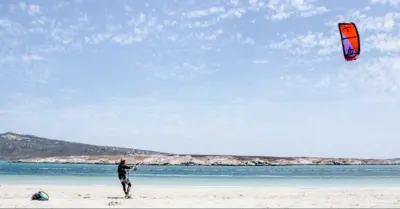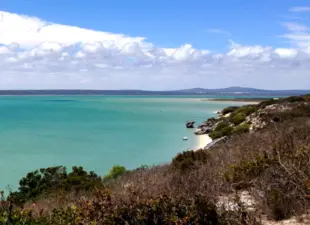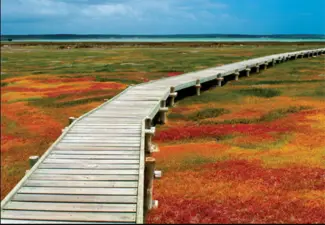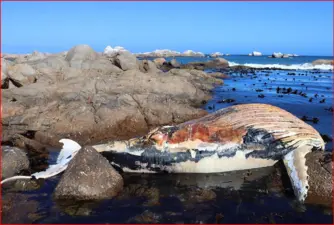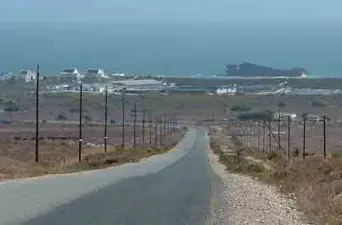
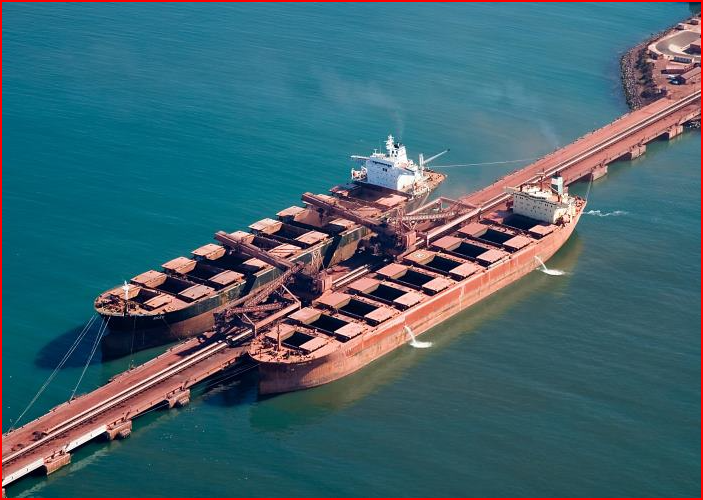
Saldanha is a seaside village that lies in the Northern most corner of Saldanha bay - the largest and deepest natural bay in the Country. The Saldanha accommodation available to travelers from all over the World includes guest houses, lodges, bed and breakfasts, and hotels. Saldanha is a seaside village that lies in the northern most corner of Saldanha Bay - the largest and deepest natural bay in South Africa. About 110 km up the Cape West Coast from Cape Town, the picturesque harbour town of Saldanha is essentially motivated by export and the fishing industry, and crayfish, fish, mussels, oysters and seaweed drive the economy. The sheltered Harbour here is dominated by the Sishen-Saldanha iron-ore project and is home to a Naval training base, the South African Military Academy and a whole fleet of fishing vessels that add a particular character to the bay. This largely unspoilt part of the world is also home to seagulls, cormorants, Cape gannets, duikers and terns that tend to outnumber humans by about a million to one and eco-tourism is popular. The first European sea traders arrived in Saldanha about 500 years ago and there is fossilised evidence that man may have been present here as many as 117 000 years ago - the West Coast Fossil park has one of the largest displays of late Tertiary vertebrate fossils in the world. Saldanha bay and Langebaan lagoon, on the south side of the bay, are very popular amongst the yachting fraternity and game fishing devotees - yellowtail and tuna are easy catches and snoek is available in winter. There is plenty of fresh sea air in the bay, with its five islands and abundant sea life, and it is a favourite amongst kite surfers and skiers and offers unrivalled fishing, deep sea diving and whale watching opportunities.
Two small towns carrying South Africa’s economy primed for R1.3 trillion ‘goldmine’
South Africa has an untapped export potential of an estimated R1.3 billion, and export towns Richards Bay and Saldanha Bay are primed to benefit if reforms to the logistics sector are taken seriously.
These towns are central to the country’s export economy, handling most of South Africa’s bulk commodities. If long-awaited logistics reforms are implemented, these ports could help drive major growth in exports, jobs, and tax revenue. Richards Bay and Saldanha Bay already handle the majority of cargo moving through South Africa’s ports. Data from StatsSA shows Richards Bay moves 44.3% of all cargo, while Saldanha Bay handles 38%. Durban and Cape Town—once the country’s top ports—now move only 8.3% combined. This drop is largely due to inefficiency and delays, with both ports ranking among the worst-performing in the world. In contrast, Richards Bay and Saldanha Bay ports are vital to South Africa’s economy because they handle the exports that keep its mining industry alive. More than 240,000 mining jobs are linked to exports that pass through these towns. The coal and iron ore they ship also bring in crucial foreign currency and tax revenue, which help keep the country’s finances stable. Richards Bay, in KwaZulu-Natal, is one of South Africa’s busiest ports. It’s home to the largest coal export facility in Africa, the Richards Bay Coal Terminal (RBCT). ( AS SHOWN IN BANNER)
Opened in 1976, the terminal started with a capacity of 12 million tonnes per year and has since expanded to 91 million tonnes. It now has a 2.2-kilometre quay, six berths, four shiploaders, and 8.2 million tonnes of storage. RBCT is renowned for its efficiency, and in 2006, it set a world record by exporting over 409,000 tonnes of coal in a single day. Saldanha Bay, on the Western Cape coast, also started operating in 1976. Its first shipment of iron ore went to the Middle East that same year. Today, it’s the largest deep-water port in the Southern Hemisphere and ideal for exporting bulk goods. Over time, it has expanded beyond iron ore to handle other types of cargo through a smaller Multi-Purpose Terminal. Transnet estimates that more than 1.1 billion tonnes of iron ore have been shipped from Saldanha so far, with around 25 vessels loaded every month.
Massive potential for South African exports

Backlog of trucks waiting to get into the Richards Bay Coal Terminal (RBCT).
A new report from Rand Merchant Bank (RMB) shows how much more these ports have to gain in the country. The Where to Invest in Africa report estimated that South Africa could grow its annual exports by as much as $75 billion (R1.3 trillion) within five years. The study, produced in collaboration with the Gordon Institute of Business Science, found that South Africa has the highest untapped export potential in Africa, surpassing that of Egypt, Morocco, and the Democratic Republic of Congo combined. The report looked at 31 African countries, covering 90% of the continent’s GDP. It assessed each country’s ability to produce and supply goods, global demand for those goods, and any barriers that prevent them from reaching markets. Based on this, it was found that South Africa could significantly increase its total exports by 2029, provided it addressed its transport and logistics challenges. The biggest single opportunity lies with the United States, where South Africa could add $7.3 billion (R126 billion) in exports. However, strained political relations between Pretoria and Washington could make this difficult. The good news is that the remaining $67.7 billion in potential exports lies outside the US, giving South Africa plenty of room to diversify into other markets and create new jobs locally. To realise this opportunity, South Africa must urgently improve its logistics system. Years of poor maintenance and underinvestment have slowed down railways, ports, and freight networks, making exports more expensive and less reliable. The government has now committed to major reforms to fix this. Led by Transport Minister Barbara Creecy, the reforms aim to bring more private sector investment into rail, air, and port operations. Transnet, which manages both Richards Bay and Saldanha Bay, plays a central role in this plan. It aims to increase freight volumes from 160 million tonnes to 250 million tonnes by 2030. If successful, this would expand export capacity and make it easier for the country to capture the R1.3 trillion opportunity identified by RMB.
THIS ARTICLE IS WRITTEN BY: Malcolm Libera 29 Oct 2025