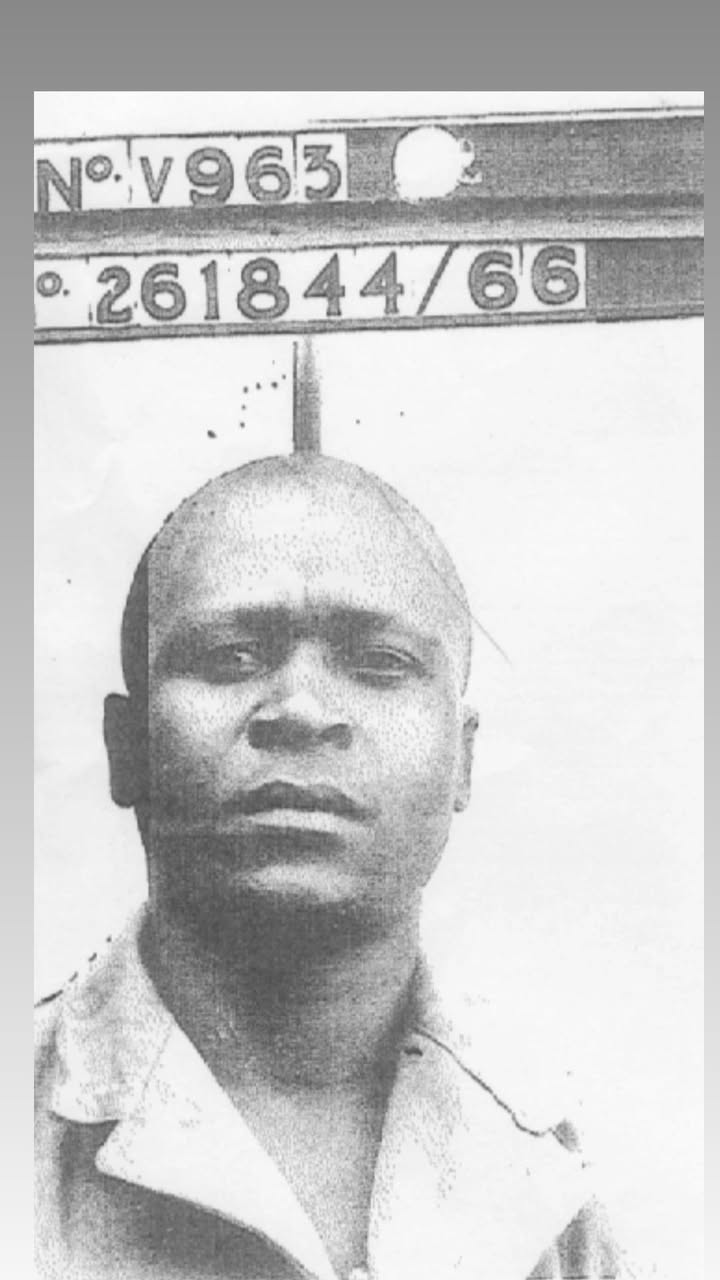
Petros Sipho Sibusiso Mkhize was born and raised in Macambini, a rural area in KwaZulu-Natal. Little is documented about his early life, but like many young African men of his generation, Mkhize would have grown up in a society already defined by racial segregation and the early structures of what would become formal apartheid. The rural areas of KwaZulu-Natal were designated as "native reserves" under the 1913 Land Act, limiting African land ownership to just 7% of South Africa's territory and creating the conditions that would force generations of young men to seek work in the industrial centers of the Witwatersrand.[2]
Mkhize eventually migrated to Johannesburg, joining the hundreds of thousands of African workers who formed the backbone of South Africa's mining and industrial economy. He settled in Soweto, the sprawling African township southwest of Johannesburg that had become home to over a million people by the mid-1960s. There he married Nomvula Jumaima Mkhubukeli (born 1941) and started a family, building a life despite the increasingly oppressive restrictions of apartheid legislation. The couple had two sons: Mbekezeli Simon Mkize (born 1959) and Mafika Jeremiah Mkize (born 1960).
Life Under the Pass Laws
By the time Mkhize arrived in Johannesburg, the apartheid government's pass law system had reached its most comprehensive and oppressive form. The implementation of the reference book system in 1952 - colloquially known as the dompas or "dumb pass" - required all African people over the age of 16 to carry documentation that controlled every aspect of their lives. These books determined where a person could live, work, and travel. Without the proper endorsements stamped into these books by white officials, an African person's presence in designated "white" areas, including Johannesburg and Soweto, was deemed illegal.
The reference book had to be produced on demand to any police officer or official. Failure to do so resulted in immediate arrest. Between 1948 and 1986, over 17 million arrests were made under the pass laws - an average of more than 1,200 arrests per day.[1] The system was designed not merely to control movement but to provide a steady supply of cheap prison labour and to maintain the fiction that African people were temporary sojourners in "white" South Africa, with their true homes being in the impoverished bantustans.
Mkhize's reference book indicated that he was originally from Macambini in KwaZulu-Natal, and it did not contain the necessary endorsements to legally permit his residence in Johannesburg or Soweto. Under apartheid law, this made him a criminal simply for being in the city where he worked and where his family lived.
Resistance and the Defiance Campaign
Despite the risks, Mkhize became involved in resistance activities against the pass law system. He participated in what was known broadly as defiance campaigns - acts of resistance that challenged the very legitimacy of laws designed to strip African people of basic human dignity and freedom of movement. Such campaigns had deep roots in South African liberation history, dating back to the 1952 Defiance Campaign organized by the African National Congress (ANC) and South African Indian Congress, when thousands of volunteers deliberately violated apartheid laws and courted arrest.
By the mid-1960s, following the Sharpeville Massacre of 21 March 1960 - where 69 unarmed protesters against the pass laws were shot dead by police[3] - and the subsequent banning of the ANC and Pan Africanist Congress (PAC), organized resistance had been driven underground. The state had declared a State of Emergency, detained thousands without trial, and instituted harsh new security legislation. Yet resistance continued in various forms, from underground armed struggle to everyday acts of defiance like refusing to carry passes or deliberately entering areas where one's presence was prohibited.
Arrest, Trial, and Imprisonment
On 14 September 1966, Petros Sipho Sibusiso Mkhize was arrested in Johannesburg. The exact circumstances of his arrest are not fully documented in available records, but his "crime" was his presence in Soweto without proper authorization in his reference book. What might seem a minor administrative violation carried devastating consequences during this period of heightened repression.
Mkhize was tried and sentenced to death on 2 December 1966. The severity of this sentence - capital punishment for pass law violations - reflects the apartheid state's determination to crush resistance through terror. While not all pass law violators received death sentences, those suspected of political activism or who had been involved in defiance campaigns were often charged under additional security legislation that carried the death penalty.
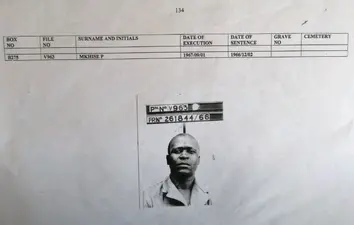
Following his sentencing, Mkhize was assigned prisoner number V963 and transferred to Pretoria Central Prison, approximately 60 kilometers north of Johannesburg. This fortress-like facility, built in 1909, had become the primary site for apartheid-era executions. Its gallows would see more judicial killings than any other execution site in the world during the 20th century. Between 1960 and 1990, over 2,500 people were hanged at Pretoria Central Prison, with a disproportionate number being Black political prisoners.[4]
Prison conditions were harsh and racially segregated. Black prisoners received inferior rations, were subjected to forced labour, and lived under constant surveillance and control. Yet even within this dehumanizing system, Mkhize maintained his dignity and connections with his family.
Letters from Prison
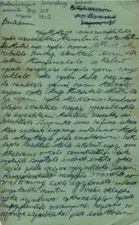
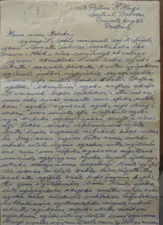
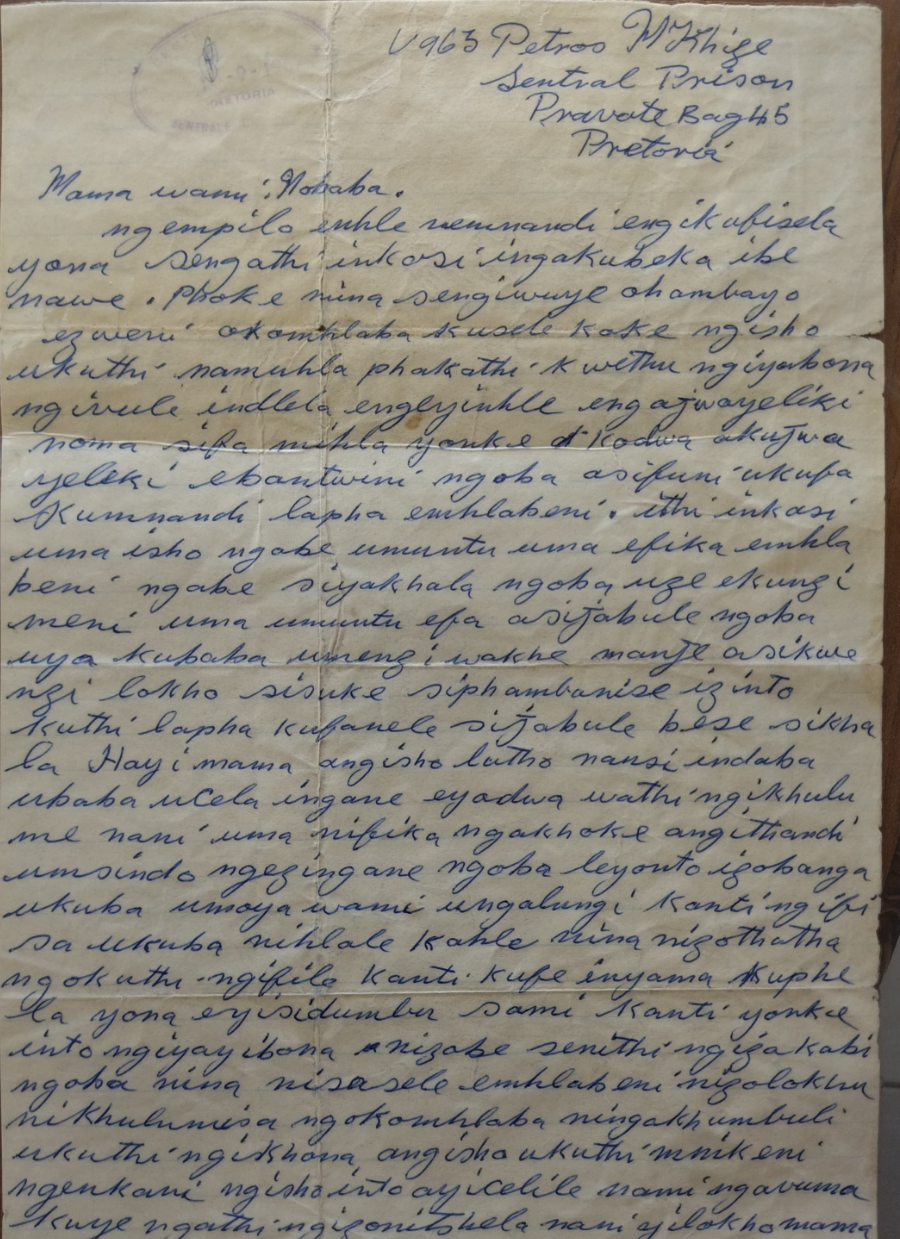
While awaiting execution, Mkhize wrote letters to his family from his cell. These letters, written in isiZulu, were sent from "V963 Petros Mkhize, Central Prison, Private Bag 48, Pretoria." In one letter, he wrote to his family at Mathubesizwe Senior Secondary School, Macambini, South Africa. His correspondence was written on the green-tinted prison notepaper that was standard issue, and like all prisoner mail, would have been read and censored by prison authorities before being posted.
The letters reveal a man striving to maintain family bonds despite his impending death. They speak to the ordinary concerns of a husband and father - checking on his children's wellbeing, sending his love, trying to provide comfort to those he would soon leave behind. These fragments of everyday humanity, preserved on prison stationery, stand in stark contrast to the cold bureaucracy of the state machinery that would end his life.
Surname Variations
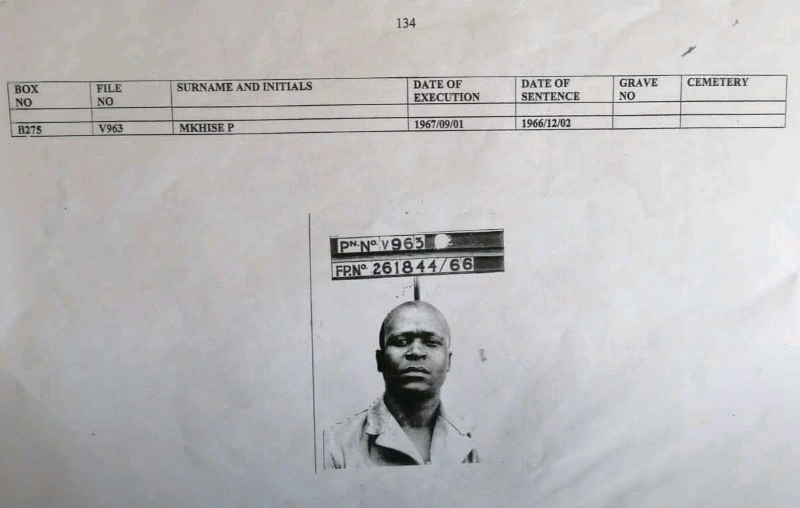
In his own handwriting, he consistently spelled his surname as "Mkhize." However, official records reflect variations such as "Mkize" and "Mkhise." His wife's surname, Mkhubukeli, was also recorded as "Mkhuphukeli" in some instances. Over time, "Mkize" became the surname used by his immediate family.
The Self-Authored Obituary
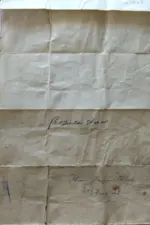
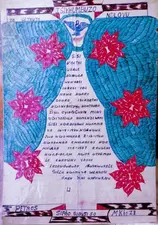
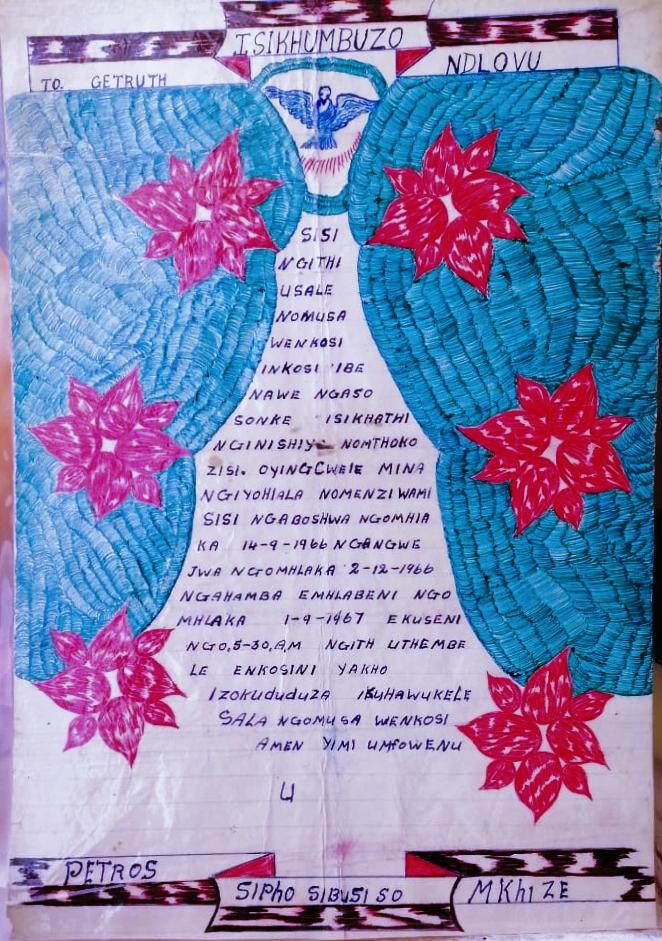
What makes Mkhize's story particularly extraordinary is his decision to write and decorate his own obituary while imprisoned and awaiting execution. This remarkable document, carefully crafted in isiZulu and decorated with hand-drawn flowers in blue and pink, represents an extraordinary act of agency and dignity by a man stripped of almost all power by the apartheid system.
The obituary is headed "ISIKHUMBUZO" (Memorial) and includes a dedication "TO GETRUTH NDLOVU." In it, Mkhize meticulously recorded the key dates of his persecution:
- Arrest: 14 September 1966
- Sentencing: 2 December 1966
- Execution: 1 September 1967
The decorative elements surrounding the text - traditional floral motifs in bright pink and blue - reflect both his cultural heritage and his determination to be remembered on his own terms. The act of writing about one's own death while still alive is profoundly haunting. It speaks to Mkhize's awareness of his fate and his refusal to allow the state to have the final word on his life and memory. In creating this document, he asserted his humanity and ensured that his story would be told by him, not just recorded in the cold administrative registers of the prison system.
The fact that he took the time to decorate the memorial with such care - drawing each flower petal, choosing colours, creating beauty in the midst of such ugliness - demonstrates a spirit that could not be crushed even in the face of death.
Execution
Petros Sipho Sibusiso Mkhize was executed by hanging on 1 September 1967 at Pretoria Central Prison. He was 29 years old at the time of his death, though his exact age is not recorded in available documentation. The execution would have taken place at dawn, as was standard practice, in the gallows chamber known as "Maximum Security" or simply "Maksimum" to inmates.
The apartheid state conducted executions with bureaucratic efficiency. Up to seven prisoners could be hanged simultaneously on the gallows' multiple traps.[5] After execution, bodies were removed, placed in numbered coffins, and buried in unmarked graves in the prison cemetery known as Mamelodi West Cemetery or later at the Pretoria Central Prison's own burial grounds. Families were often not informed of the exact burial location, and no tombstones marked the graves.[6]
Mkhize's execution was recorded in the official prison registers under the name "MKHISE P" (Box B275, File V963), one of thousands of such entries during the apartheid era. His case file would have included the court records, sentencing documents, and the official notification of execution, but these were kept from public view for decades.
Legacy and Recovery
For many years, Petros Sipho Sibusiso Mkhize's story remained largely unknown outside his family. His name was not among those that became symbols of the anti-apartheid struggle, like Steve Biko or Solomon Mahlangu. He was one of thousands whose resistance and sacrifice were documented only in prison files and family memories. This erasure was part of the broader pattern of apartheid's violence - not just the physical violence of arrest, imprisonment, and execution, but the archival violence of bureaucratic recording that reduced human beings to case numbers and file references.
It was only through the work of the Truth and Reconciliation Commission (TRC), established after apartheid's end in 1994, that the scale of apartheid-era executions began to be fully documented. The TRC's investigations revealed that between 1960 and 1990, over 2,500 people had been executed at Pretoria Central Prison, the vast majority being Black men charged under security legislation or convicted of politically motivated acts. Of those executed, approximately 134 were classified as political prisoners.[7]
The Gallows Exhumation Project, begun in 2016, sought to locate and identify the remains of those executed by the apartheid state. The project faced enormous challenges - incomplete records, unmarked graves, decades of neglect - but succeeded in exhuming hundreds of remains and, where possible, returning them to families for proper burial.[8] The "V" series prisoner numbering that Mkhize had been assigned proved invaluable for this work, as it allowed researchers to cross-reference prison records with burial records and, in some cases, identify specific remains.
For Mkhize's family, the survival of his letters and his self-authored obituary has been crucial to preserving his memory and understanding his story. These documents, kept safe through decades of silence and uncertainty, now serve as testimony to his resistance, his dignity, and his refusal to be forgotten.
Today, Pretoria Central Prison has been renamed Kgosi Mampuru II Correctional Centre, after a 19th-century Pedi king who resisted colonial conquest. The prison houses a Gallows Museum, where the execution chamber has been preserved as a memorial site. Visitors can see the gallows mechanism, the holding cells, and exhibitions documenting the history of capital punishment under apartheid. It stands as a reminder of the thousands of lives lost and the brutal machinery of the apartheid state.
Notes on Documentation
The dates recorded in Mkhize's self-authored obituary, the arrest documentation, and the prison execution register are fully consistent across all available sources. The arrest is recorded as 14 September 1966, and the formal death sentence was handed down on 2 December 1966, aligning with official court records. The execution date of 1 September 1967 is also consistent across Mkhize's own obituary, the prison execution register, and family records. His case number (261844/66) indicates that the file was opened in 1966, consistent with his arrest date. The "/66" suffix represents the year, a standard format in South African administrative documentation of the period.
As of 2026, the family has still not been able to access the full prison file, determine the precise contents of the official records, or locate the unmarked grave where Mkhize was buried, reflecting the ongoing gaps and limitations in archival access and post-apartheid recovery processes.
Archival Sources
- National Archives of South Africa, Pretoria Repository: Case docket 261844/66
- Pretoria Central Prison Records: Prisoner V963, Execution Register (1 September 1967)
- Kgosi Mampuru II Correctional Facility: Gallows Museum records
- Private family collection: Handwritten letters and self-authored obituary by Petros Sipho Mkhize
The preservation of Petros Sipho Sibusiso Mkhize's story, particularly through his self-authored obituary written while awaiting execution, stands as a powerful testament to the dignity and resistance of those who refused to accept injustice, even in the face of death. His memory is kept alive by his family and forms part of the growing documentation of those who paid the ultimate price in the struggle against apartheid.