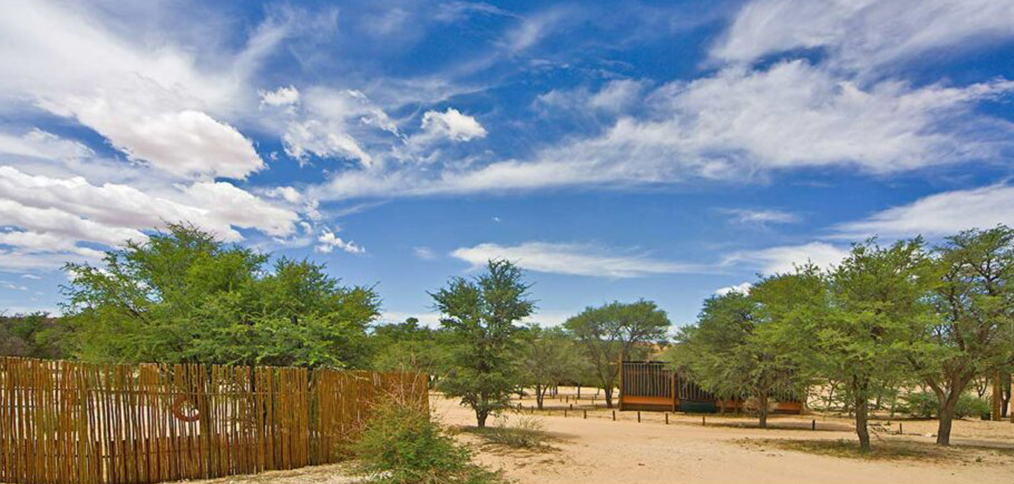
Where the red dunes and scrub fade into infinity and herds of gemsbok, springbok, eland and blue wildebeest follow the seasons, where imposing camel thorn trees provide shade for huge black-mane lions and vantage points for leopard and many raptors… this is the Kgalagadi Transfrontier Park.
Twee Rivieren is the park’s largest rest camp and administrative headquarters. It is situated on the banks of the Dry Nossob Riverbed. Activities and facilities are diverse, as are the animals and plants found both within the camp and in the surrounding areas. Twee Rivieren has a reception, shop, fuel, restaurant, information centre and swimming pool. This is the only camp with 24 hours electricity and cell phone reception.
There are 2 roads that cross the 'duneveld' in the park, the one being 55 km long the other 35 km. These roads traverse mainly through open grassland with occasional shrubs and trees and provide many birders with good views of several species. Nestled within the arid to semi-arid southern Kalahari region, the Kgalagadi Transfrontier Park boasts a unique climate.
The southwestern reaches experience summer rains, while mean annual rainfall varies from 120 mm in the southwest to 350 mm in the northeastern expanse which extends into Botswana. The unreliable and irregular rains fall mostly during dramatic thunderstorms, with specific locales witnessing annual variations from under 100 mm to over 450 mm. This rainy season occurs from January to April, reaching its peak in March.
Temperatures here are extreme, plunging to -11°C on cold winter nights and soaring to 42°C in the shade on summer days when the ground surface temperature reaches a sizzling 70°C. During the winter months, when frost is common, the ground surface temperature can be 25°C lower that the temperature of the air.
With low relative humidity and a high annual evaporation rate, the Kalahari epitomizes the essence of desert life.
Future Climate- By 2050, the Kgalagadi Transfrontier Park will face much warmer conditions, with average temperatures predicted to rise by 1.7°C to 2.9°C. While seemingly modest, these increases carry significant repercussions. Over the past five decades, we’ve witnessed a notable increase in average minimum and maximum temperatures, resulting in a staggering 37 extra days per Year where the temperature will exceed 35°C!
While historical rainfall records for the past half-century show no major shifts, projections hint at potential decreases ranging from 31mm to 95mm by 2050 under medium and high-risk scenarios. The driest scenario paints a stark picture, suggesting a region devoid of rainfall. Conversely, the wettest scenario hints at a modest increase in rainfall, though it’s deemed less likely. While no drastic changes in the distribution of the Savanna biome are foreseen under intermediate scenarios, the driest predictions suggest a substantial portion of the park transitioning to conditions more akin to desert or succulent Karoo.
"As temperatures soar and drying trends loom!", Kgalagadi Park faces profound implications for its wildlife and tourism. Accelerated evaporation of any precipitation will exacerbate existing water availability and quality challenges. Potential declines in tourism loom, especially if charismatic flora and fauna are adversely affected. As they navigate these shifts, they remain steadfast in their commitment to preserving and protecting this remarkable landscape.
Internal roads are not suitable for sedan vehicles.
HERITAGE SITES LINK AVAILIBLE IN FURTHER READING