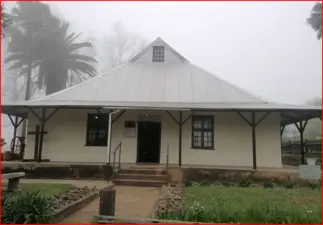
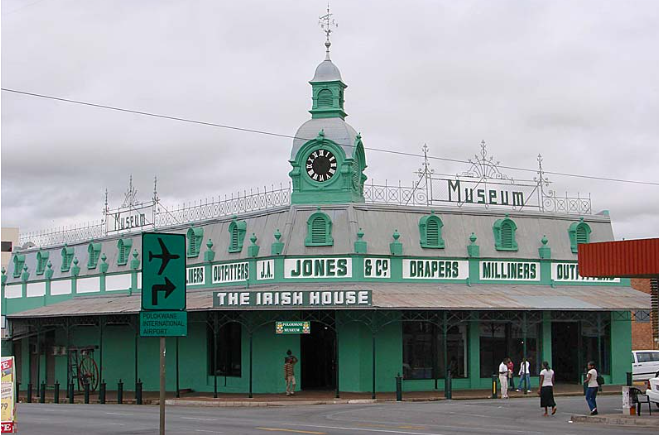
Right in the centre of the city of Polokwane is Irish House, a Victorian building that was prefabricated and moved complete to the City by a German immigrant, August Julius Herman Moschke, in the early 1900's. The building was burnt down by a fire in 1906 and rebuilt in 1910. During World War 1, Moschke was interned and upon his release he found the building in a state of disrepair and the building was then sold to an Irishman in 1920, James Albert . He used the premises as a general dealership. Jones travelled overseas to import clothes for the fashion conscious ladies and gentlemen of Polokwane then known as 'Pietersburg'. It was Jones who gave the building the name; 'Irish House'. Irish House degraded over the years until 1984, when the City Council of Polokwane purchased the building and converted it into a museum. The city council restored the building to its former glory when it was still the Irish House, complete with its green paint.
Today the Irish House Museum has displays on the History of Limpopo area, cultural groups and some archaeological finds from nearby sites, these include pottery, woodwork, weaving, ceramic, glasswork, rock art, cast iron.. It also has a number of exhibitions on the Revised National Curriculum Statement- this provides guidelines on what should be taught from Grades R to 9. This is an outcomes-based, education initiative.