For decades, these six words - “No normal sport in an abnormal society” - guided one of the most principled movements in South African history. Refusing to play or support any sport within apartheid’s segregated system, activists in the South African Council on Sport (SACOS) argued that sport was inherently political and could never be separated from the realities of apartheid.
More than thirty years after the fall of apartheid, South Africa’s stadiums are integrated, its national teams appear to embody the “rainbow nation” that the country’s founding president Nelson Mandela envisioned, and the sports boycotts SACOS fought for are long gone. But was the non-racial sporting vision that SACOS imagined fully realized?
To answer that question, it is important to understand that SACOS’s vision of non-racial sport was never simply one in which athletes of different races could compete alongside one another. The movement demanded a complete restructuring of the system, which included open membership in all clubs, integrated schools and youth competitions, equal access to facilities and resources, a single non-racial governing body for every sport, and the elimination of the racial barriers that shaped who could succeed. In short, SACOS and the activists that pushed its vision forward were just as interested in equitable opportunity in sport as they were with Black and white players wearing the same jersey and representing the same team.
The current state of South African sport is a far cry from the non-racial vision that SACOS activists fought for. That is no clearer than in the working-class coloured Cape Flats township of Bonteheuwel, the home of Desmond Abrahams, a former SACOS activist. I interviewed Desmond while on a visit to Cape Town to research the connection between sports and activism.
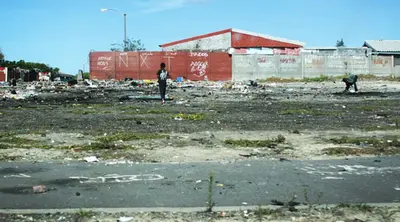
Bonteheuwel, first constructed in 1961 in the wake of the Group Areas Act and other racial legislation, is a 30-minute drive from central Cape Town and is bordered on the west by Nyanga, a mostly Xhosa-speaking working-class township, to the north by an industrial area, and to the southwest by the N2 highway, which runs between the downtown and the airport. Most of the residents live in row-houses, maisonettes, apartment blocks, or in shacks constructed in backyards.
In the struggle against apartheid, Bonteheuwel was also a hotbed of activism. The Bonteheuwel Military Wing, a cell of the ANC’s military wing, came from the area, as did the activists Ashley Kriel, Anton Franch and Coline Williams, all killed in skirmishes with police in Cape Town. Many of the sports clubs in Sea Point bear the mark of forced removals: Sea Point Swifts (for a now super-rich Atlantic Seaboard suburb) and Bloemhof Wanderers (for the apartment blocks in District Six).
Talking to Desmond, it is clear that the challenge facing South African sport today is no longer formal segregation but inherited inequality. Young athletes in communities like Bonteheuwel compete in the same sporting system as their counterparts in Cape Town’s affluent, mostly white suburbs, but the resources available to them differ dramatically.
Desmond led us to the community’s football, rugby, and cricket fields. At first glance, the facilities seemed adequate. The grass was cut, and some of the pitches were even marked. But as we spent more time there, a different story emerged.
Although the fields are publicly owned (by the City of Cape Town), their maintenance falls on local clubs and volunteers with limited resources. The result is a constant struggle to keep facilities operational. A struggle that became even more visible when Desmond took us into the adjacent clubhouse.
Only months after a renovation project, for which the community had to extensively crowdsource funds, the building had already been heavily vandalized. Copper wiring, metal fixtures, and virtually anything that could be sold for money had been stripped from the structure. Torn signs hung from the walls. Portions of the ceiling sagged overhead. Broken windows and damaged interiors testified to the difficulty of maintaining community infrastructure in a neighborhood facing persistent poverty and unyielding unemployment.
SACOS’s fight for non-racial sport was explicitly against changes that ignore the structural backbone of inequity, and yet, as South Africa remains painfully unequal, one can only assume that that vision for non-racial sport has been lost.
The condition of sport matters because, as SACOS understood, it was never something that could be separated from the country’s political and economic realities. Access to healthcare, economic opportunity, quality education, safe housing, and meaningful employment would ultimately shape who had access to fair competition and sporting success.
Bonteheuwel illustrates this tension. The children playing on those fields are entitled by law to a fair sporting experience. They can compete in the same leagues and, in theory, pursue the same opportunities as athletes from wealthier communities. Yet the circumstances that shape their lives remain profoundly unequal. The fields they play on, the schools they attend, the healthcare available to them, and the economic realities facing their families all bear the imprint of apartheid’s legacy.
This is precisely why SACOS insisted that sport could never be separated from society.
Desmond sees this contradiction every day. Standing outside the vandalized clubhouse, he reflected on the promises of non-racial sport and the realities facing communities like Bonteheuwel today. “How equal is it really?” he questioned out loud.
By SACOS’s standard, the question is not whether South African sport is integrated. It is whether South African sport has become equitable. More than thirty years after apartheid, the legal system of forced inequality is over, but the ramifications for sport and society still live on.