
Present-day Namibia was once a part of the imperial German empire. As was common during the scramble for Africa in the latter half of the nineteenth century, the territory was claimed and occupied by an expansionist European power, in this case, Germany. Their rule was oppressive and the indigenous cultures were gradually being destroyed. A rebellion by Herero people in Namibia broke out in January 1904 and continued until 31 March 1907. The Herero people had possibly migrated earlier from further north in Africa to settle in Namibia. Their freedom and culture became heavily restricted as German control grew and on 11 January 1904 the leader of the Herero, Samuel Maharero ordered the extermination of all White people excluding the English, Boers, Namas, Basters, Berg-Damaras and missionaries in the German protectorate. There is some contention regarding this order and some researchers believe that the Herero wrote a letter with these instructions after the revolt had already begun.
All preparations for the revolt were kept secret. On 12 January, several hundred mounted Herero invaded Okahandja. They killed 123 people, most of them German, and set buildings alight. The conflict rapidly escalated and Germans who had escaped several farm attacks flocked to urban areas for protection. By 14 January the violence had spread as far as Omarasa, north of the Waterberg, and the Waldau and Waterberg post offices were destroyed. The Waterberg military station was occupied by Herero and all soldiers under the command of Sergeant G. Rademacher were killed.
Maharero, the Herero leader, allowed missionaries with a small number of German women and children free passage to Okahandja. They reached their destination on 9 April 1904. On 16 January Gobabis was besieged and a German military company was ambushed near Otjiwarongo. The conflict continued but eventually, the Herero were overwhelmed. Governor T. Leutwein was prepared to negotiate a settlement, but his government was determined to suppress the revolt with arms. On 11 August the Herero resistance was crushed.
The Herero people were scattered and many of them died of starvation and thirst as they fled through the Omaheke desert. About 12 000 of the remaining Herero were forced to surrender and were placed in concentration camps where medical experiments, as well as daily executions, took place. 80% of the Herero population of Namibia was wiped out during the 1904 revolt. General Von Trotha, a seasoned African campaigner, had been sent to crush the resistance and he ordered that "Within the German borders every Herero, whether armed or unarmed, with or without cattle, will be shot. I shall not accept any more women or children. I shall drive them back to their people - otherwise, I shall order shots to be fired at them". He proceeded to poison watering holes. In a report published in London in 1918, January Cloete of Omaruru stated under oath that, when they defeated the Herero, German soldiers killed unarmed women and children. In 2016, the German government considered making a formal apology to the Herero, but the prospect of cash reparations remains an unlikely outcome.
eventREF E-0011269Revised
Event record
Herero people of South West Africa, now Namibia, begin uprising
- Date
- 11 Jan 1904
- Updated
- 10 Jan 2020
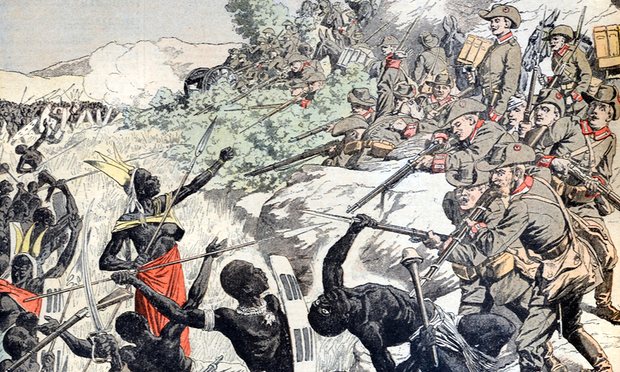
A painting depicts German soldiers shooting Herero people in 1904. Photograph: Chris Hellier/Corbis via Getty Images
Search events by date
This day in history
What happened on your birthday?
How we know this
- 01Liebenberg, J. (2004). 'Namibia's dirty little secret revisited'
- 02Wallis, F. (2000). Nuusdagboek: feite en fratse oor 1000 jaar, Kaapstad: Human & Rousseau.
- 03Potgieter, D. J. (ed) (1972). Standard Encyclopaedia of Southern Africa, Vol.5, Cape Town: NASOU, pp. 493-4.
- 04The Sunday Independent, 2 May, 2004.
- 05Burke, Jason and Phillip Oltermann (2016). 'Germany moves to atone for 'forgotten Genocide' in Namibia' in the Guardian newspaper, 25th December 2016 and available at https:// https://www.theguardian.com/world/2016/dec/25/germany-moves-to-atone-for-forgotten-genocide-in-namibia (last accessed 11th January 2017).
Last updated · 10 Jan 2020
South African History Online. (2011, March 16). Herero people of South West Africa, now Namibia, begin uprising. South African History Online. https://sahistory.org.za/nso/ref/E-0011269
South African History Online (2011) 'Herero people of South West Africa, now Namibia, begin uprising', South African History Online, 16 March. Available at: https://sahistory.org.za/nso/ref/E-0011269 (Accessed: 21 July 2026).
South African History Online, Herero people of South West Africa, now Namibia, begin uprising [website], https://sahistory.org.za/nso/ref/E-0011269, (accessed 21 July 2026).
"Herero people of South West Africa, now Namibia, begin uprising." South African History Online, 16 Mar. 2011, https://sahistory.org.za/nso/ref/E-0011269. Accessed 21 July 2026.
South African History Online. "Herero people of South West Africa, now Namibia, begin uprising." South African History Online. March 16, 2011. https://sahistory.org.za/nso/ref/E-0011269.
Further reading
 Article
Grade 10 - Topic 5: Colonial expansion in South Africa after 1750
In this topic we study the impact that British colonisation of the Cape and Natal had on the people that were living...
 Article
Herero Revolt 1904-1907
Present day Namibia was once a part of the imperial German empire. As was common during the scramble for Africa in the.....
 Article
Timeline of the German and Herero, Nama War and Genocide
1904
6 January, The settler Frau Sonnenberg tells German soldiers stationed at the Waterberg, including the Sergeant....
 Article
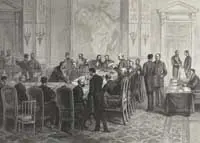
The Berlin Conference
The Berlin Conference can be best understood as the formalisation of the Scramble for Africa.
 Place
Place
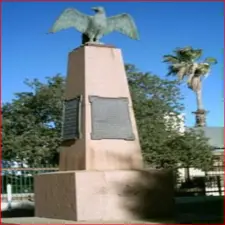
Keetmanshoop
In 1908, Gottlieb Redecker was the official builder of the German Colonial Government’s Works Department, drew up...
 Place
Place
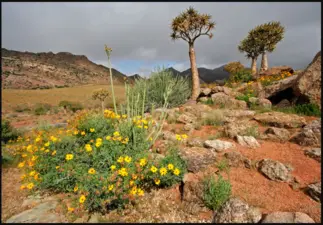
Richtersveld Cultural and Botanical Landscape, Northern Cape
The 1600 square kilometers in area is the Richtersveld Cultural and Botanical Landscape.
SAHO is free because readers fund it. Donate →