
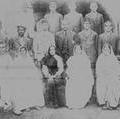
Gandhi's Satyagraha Campaign was a passive resistance campaign in protest against the legal restrictions on Indians and the tax law.The Campaign started in 1906 but by 1908 it had lost momentum. In March of 1913 the campaign got the impetus it needed to resume. In a judgement of the Supreme Court, Judge Searle refused to recognise Hindu and Muslim marriages. Angered by this, Indian women joined the Campaign for the first time. The participation of women passive resisters was a key element of the Satyagraha Campaign of 1913 - 1914
imageREF I-0067696Revised
Image record
The pioneer party of the last phase of the Satyagraha Campaign, 1913
- Updated
- 24 Jul 2019
Private Collection, Omar badsha
South African History Online. (2011, August 8). The pioneer party of the last phase of the Satyagraha Campaign, 1913. South African History Online. https://sahistory.org.za/ref/I-0067696
South African History Online (2011) 'The pioneer party of the last phase of the Satyagraha Campaign, 1913', South African History Online, 8 August. Available at: https://sahistory.org.za/ref/I-0067696 (Accessed: 16 September 2026).
South African History Online, The pioneer party of the last phase of the Satyagraha Campaign, 1913 [website], https://sahistory.org.za/ref/I-0067696, (accessed 16 September 2026).
"The pioneer party of the last phase of the Satyagraha Campaign, 1913." South African History Online, 8 Aug. 2011, https://sahistory.org.za/ref/I-0067696. Accessed 16 Sept. 2026.
South African History Online. "The pioneer party of the last phase of the Satyagraha Campaign, 1913." South African History Online. August 8, 2011. https://sahistory.org.za/ref/I-0067696.
Further reading
 Place
Place
Winburg
Winburg was founded in 1837, by Voortrekkers at the beginning of the Great Trek. It was the first town established in...

 Biography

SAHO is free because readers fund it. Donate →