
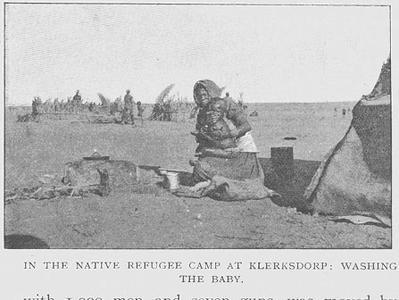
The developement of guerrilla warfare after the occupation of the Boer capitals in 1900 meant the abandonment of conventional tactics: the civilian population of all races (mainly women and children) was drawn into the conflict directly. In an attempt to overcome Boer resistance, the British authorities, in September 1900, began to clear the countryside, relocating the inhabitants by force in seperate black and white 'refugee' or concentration camps
imageREF I-0066427Revised
Image record
In the Native Refugee Camp at Klerksdorp, washing the baby. Circa 1900
- Updated
- 24 Jul 2019
Wilson, HW. After Pretoria: The Guerrilla War
South African History Online. (2011, July 29). In the Native Refugee Camp at Klerksdorp, washing the baby. Circa 1900. South African History Online. https://sahistory.org.za/ref/I-0066427
South African History Online (2011) 'In the Native Refugee Camp at Klerksdorp, washing the baby. Circa 1900', South African History Online, 29 July. Available at: https://sahistory.org.za/ref/I-0066427 (Accessed: 16 September 2026).
South African History Online, In the Native Refugee Camp at Klerksdorp, washing the baby. Circa 1900 [website], https://sahistory.org.za/ref/I-0066427, (accessed 16 September 2026).
"In the Native Refugee Camp at Klerksdorp, washing the baby. Circa 1900." South African History Online, 29 July 2011, https://sahistory.org.za/ref/I-0066427. Accessed 16 Sept. 2026.
South African History Online. "In the Native Refugee Camp at Klerksdorp, washing the baby. Circa 1900." South African History Online. July 29, 2011. https://sahistory.org.za/ref/I-0066427.
Further reading
 Place
Place
Winburg
Winburg was founded in 1837, by Voortrekkers at the beginning of the Great Trek. It was the first town established in...
 Biography
SAHO is free because readers fund it. Donate →