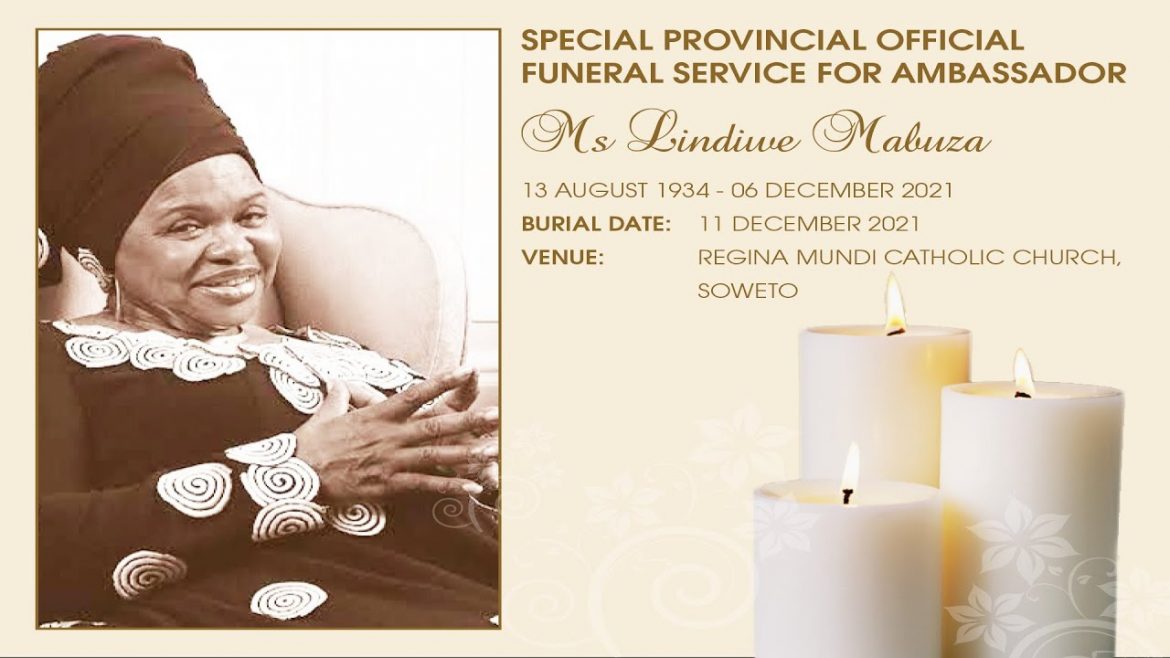
Born in South Africa in 1938, she spent much of her life in exile from apartheid South Africa at college in Lesotho, teaching in Swaziland, as a student and lecturer in the USA and as Chief Representative of the African National Congress in Scandinavia, the Philippines and the USA. Following the end of apartheid and after a brief return to South Africa as a Member of Parliament, she was quickly deployed abroad as a diplomat of the new democratic, non-racial, non-sexist South Africa. She returned to South Africa in 2009.
I knew Lindiwe from the 1980s and during the time that Lindiwe was High Commissioner to the United Kingdom (2001-2009) I got to know her very well through our close working relationship. She conducted outstanding work in strengthening and developing UK-South African relations and fostered this relationship through her frequent visits to Scotland and numerous events in South Africa House.
In an early visit to Edinburgh we had a meeting with the Lord Provost, Eric Milligan, and it was agreed that the Lord Provost would invite Lindiwe to deliver the Edinburgh Lecture and the High Commissioner would host a Robert Burns Night in South Africa House. Robert Burns is the national bard of Scotland and Burns Nights are held annually around 25th January, the date of his birth in 1759.
Lindiwe hosted annual Burns Nights, which I chaired, from 2003 until 2008. They were a twist on the traditional Burns Suppers blending Scottish and South African cultures. The alternate courses of Scottish and South African food were accompanied by South African wine and Scotch whisky.
There was Burns’ Address to the Haggis after it was piped into the dining room. After dinner there were the traditional toasts: the Toast to the Immortal Memory of Robert Burns, the Toast to the Lassies and the Reply from the Lassies. The various toasts were given by South Africans and Scots in alternative years and there was always music, song and poetry from both countries. The evening finished late with the company singing Auld Lang Syne.
At these Burns’ Nights, Lindiwe’s beautiful rendition of Burns’ ‘The Slaves Lament’ was the best I have ever heard. She captured the slave’s anguished voice in the lines:
“It was in sweet Senegal
That my foes did me enthrall,
For the lands of Virginia, -ginia, O!
Torn from that lovely shore,
And must never see it more,
And Alas! I am weary, weary O!
And must never see it more,And alas! I am weary, weary O!”
Photograph: Brian Purdie
High Commissioner Lindiwe Mabuza reciting Burns’ ‘The Slaves Lament’ at a Burns Night in South Africa House
Lindiwe had first come across Burns’ poetry when she attended St. Lewis Bertrand’s High School and committed some of it to memory which she still retained years later.
She wrote, “It was not until 2002 that I discovered
the most remarkable aspect of Burns, his opposition
to slavery in a poem called ‘The Slave’s Lament’…
…Brian Filling, President of the Scottish
Anti-Apartheid Movement, …sent me ‘The Slave’s
Lament’ to present as part of the program. I was
completely over-whelmed by some emotional turmoil
on reading this poem. Here was Burns, a white man,
jumping out of his privileged white world and white
skin to figuratively and emotionally enter the body,
mind and soul and sensibilities of an African slave
‘torn from that lovely shore’ of Senegal.”
(Mabuza, Lindiwe in Andy Hall’s, Touched by Robert Burns: Images and Insights; published, Birlinn, 2008).
At these Burns Nights Lindiwe also recited some of her own poignant poems extolling the peoples and continent of Africa. Her Poem, Africa To Me, encapsulated some of her thoughts:
“I prefer nowhere else to stir but
AFRICA
Hot cradle home of desire
constrained by periods
stained with sweat and particular
blood
AFRICA
serene love and bounty
honey that draws
with the splendour of silence
not birds that orchestrate
with wind wings and words
but lowing herds of
slithering stampedes
that braised and bonded her vastness
within the scorching exchange
within the bracketing embraces
of stone love at noon
……..”
Lindiwe’s recitations drew great acclaim from the audience, which included UK Cabinet Ministers, MPs, MSPs, Local Authority Councillors, business associates, church people, trade unionists, academics and musicians. These occasions were a great success in terms of culture, diplomacy and solidarity.
Lindiwe delivered the prestigious Edinburgh Lecture and the University conferred on her an Honorary Doctorate in 2003. The connections with Scotland continued and in 2004 Lindiwe initiated many events to celebrate 10 years of Freedom in South Africa. These were phenomenally successful and included a huge solidarity conference in London of which I was honoured to be a member of her Advisory Committee. There was also the brilliantly successful open-air “South Africa in the Gardens” event held during the Edinburgh International Festival, initiated by our friend Lesley Hinds, the Lord Provost, and featuring the South African Naval Band, leading South African musicians and stalls with the produce of all nine South African provinces.
There were also the very successful Writers Conferences in Glasgow and Edinburgh initiated by Lindiwe, which brought together the best of Scottish and South African writers including Mongane Wally Serote, Andre Brink, Keorapetse ‘Willie’ Kgositsile, Achmat Dangor from South Africa and Jim Kelman and Alasdair Gray from Scotland. Lindiwe supported and opened our photographic exhibition, “From Apartheid to the Presidency” by Peter Magubane in Glasgow, which later went on a UK nationwide tour.
Lindiwe delivered the ‘Toast to Caledonia’ at the Lord Provost’s Burns Supper in Glasgow. Her Toast which included ‘The Slave’s Lament’ was amazing and very much appreciated by the thousand-strong audience.
Another of Lindiwe’s outstanding initiatives was the publication of the book Oliver Tambo Remembered edited by Pallo Jordan . The book was a very fitting tribute to that giant of the South African liberation movement.
Books, of course, were a particular love of Lindiwe. So it was most appropriate that on one occasion she sent off one of ACTSA Scotland’s container load of books to libraries in the Eastern Cape and on another visit she launched her own book of poetry Footprints and Fingerprints.
We, in Scotland, and throughout the UK, gained immeasurably from Lindiwe’s inspiring and unstinting work as did the cause of Scottish-South African solidarity. When she was ending her tour as High Commissioner to the UK we presented a photobook to her commemorating her time in the UK and I wrote in the preface, “We are sorry to see you leave these shores but we are pleased that, at last, you are returning home to your beloved country. You have been an outstanding ambassador for South Africa and we have been privileged and honoured to have worked with you. Hamba Kahle!”
In one of Lindiwe’s poems, Thoughts from the Pacific, she wrote:
“If I were a song-writer
I would compose for the world
Ear-wax-drilling-lyrics –
Pound gongs,
Drum drums,
Centipede-legged sounds of pain
Jut earsplitting wordspears to the hearts’ brain
So the whole world can really hear
The feels of exile.
…….
I would write of the circled hands of
A continent,
A face of an Africa
Spangled with glowworm eyes.
Because she will reclaim her own
From these years’ tides.”
The last occasion when I met Lindiwe was at her book launches held in the House of Lords and in the High Commission at Trafalgar Square in London in June 2019. Following those events the current High Commissioner to the UK, Nomatemba Tambo, invited me to the dinner held at Highveld, the High Commissioner’s Residence, in honour of Lindiwe. It was a great pleasure to be seated beside Lindiwe and to enjoy her company again.
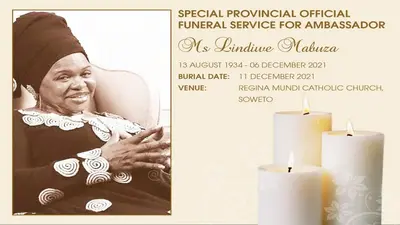
It was with great sadness that we mourned the passing of Lindiwe on 6 December 2021 but we celebrate her outstanding life given to the struggle for the liberation of South Africa.
Brian Filling is the Honorary Consul for South Africa in Scotland,
Chair, Nelson Mandela Scottish Memorial Foundation and Chair, ACTSA Scotland
February 2022