
682 records
 Article
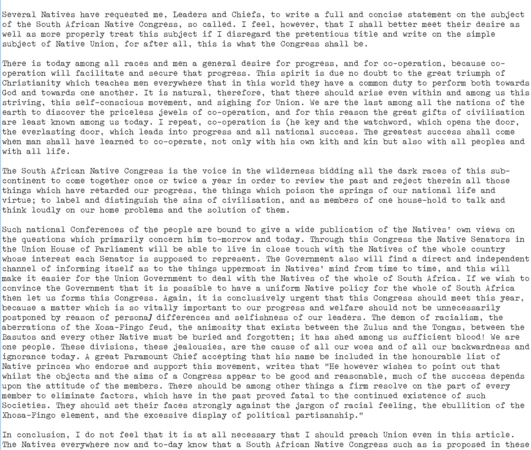
”Native Union”. Article by Pixley ka Isaka Seme, in October 24, 1911
Several Natives have requested me, Leaders and Chiefs, to write a full and concise statement on the subject of the South African Native…
 Article
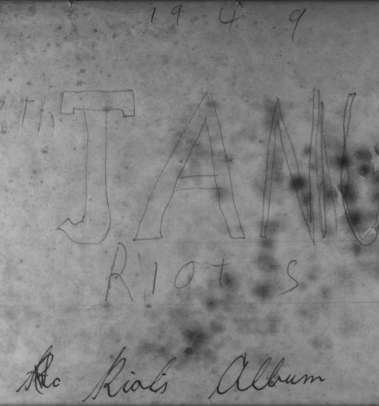
The Durban Riots: Press Clippings of Haji Ahmed Suleman Ballim
 Article
The ‘Hani Memorandum’ – introduced and annotated by Hugh Macmillan
 Article
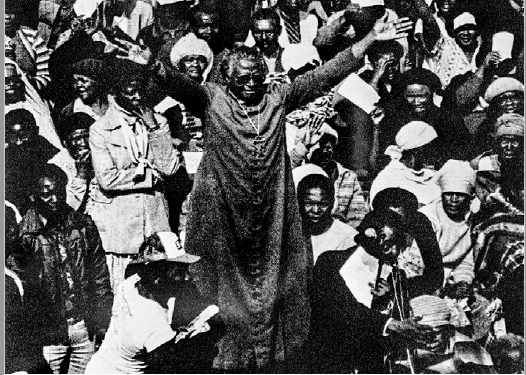
‘The Arch’ – our moral beacon – Desmond Mpilo Tutu 1931 - 2021
Shades of Empire: Police Photography in German South-West Africa by Lorena Rizzo
 Article
How history will judge FW de Klerk by RW Johnson, politicsweb (28 November 2021)
Many of the obituaries of F.W. de Klerk were rather bad-tempered and some were downright spiteful. It seemed to stick in the throat of many…
 Article
Visualizing the Realm of a Rain-Queen by Patricia Davison and George Mahashe
Teaching South African History in the Digital Age: Collaboration, Pedagogy, and Popularizing History by Jill E. Kelly, Omar Badsha, History in Africa, Volume 0 (2020)
 Article
Manifesto On Values, Education and Democracy by Kader Asmal
 Article
A Speech to Displease All Parties by Imraan Coovadia, 11 October 2021
Fred Khumalo reminded us two years ago, on the occasions of the Mafika Gwala lecture, that as a young man he took a collection of his verse…
 Article
Photography and African Futures by Richard Vokes and Darren Newbury
 Article
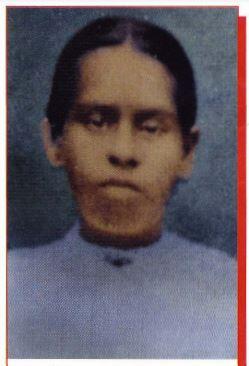
Valliamma Munuswami Mudliar – 1898 – 1914
Valliamma Munuswamy Mudaliar lost her life at the young age of 16 in 1914. Mudaliar was imprisoned for marching against the South African…
 Article
Programme of the South African Communist Party - 1962 - The Road to South African Freedom
Joint Statement by Chief Albert Lutuli, Dr. G.M. Naicker and Peter Brown appealing to the British People to Boycott South Africa, 5 December 1959
In May, 1960, the Union of South Africa will be 50 years old. The Government is preparing to celebrate this jubilee with great enthusiasm,…
 Article
The South African Communist Party and the Collapse of the Soviet Union by Stephen Ellis
For 40 years (1950-90) the South African Communist Party (SACP) was banned by a government that represented international communism as the…
Men are interesting too: Photography, crisis and the masculine by Stella Viljoen
 Article
Print Matters: History of Photography in Illustrated Magazines by Andres Zervigon
 Article
June 16 - a day to remember
 Article
“We Shall Resist” - The Role of Indian Women in the Passive Resistance Campaign 1946-1948 by Kalpana Hiralal
Group Areas Act and Its Effects on Indian People in Natal, May 1956 by Dr Gangathura Mohambry (Monty) Naicker
Paper On The Group Areas Act And Its Effects On The Indian People Of Natal, May 195649 A: HISTORY AND AIMS OF THE ACT 1. The Group…
 Article
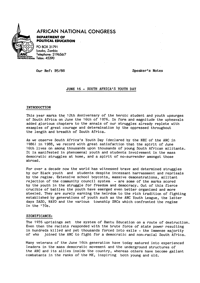
June 16: South Africa's Youth Day
Speakers notes for the 12th anniversary of June 16th, 1976. Examines the significance of the day, the enemy reaction, the responsibility of…
 Article
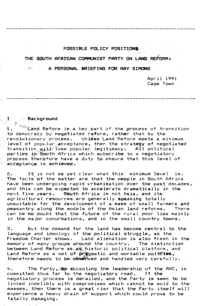
Possible policy positions, The South African Communist Party on Land Reforms: a personal briefing for Ray Simons
Background of land reform and the Party's role, the South African Communist Party and other political organisations' involvement in land…
Message to the Seventh Congress of the South African Communist Party by O. R. Tambo, April 1989
Comrade Joe Slovo, General Secretary of the South African Communist Party, Comrade Dan Tloome, Chairman of the South African Communist…
 Article
Constitution and Rules of The South African Communist Party
 Article
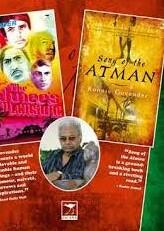
Obituary for Author, Playwright and Activist, Ronnie Govender by Pregaluxmi (Pregs) Govender
 Article
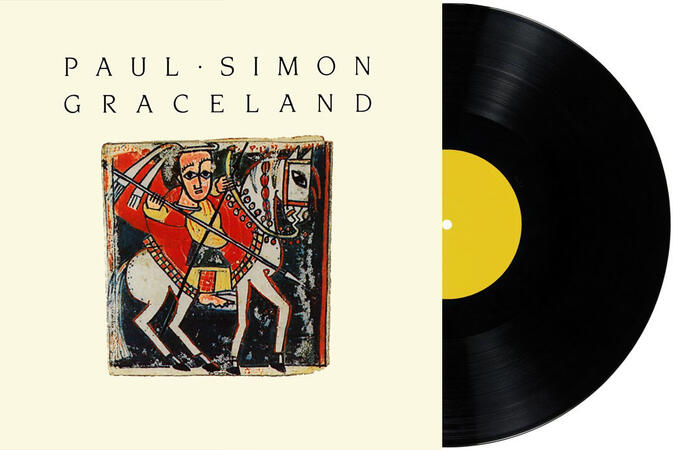
Paul Simon’s Graceland - Days of wonder and miracles by Yunus Momoniat
When Paul Simon embarked on a project to draw inspiration from South African musicians, he set out on a perilous obstacle course that would…
 Article
Towards a United Africa by N.Numade
 Article
Negotiating Culture in Contemporary South Africa: Photographic self-representations from the Cape Flats by Heike Becker
 Article
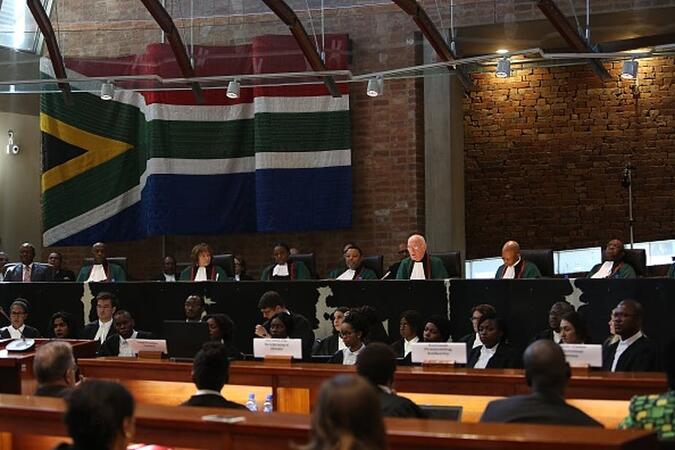
South Africa’s 1994 ‘miracle’: what’s left? by Christi van der Westhuizen
In the 1990s, a commonly held view was that South Africa had achieved a “miracle” because of its relatively peaceful political transition…
The History of the SACP 1912-1990
 Article
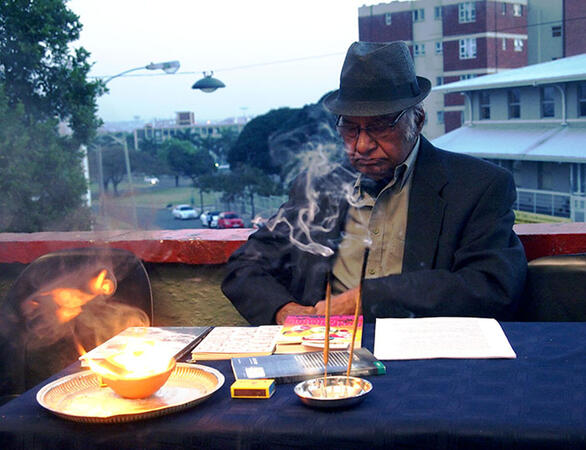
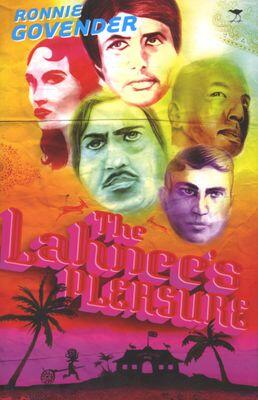
Ronnie Govender: ‘Unbowed, Unbroken’ by Niren Tolsi
The South African activist and man of letters used language as a weapon to defend the marginalised and reflect upon the people, places and…
 Article
The eye of leadership | Ronnie Govender passes on… by Karlind Govender
Sathieseelan Gurulingam Govender, most commonly known as Ronnie Govender once informed me of the deep leadership of the real world bus…
Unfixed: Photography and Decolonial Imagination in West Africa by Jennifer Bajorek
South Africa remains a nation of insiders and outsiders - 27 years after democracy by Professor Steven Friedman
Twenty seven years into democracy, South African politics is still for the few. And those who complain the most have the least to grumble…
 Article
The Work of Cultural Criticism: Re-visiting The South African Opinion by Corinne Sandwith
Will the real PAC please stand up? by Phumza Sokana
INFIGHTING within the Pan Africanist Congress (PAC) is far from over as two factions in the party battle with each other over the…
”Report on Talks between the PAC and the OAU liberation Committee Sub-committee” by Potlako K. Leballo, Dar es Salaam, November 20,1968
At their 13th Ordinary session in Algiers, last July, the OAU Committee of Eleven adopted the following resolution regarding the Pan…
 Article
Wreckers of the Fight against Apartheid: The myth of PAC militancy by Sol Dubila
 Article
PAC is the revolution by Victor L Mayekiso
 Article
With the PAC in exile by Vusi Shange
 Article
Review article - How Can Man Die Better...Sobukwe and Apartheid, by Benjamin Pogrund
 Article
The PAC conference: 1959
Has PAC revival run out of steam
 Article
Why the United Front failed: Disruptive role of the PAC by Dr Yusuf Dadoo
Why the United Front failed: Disruptive role of the PAC, by Dr Y M Dadoo, an article published in New Age, March 29, 1962. The article…
 Article
An MK combatant speaks on Sharpeville
 Article
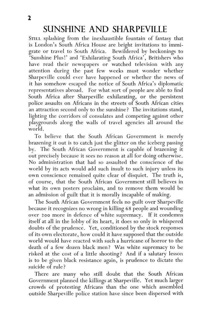
Sunshine and Sharpeville
 Article
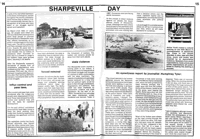
Sharpeville Day - an eye witness report by Humphrey Tyler
 Article
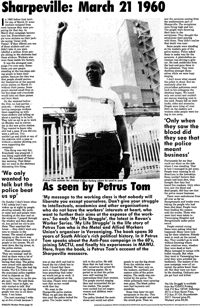
Sharpeville - March 21, 1960 by Petrus Tom
In 1960 before that terrible day of March 21 some workers resigned from work because they were preparing for that day.
 Article
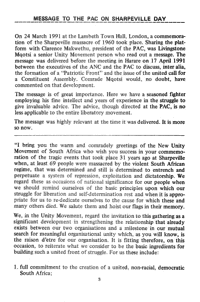
Message to the PAC on Sharpeville Day by Livingstone Mqotsi
 Article