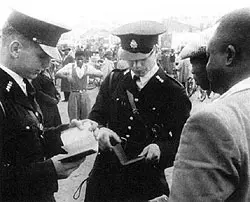
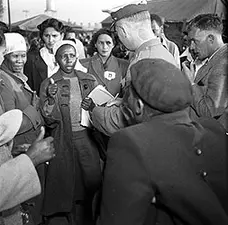
The 1960s witnessed the banning of both the ANC and the PAC in the aftermath of the Sharpeville Massacre. In response to the banning, both parties were forced to establish underground structures to continue the struggle. The PAC launched its armed wing Poqo while the ANC, working closely with SACP, jointly set up uMkhonto we Sizwe (MK). Several members of the ANC, SACP and PAC skipped the country and went into exile where they established offices, military training bases and camps.
In South Africa, the government passed a series of security laws which enabled it to arrest, detain and imprison political activists. Both the PAC and ANC were severely crippled by the arrest, detention and imprisonment of their leaders and members. For instance, the early Poqo Trials, Rivonia trial, the Little Rivonia and Bram Fisher trials, among others, affected the PAC and the ANC. Attempts to bring the PAC and ANC together by forming a united front failed. In exile, the Anti Apartheid Movement sprang up in Britain, Holland, Sweden and other countries and put pressure on the South African government to dismantle apartheid. With the liberation movements severely crippled inside the country, the formation of SASO had an impact that spun into the following decade, the 1970s.
1960
Both the
African National Congress (ANC) and the
Pan Africanist Congress (PAC) take up anti-pass campaigns.
1960Brian Percy Bunting is detained by the South African government.
1960Sam Kahn goes into exile.
1960
The Anti-Apartheid Movement (AAM) is formed in Britain with the re-naming of the Boycott Movement. The AAM is an umbrella organisation that took a strong moral stand against apartheid and white supremacy in South Africa, operating as an instrument of solidarity with the liberation struggle. It embraced a network of organisations including student bodies, trade unions, the Communist Party and sections of the British Labour Party. After the banning of the ANC in 1960 and the reconstruction of its mission in exile, the ANC formed a strategy of establishing productive working relationships with organisations in the West such as the AAM.
1960Desmond Tutu is ordained as a deacon in the Anglican Church.
1960
1 January, Minister of Bantu Education assumes control of University College of Fort Hare. African students are prohibited from attending formerly ‘open universities’ except the University of South Africa and Natal Medical School.
1960
3 February, Harold Macmillan, British Conservative Prime Minister, delivers a speech, which became known as the ‘winds of change’ speech, to the South African Parliament. In the speech he condemns apartheid and it becomes the first major international criticism against South Africa’s racial segregation policies.
1960
February/March, The
Pondoland Revolt, an uprising against the imposition of Bantustans and the opposition to the system of Black authorities takes place in the Transkei.
1960
14 March, The defense team opens their case in the
Treason Trial.
1960
16 March,
Robert Sobukwe writes to the commissioner of police, Major General Rademeyer, stating that the PAC would be holding a five-day, non-violent, disciplined and sustained protest campaign against pass laws, starting on 21 March.
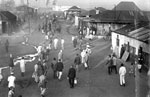
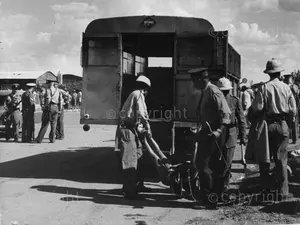
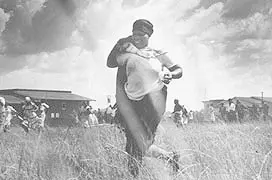
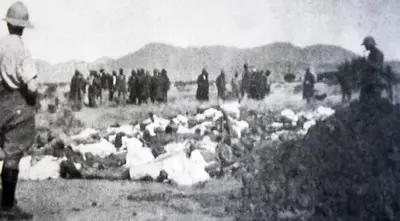
196021 March, At Sharpeville the police open fire on an unarmed and peaceful crowd, killing 69 and wounding 186 in what becomes known as the
Sharpeville Massacre. Two others were killed, and 49 were wounded in Langa, Cape Town. The Sharpeville massacre “signalled the turn to armed resistance in South Africa”
1960
22 March,
Dr. Hendrik Verwoerd tells the South African Parliament that the riots cannot be described as a reaction against the Government's apartheid policy and passes. He claimed that such disturbances are a periodic phenomenon and have nothing to do with poverty and low wages. He further states that his first duty is to thank the South African police for the courageous, efficient manner in which they handled the situation. He further announces that 132 members of the PAC, including Robert Sobukwe, are being held in Johannesburg and are to be charged with sedition.
1960
23 March, Robert Sobukwe, president of the PAC, and
P.K Leballo, its national secretary, as well as 11 others are charged with incitement to riot.
1960
25 March, Representatives of 29 African and Asian members request an urgent meeting of the Security Council to consider the situation in South Africa.
1960
27 March, The Commissioner of Police announces that the pass laws are to be suspended until a normal situation has been restored. The Police Commissioner says that the pass laws are not being suspended to appease the unfounded protests of Bantu agitators, but because the jails can no longer accommodate the many Africans who present themselves for arrest by openly violating the pass laws.
1960
28 March, ANC calls a nation-wide stay-at-home in protest to the Sharpeville massacre. Pass books are burned in countless bonfires. At one of the events
Chief Albert Luthuli publicly burns his pass.
1960Oliver Tambo leaves South Africa illegally on the instruction of the ANC to carry on the organisation’s work outside the country.
1960
30 March, The government declares a State of Emergency and arrests over 2 000 people. At lunchtime, an estimated group of between 30 000 and 50 000 Africans from surrounding African townships march into the centre of Cape Town led by Phillip Kgosana and demand an interview with the Minister of Justice. The Chief of Security promises to approach the Minister and the crowds march out of Cape Town. Immediately after they disperse, Erasmus announces in Parliament that a State of Emergency has been declared in 80 of the 300 magisterial districts, including every important urban area, and that 18 regiments of the Citizens Force have been mobilised to supplement the police, army and air force.
1960
Chief Albert Luthuli is detained and held until August when he is tried. He is given a six-month suspended sentence and fined £100.
1960
1 April, The United Nations Security Council, in its first action on South Africa, adopts
Resolution 134 (1960) deploring the policies and actions of the South African Government which have given rise to the loss of life of so many Africans and have led to international friction. The SC calls upon the Government to abandon its policies of apartheid and racial discrimination. It further requests the Secretary-General, in consultation with the South African Government, "to make such arrangements as will adequately help in upholding the purposes and principles of the [United Nations] Charter." The vote on the resolution was 9 in favour and 2 abstentions (France and the United Kingdom).
1960
7 April, The
Unlawful Organisations Act No. 34 comes into effect. Under this Act any organisation deemed a threat to the public can be declared unlawful by the government.
1960
8 April, The government announces that the ANC and the PAC have been banned under newly passed the Unlawful Organisations Act.
1960
9 April, At the opening of the Union Exposition on the Witwatersrand, to mark the jubilee of the Union of South Africa, David Pratt, a White farmer from Natal, attempts to assassinate Dr. Henrik Verwoerd by firing two shots from a pistol at point blank range. One bullet perforates his right cheek the other his right ear.
1960
12 April, An intelligence report records the arrival of Oliver Tambo in Francistown from where he is to make the journey to Tanganyika.
196019 April, The
South-West African People’s Organisation (SWAPO) is founded in Windhoek, South West Africa (later renamed Namibia), to oppose South African rule.
1960
May, The South African United Front (SAUF) is formally launched in London. The SAUF was an attempt to unite liberation movements in South African to speak with one voice. Nana Mahomo and Peter Molotsi represented the PAC,
Oliver Tambo and
Yusuf Dadoo represented the ANC, Jarientundu Kozonguizi represented the South West African National Union (SWANU) and the South West African People’s Organisation (SWAPO) joined later.
1960
4 May, Robert Sobukwe is sentenced to three years in prison for inciting Africans to protest against pass laws. He refuses to appeal, and refuses the aid of an attorney, on the grounds that the court has no jurisdiction over him because it cannot be considered either a court of law or a court of justice.
1960
June, The Central Committee convenes a meeting of members who are not detained and other activists and a decision for the
South African Communist Party (SACP) to go public is made.
196014-26 June, The second conference of Independent States held in Addis Ababa, Ethiopia resolves to impose sanctions against South Africa.
1960
July,
Dr. Yusaf Dadoo and
Vella Pillay visit USSR as representatives of the SACP for the establishment of ties and rendering of support.
1960
14 July, The underground existence of the South African Communist Party is announced through pamphlets.
Bram Fischer remains a member of the central committee.
1960
August, ZB Molote who was detained by the government under the state of emergency regulations is released and becomes acting president of the PAC until August 1962.
1960
August, Bram Fischer undertakes one of his most significant acts as an advocate, leading the evidence of
Robert Resha.
1960
24 August,
Geraldine Fraser-Moleketi, trade unionist, ANC member and Minister of Public Service and Administration after 1994, is born in Lansdowne, Cape Town.
196026 August, The state of emergency, declared after the Sharpeville Massacre, is lifted.
1960
31 August, The government lifts the State of Emergency decreed on 30 March in the wake of anti pass protests.
1960
September, The third issue of The African Communist acknowledges that it is published by the banned SACP.
1960
The National Committee of Liberation (later renamed the African Resistance Movement, ARM) is founded by members of the South African Liberal Party such as John Lange, Monty Berman and Myrtle Berman.
1960
7 October, Bram Fischer closes the case for the defense in the Treason Trial.
1960
December,
South African Congress of Trade Unions (SACTU) delegates to the International Labour Organisation (ILO) conference in Lagos, Nigeria are denied travel permits and have to withdraw from the conference.
1960
8 December, Letlapa Mphahle, an operative of the Azanian People’s Liberation Army (APLA) and president of the PAC is born Rosenkranz in Northern Transvaal.
1960
Dr. Yusuf Dadoo heads another delegation which includes
Michael Harmel,
Joe Matthews and Vella Pillay at the International Meeting of the Communist and Workers’ Parties in Moscow.
1961
SACP and ANC members meet underground in Durban and decide to launch
Umkhonto we Sizwe (MK), a military wing separate from the ANC, but jointly led by the ANC and SACP.
1961
Bram Fischer is appointed Johannesburg Bar Council chairman.
1961
FIFA suspends the Football Association of South Africa.
1961
Desmond Tutu becomes a minister in the Anglican Church.
1961
January, Bram Fischer is served with a new banning order for another five years.
1961
23 January, The report of the Secretary-General of the United Nations, Dag Hammarskjold responds on the implementation of the Security Council resolution passed on 1 April 1960. He states that in the course of his discussions with the Prime Minister of South Africa, ‘so far no mutually acceptable arrangement’ had been found on racial policies in South Africa.
19612 March, Bishop Ambrose Reeves, Anglican Bishop of Johannesburg, resigns after being deported from South Africa in September 1960 for his strong condemnation of the South African government.
1961
15 March, Following strong opposition in the Conference of Commonwealth Prime Ministers, Dr. Henrik Verwoerd announced the withdrawal of South Africa from the Commonwealth "in the interests of South Africa's honour and dignity".
1961
25-26 March, The All-in African Conference is held in Pietermaritzburg and is attended by 1 400 delegates representing 145 religious, cultural, peasant, intellectual and political bodies. The conference calls for a national convention of elected representatives. The conference also elects
Nelson Mandela as secretary of the National Action Council.
1961
29 March, The accused in the Treason Trial are found not guilty, after a four year long trial.
1961
29 March, Phillip Kgosana arrives in Dar-es-Salaam after skipping the country via Swaziland, Lesotho and Botswana.
1961
1 April, Robben Island is turned into a prison for those convicted of political crimes.
1961
27 April,
Walter Sisulu and his home at Orlando West are searched and various documents are seized, in which Africans are instigated to strike on 29, 30 and 31 May 1961. A case in compliance with Section 2 (A) of the Act 8/1953 (Instigation) is made against him.
1961
12 May, The General Law Amendment Act No 39 is passed. This Act provides for the detention of people for twelve days without bail. The Act also criminalised the organisation of prohibited gatherings and created a presumption of guilt regarding intimidation charges.
1961
29-31 May, A Nation-wide Stay-At-Home, organized by the ANC, takes place. The PAC calls for non-Whites to ignore the stay-at-home. It is estimated that more than 40% of the labour force on the Rand stay at home.
1961
31 May, South Africa becomes a republic and the country’s membership of the Commonwealth simultaneously expires. A nation-wide strike is held in protest against the
establishment of the Republic of South Africa. 1961
June,
Billy Nair is arrested and charged with incitement to strike during the May Stay-At-Home. Three hours after that he is given a five-year banning order preventing his movement outside the Durban magisterial district and prohibiting him from entering a factory, African location, hostel or village.
1961
5 July, The Indemnity Act commences. The Act, which applied retrospectively to 21 March 1960, indemnifies the government, its officers and all other persons acting under their authority for acts of of violence and torture committed while in pursuit of official duties.
1961
8-10 July, The Malmesbury Convention of Coloured Leaders is held. The convention seeks to foster unity between Coloureds and Africans.
1961
26 August, A.K. Ganyile, a Pondo leader who was living as a refugee in Basutoland, is kidnapped with two companions by six South African police. They are taken across the border and imprisoned in Transkei.
1961
September,
Poqo (pure/ alone) an armed wing of the PAC is established in South Africa to form cells and commence work towards the armed struggle. The name had the translation of the Pan Africanist Congress as ‘Umbutho wama Afrika Poqo’ (the organisation of Africanists or ‘undiluted’ or ‘pure’).
1961
29 September, Three members of the NCL attempt to destroy records at the Johannesburg Bantu Administration Tax Office by pouring petrol through the letter box and setting it alight. The building is damaged but the records are not destroyed.
1961
October, Dr. Yusuf Dadoo and
Moses Kotane visit Moscow and are invited to attend the 22nd Communist Party of the Soviet Union Congress.
1961
4 October, The second election for the four Coloured representatives in Parliament takes place. The four seats are won by Independent candidates who were supported by the United Party.
1961
8 October, South African holds its first (Whites only) general election since becoming a Republic. The National Party (NP) wins the majority of seats, with 67% of seats, followed by the United Party, with 31%.
1961
9 October, Members of the NCL cut legs of an electricity pylon in Edenvale, Johannesburg. This cuts the electricity supply to of a large section of the eastern suburbs of Johannesburg.
1961
28 October, Walter Sisulu attends a gathering in the form of a welcome party at the house of
Lilian Ngoyi. He is, together with Lilian Ngoyi and
Alfred Nzo, arrested and charged under inter alia section 9(1) of Act 44 of 1950. The case is later withdrawn because sufficient evidence could not be supplied to prove that the party was in fact a meeting.
1961
December, A PAC pamphlet is distributed in Langa threatening violence against Whites. A raid on the South African Railway and Harbour Workers Union's office results in the seizure of individual membership cards and subsequent intimidation of members through threats of dismissal and actual transfers to lower paying jobs.
1961
11 December, Chief Albert Luthuli, ANC President at the time, is awarded the 1960 Nobel Peace Prize in Oslo.
1961
16 December,
Umkhonto we Sizwe (MK, ‘The spear of the nation’), the armed wing of the ANC, announces its existence through a series of bomb blasts against apartheid structures in Johannesburg, Port Elizabeth and Durban. One of its aims was to "hit back by all means within our power in defence of our people, our future and our freedom".
1961
20 December, The NCL and MK carry out a joint operation to blow up a power pylon (to be carried out by the NCL) and sabotage a telecommunications substation (to be carried out by the MK). The substation attack fails and only two legs of the pylon are blown up.
1961
22 December, The NCL announces its existence through a press release.
1962
The New Age, which is published in Cape Town, is banned.
1962
Desmond Tutu moves to London to further his studies in theology at Kings College.
1962
January, The fifth SACP National Conference takes place underground in Johannesburg. The Conference adopts ‘The Road to South African Freedom’ an elaborate policy document which Bram Fischer (who is acting chairman of the central committee of the SACP) helps to draft.
1962
11 January, Nelson Mandela secretly leaves South Africa to make a surprise appearance at the Pan African Freedom Movement Conference in Addis Ababa.
1962
17 January, Charges against Pondo leader, A.K. Ganyile, are dropped. He is allowed to return to Basutoland where he claims damages against the Minister of Justice and the policeman who had kidnapped him.
1962
1 February, A statement by Chief Albert Luthuli entitled ‘We don’t want crumbs’ appears in the New Age. In the statement Luthuli unequivocally rejects the governments’ homeland policy.
1962
March, Trade Unions Congress (TUC) in a conference held in East London agrees to change the name of the organisation to the
Trade Union Congress of South Africa (TUCSA) and open its membership to all bona fide trade unions.
1962
16 March, Several
Poqo members in Langa, Cape Town are involved in the killing of a policeman named Moyi while five others are injured in the violence.
1962
May, The NCL merges with two other small groups, the Socialist League of Africa and the African Freedom Movement, and various radical dissidents from the Liberal Party. The reconstituted NCL advocates political pluralism amongst organisations engaged in armed struggle.
1962
June, The General Law Amendment Act 76 (Sabotage Act) is passed. The Act created sabotage as offence for which the penalty of death could be imposed. Furthermore, the Act increased the powers of the president to declare organisations illegal and impose more stringent conditions on banning orders and house arrests.
1962
16 June, The bodies of three young women who had been hacked and stabbed are found in a plantation. A week earlier, Poqo members had warned the members at the men’s hostel in Mbekweni that women were not allowed at the hostel. Three men were charged with the murders, and were all alleged to be Poqo members. One was acquitted. The other two, Joseph Mqitsane and Aaron Njokwane were convicted and sentenced to death.
1962
July, Nelson Mandela returns to South Africa and travels to Stanger, Natal to meet with Chief Albert Luthuli who was banned at the time.
1962
15 July,
Ebrahim Rasool, ANC member and Premier of the Western Cape, is born in Cape Town.
1962
5 August, Nelson Mandela is arrested just outside Howick, Natal after the police receive a tip-off of his location by a CIA agent based in Durban.
1962
September, the PAC convenes a Presidential Council in Maseru which endorses the appointment of Leballo as acting president,
John Nyathi Pokela as Secretary, M Gqobose as a member of the Presidential Council, ZB Molete as Secretary for Publicity and Information, Zephaniah Mothopeng as Acting National Treasurer and E Mfaxa as National Organizer.
1962
September, The
Congress of Democrats (COD) is banned under the Suppression of Communism Act.
1962
26 September, Mthobeli Nathaniel Magwaca, a policeman, is murdered. Poqo members Golifile Tile and Gladstone Nqulwana and two others are charged and convicted of the murder. Gladstone Nqulwana is later sentenced to death for his role in the murder.
1962
October, ANC conference takes place in Lobatsi, Botswana.
1962
October, Leballo travels to London and New York where he addressed the United Nations. He also meets with PAC representatives in exile.
1962
Chief Albert Luthuli is appointed rector by the students of Glasgow University in recognition of his ‘dignity and restraint in a potentially inflammatory situation’.
196213 October,
Helen Joseph is placed under house arrest, becoming the first person to be put under house arrest under the Sabotage Act.
1962
7 November, Nelson Mandela is sentenced to five years in prison for incitement and illegally leaving the country.
196222 November, A group of 250 men carrying axes, pangas and other self made weapons leave Mbekweni Township and march to Paarl. The group divides itself into two with one band marching to the town’s prison to release fellow comrades in detention and the other to attack the police station. This results in clashes with the police and the death of five Poqo members, namely Godfrey Yekiso, Madodana Camagu, John Magigo, Ngenisile Siqwebo. The
Paarl rebellion was violently put down when police reinforcements were sent from Cape Town to assist.
1962
23 November, Matthews Mayezana Mali is shot dead by the South African Police while leading a march of PAC supporters to the Paarl police station in order to hand over a list of grievances.
1962
December, The SACP, represented by
Arthur Goldreich and Vella Pillay, requests a meeting in Moscow to discuss assistance to MK. ‘Technical consultations’ with relevant Soviet specialists are organized for Arthur Goldreich.
1962
10 December, Chief Albert Luthuli and
Dr. Martin Luther King Jnr issue a joint statement ‘
Appeal for Action Against Apartheid’.
1963
The
Transkei is separated from the Cape Province. Prime Minister Dr. Hendrik Verwoerd declares that the Transkei is to become a self-governing state, and that this will follow for other homelands.
1963
The Republican Intelligence (RI) is established as a covert branch of the Security Police. It is the forerunner of the Bureau of State Security (BOSS).
1963
Brian Percy Bunting is prohibited from publishing while writing for Spark.
1963Dennis Goldberg is served with a stringent banning order by the the South African government.
1963Steve Biko is introduced to politics as a teenager, when one of his older brothers, Khaya, a student at Lovedale High School, is arrested as a suspected
Poqo member and jailed for three months. The
South African Police interrogate Steve Biko in connection with his brother’s PAC activities, and Steve Biko is subsequently expelled from Lovedale. Biko develops a strong antipathy toward White authority, and carries this attitude with him when he enters St Francis College at Marianhill in Natal, a liberal Catholic boarding school and one of the few remaining private high schools for Africans in South Africa.
1963
January, Moses Kotane leaves South Africa for Dar es Salaam to assist Oliver Tambo. He is accompanied by
Duma Nokwe.
1963
During a mission for the ANC, Moses Kotane meets Kwame Nkrumah, president of Ghana.
1963
February, After Chris Hani and Archibald Sibeko sentence is confirmed it is decided that they should go into hiding until a group could be assembled for the journey into exile.
1963
March, P.K Leballo, PAC's deputy leader in Maseru, Basutoland, holds a press conference declaring that 150 000 PAC supporters are preparing for a general uprising the following month. His communication with South African PAC members is intercepted by the South African police, leading to massive crackdowns of thousands of PAC members. Nonetheless, PAC leaders continue to make plans for using Basutoland as a base from which to launch guerrillas into South Africa, seeking funds from anti-Communist sources.
1963
2 March, Thirty-four South African students are arrested by immigration officers in Northern Rhodesia (now Zambia). They are taken to Bulawayo and handed over to the South African police.
1963
May, The General Law Amendment Act No 37 commonly referred to as the ‘Ninety Day Detention’ law is passed. The Act enabled the government to detain any person suspected of a political crime for 90 days without access to a lawyer. Numerous political activists were detained under this law usually in solitary confinement.
1963
May,
Joe Slovo and
J.B. Marks leave South Africa to mobilise support for the ANC’s cause from various African states.
1963
Chris Hani begins his journey into exile first travelling to Soweto where he stays with a family sympathetic to the struggle. A few weeks later the group leave for Bechualand (now Botswana) and then to Northern Rhodesia (Zambia). However, on reaching Lusaka Chris Hani, along with the rest of the group, is arrested. After a brief court appearance the men are freed and taken by the United National Independence Party (UNIP) to the border with Tanganyika.
1963
25 May,
The Organization of African Unity (OAU) is formed. The Organization’s charter commits to the liberation of every African country from colonialism and repression.
1963
June, PAC member Jeff Kgalabi Masemola is charged together with 14 other people in the Pretoria Supreme Court with conspiracy to commit sabotage. He is subsequently sentenced to life in prison.
1963
June-6 August,
Albertina Sisulu becomes the first woman to be arrested under the General Laws Amendment Act and is held in solitary confinement.
1963
26 June, Walter Sisulu makes a
broadcast on the Clandestine ANC Radio.
1963
6 July,
Robert McBride, ANC member and political activist and future chief of Ekurhuleni Metro Police, is born in Durban.
1963
11 July, Acting on information provided by Gerard Ludi, police raid Lilliesleaf Farm in Rivonia, Johannesburg. Virtually the entire leadership of the MK – Walter Sisulu,
Govan Mbeki,
Raymond Mhlaba,
Ahmed Kathrada,
Lionel Bernstein and Bob Hepple – is arrested.
1963
3 August, Police arrest saboteur Bruno Mtolo who later becomes the prosecution’s main witness in the Rivonia Trial.
196311 August, Harold Wolpe, Arthur Goldreich,
Moosie Moolla and Charlie Jassat escape from Pretoria Central Prison after bribing a young prison warder.
1963
28 August, Harold Wolpe and Arthur Goldreich arrive in Francistown, Bechuanaland Protectorate from Swaziland. From there they go into exile in London.
1963
September, The NCL successfully carries out coordinated attacks on signal cables at four Cape Town Railway Stations. As a result the leadership of the NCL moves to Cape Town.
1963
5 September,
Looksmart Ngudle dies while being held in detention. The Special Branch report claims that he had committed suicide by hanging himself.
1963
9 September, To prevent an inquest into the circumstances of Looksmart Ngudle’s death, the state places a banning order on him, as a banned person who cannot be quoted. As a result he becomes the first person to be banned after his death.
19639 October, 11 accused including those arrested at Lilliesleaf Farm, are brought to court in what becomes known as the
Rivonia Trial. While serving his 5 year sentence, Nelson Mandela is also charged in the Rivonia trial. The offences alleged are: (1) recruiting persons for training in the preparation and use of explosives and in guerrilla warfare for the purpose of violent revolution and committing acts of sabotage, (2) conspiring to commit the aforementioned acts and to aid foreign military units when they invaded the Republic, (3) acting in these ways to further the objects of communism, and (4) soliciting and receiving money for these purposes from sympathizers in Algeria, Ethiopia, Liberia, Nigeria, Tunisia, and elsewhere.
1963
9 October, The Rivonia Trial begins but is adjourned for three weeks to allow the defence to study the indictment as the prosecutor had refused to give a copy to the defence.
1963
29 October, Justice De Wet rejects the first indictment against the 10 accused in the Rivonia Trial.
1963
A proposal was made to quash the indictment against the 11 accused
1963
30 October, Bob Hepple’s charges are withdrawn and is conditionally released. Justice De Wet rejects the first indictment against the 10 accused in the Rivonia Trial.
1963
November,
Dave Kitson resigns from the SACP to head MK. Bram Fischer becomes Dave Kitson’s liaison with the Party.
1963
November, Chris Hani along with 30 other MK cadres arrives in Moscow, USSR for further military training.
1963
25 November, Bob Hepple escapes with his wife Shirley to Bechuanaland Protectorate thento the ANC in Dar es Salaam. From there they go into exile in London
1963
3 December, The Rivonia Trial begins again with a second indictment. The defendants enter ‘not guilty’ pleas. The prosecutor, Percy Yuter presents the opening statement.
1963
8-9 December, The Central Committee of the SACP holds a meeting in Prague.
1963
10 December, Bruno Mtolo takes the stand in the Rivonia Trial.
1963
11 December, Joseph Mqitsane and Aaron Njokwano are executed for their murder of three women found in the plantation on 16 June 1962.
1964
The PAC moves its headquarters from Lesotho to Dar-es-Salaam in Tanzania.
1964
The Civil Rights Act is declared in the USA. This increases African-American anti-apartheid lobbying during the Johnson era.
1964
The National Liberation Council is renamed the African Resistance Movement.
1964
4 March, The prosecution rests its case in the Rivonia Trial.
1964
20 April, As part of the defense opens its case Nelson Mandela's makes the statement, ‘
I am prepared to die’, from the dock.
1964
May, Minister of Justice,
B.J. Vorster, serves Chief Albert Luthuli with yet another five-year ban confining him to his home in Groutville.
1964
20 May, Closing statements in the Rivonia Trial begin.
1964Z.K. Matthews makes a speech, entitled ‘
The Road From Non-Violence to Violence’ at a conference in Kitwe, Northern Rhodesia, sponsored by the World Council of Churches.
1964
31 May, Albertina Sisulu is served with a five-year banning order which restricts her to the magisterial district of Johannesburg, prevents her from visiting any area where Black people lived and communicating with any listed or banned person except her husband.
1964
12 June, The Rivonia Trial ends. Nelson Mandela,
Walter Sisulu,
Govan Mbeki,
Elias Motsoaledi,
Andrew Mlangeni, Raymond Mhlaba and Dennis Goldberg are found guilty on all four charges and sentenced to life imprisonment. Ahmed Kathrada is found guilty on one charge of conspiracy while Lionel Bernstein is found not guilty. He is later rearrested, released on bail, and placed under house arrest.
1964
July, The External Central Committee of the SACP holds a conference in Moscow.
1964
8 July, Bram Fischer is detained under the
ninety-day law but is released three days later.
196424 July, A suitcase filled with dynamite is placed at the “Whites-only” concourse of Johannesburg station which explodes injuring 20 people and killing an elderly woman. It later emerges that
Federick John Harris, a member of ARM, had placed the bomb.
1964
26 July, A new refugee centre in Francistown, built to replace the old transit centre for political activists, is bombed. No one is injured but the building is completely destroyed.
1964
August, Leballo in a South African chartered aircraft stops over in Johannesburg and his plane is heavily guarded by the South African government, but the aircraft is allowed to proceed. This raised suspicions about Leballo and his connections to the apartheid regime as it was assumed that the government would have arrested the leader of a banned organization on its soil.
1964
18 August, South Africa is banned by the International Olympic Committee (IOC) from the Tokyo Olympic Games after refusing to condemn apartheid.
1964
September, Specialized training in guerrilla warfare is organized for the higher levels of the ANC and SACP leadership, including Oliver Tambo, Moses Kotane, Duma Nokwe, Joe Slovo and Ambrose Makiwane.
1964
23 September, Bram Fischer is arrested for contravening the Suppression of Communism Act along with 11 eleven others in a trial that became known as the Fischer Trial as Bram is accused number one. Violet Weinberg and Lesley Schermbrucker take the place of their husbands, who are arrested along with Bram Fischer, on the central committee of the SACP.
196424 October, Northern Rhodesia gains its independence from Britain. The country becomes known as the Republic of Zambia with
Kenneth Kaunda as its first president.
1964
November, Chris Hani and the 30 cadres return to Der es Salaam from military training in the Soviet Union.
1964
The ANC leadership is offered a piece of land at Kongwa, 400 kilometers south of the Dar-es Salaam, for use by MK. Chris Hani is put in charge of setting up the camp.
1964
South Africa is expelled from the International Labour Organisation (ILO) and the Food and Agricultural Organisation (FAO)
1964
6 November, The government publishes a notice containing 303 names of people served with banning orders. Only 68 these were listed are listed as Communists under the Suppression of Communism Act.
1964Vuyisile Mini, Wilson Khayinga and Zinakile Mkhaba, SACTU leaders, are sentenced to death and
executed.
1964
16 November, The Fischer Trial opens in the Johannesburg Regional Court. Along with Bram Fischer, 13 others are charged including Ivan Schermbrucher,
Eli Weinberg,
Esther Barsel,
Norman Levy, Lewis Baker, Ken Strachan, Ann Nicholson, Constantinos Gazides, Paul Trewhela, Sylvia Neame, Florence Duncan, Mollie Doyle and
Hymie Barsel. It is after the testimony of
Piet Beyleveld, a comrade who had turned state witness, and Gerald Ludi, a spy who infiltrated the SACP, that Bram Fischer calls the reconstituted SACP central committee together to discuss his going underground.
1965
South Africa is excluded from the International Civil Aviation and from the United Nations Educational, Scientific and Cultural Organisation (UNESCO).
1965
Steve Biko matriculates after finishing his schooling at St Francis College in Marianhill, Natal.
1965
Jackson Fuzile, a member of the MK regional command and ANC committee in Port Elizabeth, is brought to trial for arranging the departure of ANC members from the country for military training.
19655 January,
Mac Maharaj, Laloo Chiba, Raymond Nyanda and
Andrew Masondo arrive at Robben Island.
1965
23 January, Bram Fischer goes underground to a farm in Rustenburg where he becomes a Mr. Douglas Black. A massive country-wide search begins for the ‘Rooi Pimpernel’, as he is dubbed.
196525 January, The Fischer Trial reconvenes but Bram Fischer is not present. Harold Hanson reads out a letter written by Bram Fischer announcing his decision to go underground.
1965
February, Michael Dingake leaves South Africa for Botswana. From Botswana he organises infiltration routes from Zambia into Botswana for MK operatives.
1965
1 April, Frederick John Harris is hanged for planting a bomb at Johannesburg Station.
1965
13 April, The Fischer trial ends with 12 of the original 14 charged found guilty. Eli Weinberg and Ivan Schermbrucker are sentenced to five years’ imprisonment, Hymie Barsel is found not guilty and the others are sentenced to terms ranging from one to three years.
1965
May, JD Nyaose leads a delegation to China where finances were donated to fund activities of the PAC.
1965
25 June,
The Criminal Procedure Act No 96 commences. The Act doubles the period of detention from 90 days to 180 days which could be renewed on completion. Under this law state witnesses could also be detained for future trials.
1965
12 August, JD Nyaose, a founding member of the PAC and president of FOFATUSA is expelled from the party after attending the Indonesian Independence celebrations as a representative of FOFATUSA. Nyaose unsuccessfully challenged his expulsion.
1965
11 November, After 70 hours of interrogation Violet Weinberg gives the Special Branch information on the whereabouts of Bram Fischer. Bram Fischer is arrested at his home in Bramley after 294 days underground and is taken first to Pretoria Central then to Pretoria Local Prison.
1965
The Unilateral Declaration of Independence (UDI) of Southern Rhodesia from Britain is signed by the administration of Ian Smith.
1966
Chris Hani is moved to Zambia where he is responsible for setting up a joint training programme with ZAPU before their entry into Rhodesia in what would later become the known as the Wankie campaign. While trying to re-enter Botswana Chris Hani is arrested and detained for two weeks before being sent back to Lusaka.
1966
Desmond Tutu completes his Masters of Theology.
1966
Michael Dingake is kidnapped on his way to Lusaka and transferred to Pretoria. After being tortured he is indicted for being a member of and carrying out activities for the banned ANC and SACP. He is sentenced to 15 years and sent to Robben Island.
1966
The Coloured Labour Party is formed by members who were disaffected with the pro-government, conservative policies of the Federal Party and Coloured National Party.
1966
11 February, District Six is declared a “Whites-only” area by the government and forced removals begin for over 50, 000 residents.
1966
March, The South African Coloured People’s Congress dissolves to join PAC.
1966
21 March, As a result of the Sharpeville Massacre in 1960, the United Nations General Assembly declares this day ‘International Day for the Elimination of Racial Discrimination’.
1966
23 March, The Bram Fischer’s trail opens in the central court of the Palace of Justice in Pretoria in front of Mr. Justice Boshoff. Bram’s defence is led by Sydney Kentridge. Bram Fischer pleads not guilty to fifteen charges ranging from sabotage, being a member of the SACP and participating in its activities to six charges of fraud.
1966
28 March, The prosecution, after two days of presenting evidence, formally closes its case. Sydney Kentridge announces that the defence will not call any witnesses but that the accused will make a statement from the dock. Bram Fischer presents his
“What I did was right” statement. After five hours in the dock the court is adjourned for 6 weeks.
1966
9 May, Bram Fischer is sentenced to life in prison on the count of sabotage; to twenty-four years on the six charges under the Suppression of Communism Act; to fines totalling R120 (or six months in prison) for six contraventions of the Aliens Act and to three months on the two counts of forgery. All the terms are to run concurrently. Bram Fischer decides not to appeal.
19666 June, Robert F. Kennedy delivers his speech to the
National Union of South African Students (NUSAS) annual Day of Affirmation at the University of Cape Town.
1966
July, Steve Biko attends the annual NUSAS Congress as an observer. He impresses the NUSAS leadership enormously and is considered for grooming to become the first Black president of the student organisation. Subsequently he is invited to a NUSAS leadership training seminar. At the conference, about a quarter of the delegates are African, Coloured or Indian. The Black students put forward a motion to cancel annual fund-raising festivals (rags) unless they are racially integrated, but the motion is defeated.
1966
23 August, A paper on apartheid is presented on behalf of the ANC to the United Nations Human Rights (UNHR) Seminar on apartheid, held in Brazil, 23 August-5 September.
1966
26 August, SWAPO and the South African police clash at Omugulu-gwo-Ombashe in northern South West African during Operation Blue Wildebeest.
1966
6 September, Prime Minister Dr. Hendrik Verwoerd is stabbed in the neck and chest by Dimitri Tsafendas. The Prime Minister is rushed to Groote Schuur but is declared dead on arrival.
1966
13 September,
B.J Vorster succeeds Dr. Hendrik Verwoerd as the eighth Prime Minister of South Africa.
1966
30 September,
Botswana gains independence from Britain.
1966
4 October,
Lesotho gains independence from Britain and a constitutional monarchy is established.
1967
The Defence Amendment Act makes military service compulsory for all White males. Defence spending rocketed during the 1960s from US$63 million at the time of Sharpeville to more than US$1 billion by the early seventies.
1967
Desmond Tutu returns to South Africa to teach theology and becomes a chaplain at Fort Hare University.
1967
Chris Hani travels to Swaziland to secretly meet Gasson Ndlovu, head of Poqo, to discuss possible co-operation with the MK.
1967
1 May, Bram Fischer is awarded the Lenin Peace Prize.
1967
27 June, The Terrorism Act No. 83 commences. The Act is applied retroactively to 27 June 1962, a date which the government alleged military training commenced. The Act allowed for individuals to be held in detention indefinitely. Furthermore, under this Act, the minister could withhold information about the numbers and names of those detained under this Act.
1967
July, The OAU and ALC temporarily closes the PAC office in Dar-es-Salaam Tanzania after AB Ngcobo and PN Raboroko attempt to seize control of the office despite resistance from some members of the party. This forces the PAC to convene a Unity Conference in Moshi, Tanzania with the support of the OAU and ALC.
196721 July, Chief Albert Luthuli is struck by a train while walking on a railway bridge close to his home in Stanger, Natal. Oliver Tambo becomes acting president of the ANC.
1967
23 July, Three thousand people gather at the church in Groutville to attend Chief Albert Luthuli’s memorial service. Nokukhanya Luthuli unveils a memorial stone erected over his grave.
1967
July-September, MK begins a joint campaign with ZIPRA, a people's army fighting for the liberation of Rhodesia (later
Zimbabwe) in what becomes known as the
Wankie Campaign.
1967
2 August, Chris Hani’s contingent is named the Luthuli Detachment by Oliver Tambo in honour of Chief Albert Luthuli. They are sent into the Wankie Game Reserve (Hwange National Park) on their first covert mission.
1967
The Luthuli contingent is engaged in their first battle against the Rhodesian army in which they successfully force the army to retreat. Other clashes follow in which some the MK guerrillas are forced to retreat to Botswana.
1967
September, The MK soldiers are arrested by the Botswana security force. They are sentenced to between one and six years for the possession of weapons.
1967
31 October, Nontasi Tshweni, Zibongile Serious Dodo, Donker Ntsabo and Jim Ngatweni are executed for the murder of policeman Moyi in Langa, Cape Town on 16 March 1962.
1968
Attempts at opening the “Eastern Front” in Rhodesia are made, after fierce encounters ANC-ZAPU units are forced to withdraw to Zambia.
1968
The Azanian People’s Liberation Army (APLA) is formed and succeeds Poqo as the armed wing of the PAC. Poqo members form the bedrock of APLA as they were deployed in various countries for training and establishing PAC offices. Gerald Kondlo was the first APLA commander.
1968
16 March, Vuyisile Sharps Qoba is executed for his part in the murder of policeman Moyi in Langa, Cape Town on 16 March 1962.
1968
May, The PAC launches ‘Operation Villa Piri’ where several members of APLA attempt to enter South Africa through Mozambique. Several members of the unit are killed including its commander Gerald Kondlo.
196827 March, The Separate Representation of Voters Amendment Act is enacted and creates the Coloured Persons Representative Council.
196821 May, The Separate Representation of Voters Amendment Act, No. 50 is passed which removes Coloured representatives from all three government’s representative structures – the House of Assembly, Provincial Council and Senate.
1968
16 June, The ANC issues a pamphlet entitled ‘
We are at War!’
1968
18 June, Oliver Tambo delivers a speech, entitled ‘
Need for new level of international action against apartheid’, to a special session of the UN’s Special Committee Against Apartheid in Stockholm, Sweden.
1968
July, Steve Biko attends a NUSAS conference at Rhodes University. He is deeply offended by the segregation of student accommodation and decides to break with NUSAS and form an all-black student union, the
South African Students’ Organisation (SASO).
1968
August, Zambia bans the PAC and expels its leadership.
1968
6 September,
Swaziland becomes independent.
1968
13-16 September, At the fifth session of the Assembly of Heads of State and Government of the OAU, in Algeria, Oliver Tambo delivers the joint speech by leaders of Liberation Movements, entitled ‘
We shall win’.
1968
December, The political prisoners at Pretoria Central and Pretoria Local are moved into a special wing in Pretoria Local built especially to hold political prisoners.
1969
The ANC opens its membership to include White people.
Jack Simons and
Ray Alexander Simons are amongst the first White people to become members of the ANC.
1969Winnie Madikizela-Mandela is placed in solitary confinement at Pretoria Central Prison for 17 months under the Terrorism Act.
1969
1 January, Moses Kotane suffers a severe stroke and is taken to Moscow for treatment. As a result J.B. Marks becomes SACP Party Chairman.
1969
February-March, The trial of
Dorothy Nyembe and 11 others takes place at the Supreme Court on charges of conspiracy to overthrow the government. Of the 12 accused, 11 including Nyembe are found guilty under Terrorism Act.
1969
25 April -1 May, The ANC holds the Morogoro Consultative Conference in Tanzania. During the period preceding the conference, the ANC was involved in internal wrangles over strategy and tactics. In convening the conference the ANC’s leadership conceded that there were reasonable grounds for discontent within MK and far-reaching reforms had to be adopted in order to redirect the war effort. Both the armed struggle and mass political struggle were to be used to defeat the enemy, which depended on building ANC underground structures within the country. At the conference the document entitled ‘
Strategy and Tactics’ is adopted.
1969
May, Founder member and former president of the PAC Robert Sobukhwe is released from prison and banished to Galeshewe in Kimberley. In addition he is served with a five year banning order that restricts him to Kimberley and keeps him under house arrest between 6pm and 6 am.
1969
12 May-end June, A country-wide swoop by the police takes place, with political activists and family members of political prisoners being detained in Johannesburg, Pretoria, Cape Town, Durban, Port Elizabeth, Cradock and Pietermaritzburg. The Commissioner of Police stated that those in custody were being held in connection with the activities of the ANC.
196916 May, The South African Bureau of State Security (BOSS) is established under the leadership of Hendrik van den Bergh to deal with issues of national security. It replaces the Republican Intelligence.
1969
July, An SACP delegation, led by J.B. Marks, participates in the International Communist and Workers’ Party Meetings.
1969
Albertina Sisulu’s five-year banning order is renewed with amended conditions. Partial house arrest is added.
1969
1 July, The constitution of the South African Students’ Organisation (SASO) is adopted at its inaugural conference and Steve Biko is elected president. Other leading party members include:
Barney Pityana, Harry Nengwekhulu, Hendrick Musi, Petrus Machaka, Manana Kgware, Aubrey Mokoape, J Goolam and
Strini Moodley. Though the new organisation is committed to a philosophy of Black Consciousness, it does not reject the liberalism of NUSAS right away.
1969
September, The first election for the Coloured Persons’ Representative Council is held.
1969
December, Twenty-two of the detainees arrested in the May-June swoop are charged under the Suppression of Communism Act.
1969
16 December, Oliver Tambo makes a broadcast, entitled ‘
Capture the Citadel’, to South Africa on the eighth anniversary of the formation of the MK.