1976
According to the government-appointed Cillie Commission of Enquiry 575 people died. Police action resulted in 451 deaths.
1976
3 907 people were injured. The police were responsible for 2 389 injuries.
1976
Both the death and inquiry figures were disputed by various sources as being too low.
1976
5 980 were arrested for offences related to the resistance in the townships.
1976
Within four months of the Soweto revolt 160 African communities all over the country were involved in resistance. It was estimated that at least 250 000 people in Soweto were actively involved in the resistance. Resistance in the various communities were located in all four provinces and the homelands.
1976
A police witness said to the Cillie Commission that at least 46 incidents of arson, strikes and disturbances occurred in Venda, Lebowa and Gazankulu.
1976
The Internal Security Amendment Act replaced the Suppression of Communism Act. The new act enhanced the powers of the Minister of Justice and included the declaration of unlawful organisations, prohibition of publications, prohibition of attendance at gatherings, the restriction of persons to certain areas, detention of persons in custody and witnesses, large numbers of students left the country and went into exile.
1976
South African troops invaded Angola in support of the Unita and FNLA alliance. They penetrated up to 900 km into Angola.
1976
5 January, The Meadowlands Tswana School Board meets with the local inspector of the Bantu Education Department to discuss the conflict that has been escalating in Soweto schools since the beginning of the school year.
1976
24 February, The first indications of protest over schooling in Afrikaans appears in Soweto schools.
1976
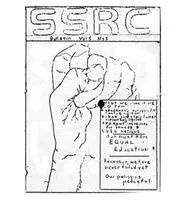
4 March, The Black People's Convention, the South African Students Organisation and the South African Students Movement become active in Soweto schools over the issue of schooling in Afrikaans
1976
30 April, Pupils at Orlando West Junior School go on strike against the use of Afrikaans in education.
1976
12 May, A female teacher is attacked by two robbers on her way to school and is saved by more than 100 pupils from Orlando North Secondary School, who catch the robbers and beat them to death. In another incident in May, a pupil stabs a teacher at Pimville. Police try to arrest the pupils but are stoned by other pupils.
1976
16 May, Pupils at Phefeni Secondary School start boycotting classes in protest against the use of Afrikaans in education. The unrest spreads to Belle Higher Primary School, Thulasizwe Higher Primary School, and Emthonjeni Khulo Ngolawazi Higher Primary School.
1976
17 May, Pupils at Orlando West Junior School strike in protest at the dismissal of a member of the school board. They bombard the principal's office with stones and draw up a memorandum of grievances, which they hand to the principal.
1976
24 May, Pupils reject a call by the Orlando Diepkloof School board to return to school. The strike spreads to Pimville Higher Primary School. The SA Students Movements makes an attempt to consolidate the situation and holds a conference in Roodepoort to discusses the campaign against the use of Afrikaans as a medium of instruction.
1976
8 June, Security police arrive at Naledi High School and attempt to arrest the leader of the local branch of the SA Students Movement. Pupils stone the police and bum their car.
1976
11 June, The recently appointed deputy minister of "bantu education", Andries Treumicht, rejects the applications by five Soweto schools to depart from the so-called 50-50 policy in secondary education, which entailed equal use of English and Afrikaans in schooling.
1976
13 June, The Naledi branch of the SA Students Movement holds a meeting, attended by representatives of all Soweto schools, at which it is decided that protests will be held on June 16 against the use of Afrikaans in education.
1976
An action committee called the Soweto Students' Representative Council is formed to organise the demonstration, with two representatives from each school.
1976
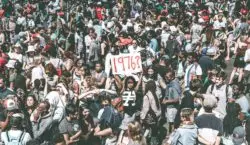
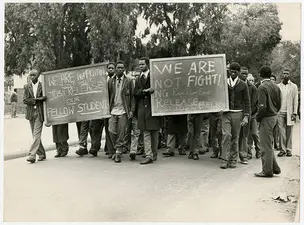
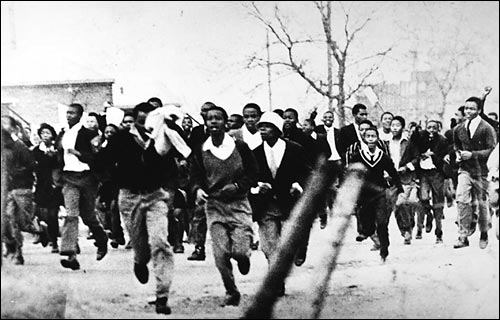
16 June, The Soweto uprising takes place on the day that the Internal Security Amendment Act comes into operation. It is hard to get a clear picture of exactly what happened on the day. It is exam time for senior pupils, and the exams must be written in Afrikaans. A march starts and pupils from many schools along the way join in. Teargas is fired. Gunshots are fired at the pupils and pandemonium breaks out. Anger at the senseless killings inspires retaliatory action. Police cars are burnt. Fires blaze throughout the night. At least 200 people are killed. The Internal Security Amendment Act, which replaced the Suppression of Communism Act, gives the minister of "justice" enhanced powers to declare organisations unlawful, to prohibit publications, to prohibit attendance at gatherings, to restrict persons to certain areas and to detain persons and witnesses in custody.
1976
17 June, The second day of the protest is marked by uncontrollable fury. Fires rage in townships throughout the country. Pupils stone cars passing through Soweto. Police shoot at random, and at anyone who raises a fist and shouts "power". Helicopters fly overhead. Workers refuse to go to work.
1976
18 June, The number of skirmishes between pupils and police diminishes. A general stayaway is organised. There are reports of pupils seizing weapons from the police and using them to shoot back at the police.
1976
19 June, The Government Gazette announces that 123 persons have been banned as a result of the June 16 revolt. The minister of police imposes a nationwide prohibition on the holding of meetings, which was later extended to the end of the year.
1976
July, The Minister of Police impose a nationwide prohibition of meetings, which, renew until the end of the year.
1976
October 2 The Republic of Transkei Constitution Act is passed.
1976
30 November, 700 people were in detained.
1976
31 December, Then Prime Minister BJ Vorster says: "The storm has not struck yet. We are only experiencing the whirlwinds that go before it."
1976
Winnie Mandela is elected to the Black Parents Committee. Mass detentions follows and she is one of six executive members of the Federation of Black Women to be detained. She is released and banned again.
1976
1979 15 November - 15 June, 110 bombings by insurgents occurred.
1977
The period for continuous military service for white youths is increased to two years.
1977
It was announced heavily that armed police are patrolling the border to intercept armed insurgents from entering the country and to prevent youths from leaving for military training.
1977
Only about 3 000 pupils out of a possible 27 000 pupils applied for re-admission to Soweto schools.
1977
230 000 people were arrested for pass law offences.
1977
Funds for Bantu Education increased from R78 million in 1976/77 to R117 million in 1977/78.
1977
June, The Urban Bantu Councils collapsed when the majority of its members resigned under pressure from students.
1977
12 September, The founder and first president of the South African Students Organisation (SASO). Mr Steve Biko, became the 40th person to die in detention. Ten people died in detention that year.
1977
19 October, Major black consciousness and other organisations were banned. Fourty-two people were detained and at least seven people were banned. Various newspapers including The World, the Weekend World and a Christian Institute publication, Pro Verlate, were banned.
1977
November, The UN Security Council declared that a further acquisition of arms by South Africa would be a threat to international peace. An indefinite arms embargo was imposed.
1977
The National Party won 134 seats in the general election, the highest proportion ever gained by one party in South Africa. 401 people were charged in security trials.
1978
Mr P. W. Botha was elected as Prime Minister.
1978
The (Coloured) Labour Party, (Indian) Reformed Party and Inkatha formed the South African Black Alliance.
1978
It was estimated that 4 000 refugees were undergoing military training in Angola, Mocambique, Libya and Tanzania.
1978
1 096 publications were banned and 300 films banned or subjected to age restrictions and excision.
1978
9 832 persons were removed to the homelands.
1978
January, Dr Richard Turner was shot dead in his home.
1978
May, The Azanian Peoples Organisation (AZAPO) was formed to fill the gap left by the Black Consciousness Movement, banned in 1977.
1978
30 June, 14 390 people were convicted on unrest related charges.
1978
October, The Federation of South African Trade Unions (FOSATU) was formed.
1978
30 November, 261 were detained during 1978.
1979
The Wiehahn Commission of Enquiry into labour legislation recommended the legalisation of African trade unions. This led to the government amending the Industrial Conciliation Act to put this recommendation into effect. The Riekert Commission recommended the limited easing of restrictions on the mobility of urban workers.
1979
335 people were charged in terms of Section 16 of the Immorality Act.
1979
The boycott of Fattis and Monis products in May in support of the Food and Cannings Workers Union was the first consumer boycott since the late fifties.
1979
The Soweto Civic Association and the Port Elizabeth Black Civic Organisation are formed.
1979
108 911 families were moved in terms of the Group Areas Act.
The South African Allied Workers Union is formed.
The South African Allied Workers Union is formed.
1979
April, FOSATU was formally constituted with 12 affiliates representing 45 000 workers.
1979
June, The Congress of South Africon Students (COSAS) is formed.
1979
September, The inaugural conference of Azapo was held.
1979
November, The Azanian Students Organisation (AZASO) is formed .
1979
30 November, 334 people were detained.
1979
The Senate is abolished and it is replaced by a President's Council consisting of 60 members of the Chinese, Coloured, Indian and white communities.
1979
The Taxation of Blacks Amendment made further provision to put 'African taxpayers on the same footing as those of other races.'
1979
16 707 were convicted on politically-related charges.
1979
768 people were detained.
1979
Attendance at African schools increased by 89% since 1965.
1979
Boycotts of schools and universities started at secondary schools in Cape Town and spread to primary schools and spread finally to schools country-wide.
1979
The boycott of red meat was called for by the Western Province General Workers Unions. A boycott of Colgate was also called for by the Chemical Workers Industrial union.
1980
January, Three guerrillas were shot dead in a siege at the Volkskas bank in Pretoria. Two hostages were killed and 9 hostages and two policeman were seriously injured.
1980
April, The Coloured Representative Council was dissolved.
1980
The Black Consciousness Movement of South Africa changed its name to the Black Consciousness Movement of Azania.
1980
The African United Automobile Workers Union split and the Motor Assemblies and Components Workers Unions of South Africa was formed (MACWUSA).
1980
July, 10 000 Johannesburg municipal workers went on strike.
1980
14 September, The Council of Unions of South Africa (CUSA) was formed, comprising 9 affiliates.
1980
October, The Media Workers Association of South Africa called for a boycott of all commercial newspapers. MWASA was previously known as the Writers Association of South Africa.
1981
The National Party won the general election by winning 131 of 165 seats in parliament.
1981
The Anti - South African Indian Council Committee and the Transvaal Anti-SAIC Committee were formed to oppose South African Indian Council elections. Less than 20% of registered voters cast ballots, in Fordsburg the percentage poll was 1,75%.
1981
Over fifty organisations banded together to campaign countrywide against the 20th anniversary celebrations of the South African Republic.
1981
Twelve African National Congress members killed when South African armed forces attacked Matola in Mocambique.
1981
At least fourty attacks by ANC insurgents occurred during 1981.
1981
630 people were detained. Just under twenty people were banned.
1981
The Government-appointed De Lange Commission of Enquiry into Education recommended equal opportunities for education including equal standards for everyone.
1981
A boycott of Wilson-Rowntree sweets was called by the South African Allied Workers Union.
1981
There were 342 strikes affecting 87 189 workers as compared to 1976 where there were 245 strikes affecting 28 013 workers.
1981
November, Tshifiwe Muofhe died in detention.
1982
In the Western Cape two federations of civic associations were formed. They were the Cape Areas Housing Action Committee and the Federation of Cape Civics.
1982
The National Union of Mine-workers was formed.
1982
Membership of FOSATU passed the 100 000 mark.
1982
The International Security Act of 1982 replaced the International Security Act of 1950, the Suppression of Communism Act of 1953, the Riotous .Assemblies Act of 1956, and sections of the General Laws Amendments. The Act served to consolidate all security legislation. Other security legislation passed were the Protection of Information Act, Intimidation Act, and the Demonstrations in or near Court Buildings Prohibition Act.
1982
264 people were detained.
1982
85 people were restricted under the Internal Security Act.
1982
87 people were either refused passports or had them withdrawn.
1982
Sporadic boycotting of schools and universities continued.
1982
February, Neil Aggett died in detention.
1982
March, Fifteen National Party members broke away to form the Conservative Party.
1982
April, Siphiwo Mtimkhulu of COSAS disappeared.
1982
August, Ernest Dipale died in detention.
1983
The National forum committee was revived. 100 organisations were present.
1983
CUSA's membership reached the 100 000 mark. Its fastest growing affiliate was the National Union of Mineworkers.
1983
Boycotts and demonstrations at schools affected 10 000 pupils country-wide. At least 22 meetings were banned. Simon Mndawe and Paris Malatji died in custody.
1983
48 people died in 220 incidents of insurgency since 1976. 172 ANC insurgents were killed during that period
1983
May, The Transvaal Indian Congress was revived.
1983
August, The United Democratic Front (UDF) was launched with 575 affiliate organisations.
1983
More than two-thirds of white voters supported the new constitution in a referendum.
1983
September, The Republic of South African Constitution Act was passed. The Act made provision for a State President with wide-ranging executive powers and a tricameral parliament.
1983
1986 July - March, The boycott of buses in Mdantsane, Ciskei ' was started in July and was called off in March.
1984
The elections in the (Coloured) House of Representatives had a poll of 18,1% of eligible voters, the percentage poll in the (Indian) House of Delegates was 16,2% of eligible voters, this was a result of the campaigning against the election by black political organisations.
1984
50 members of community councils resigned after pressure from students, youth and civic organisations. There were 30 petrol bomb attacks against community councillors. 99-year leasehold rights for African people were extended to the Western Cape. There were 58 incidents of sabotage. 469 strikes occurred involving 181 942 workers. 300 families in Mogopa in Western Transvaal were forcibly removed from their ancestrial homes.
1984
50,13% of pupils in the Department of Education and Training passed their matriculation examinations.
1984
The ban on all outdoor meetings was renewed for another year.
1984
530 people were detained in terms of security legislation. Another 1127 people were detained under other laws.
1984
Sergeant Jan Harm van As was sentenced to 10 years imprisonment for the death in detention of Paris Malatji. This was the first conviction for a death in detention.
1984
Some political prisoners released were Heman Andimba Toivo ja Toivo, David Kitson and Dorothy Nyembe.
1984
16 March, Mocambique and South Africa signed the Nkomati peace accord.
1984
August, Boycotts and demonstrations in schools affected about 7% of the school population. In August demonstrations affected 800 000 school children.
1984
September, Mr P.W. Botha was elected the first executive state president.
1984
3 September, 175 people were killed in political violence incidents.Violence erupted in the Vaal Triangle, within a few days 31 people were killed.
1984
23 October, 700 police and army personnel were used in the Vaal Triangle.
1984
5-6 November, There were a number of stayaways from work called in 1984. The major stayaway occurred on 5 and 6 November when 500 000 workers and 400 000 students stayed away.
1984
1986 September - 24 January, People were killed in political violence incidents, 3 658 injured. 25 members of the security forces were killed and 834 injured. There were 3 400 incidents of violence in the Western Cape.
1985
The 30th anniversary of the Freedom Charter.
1985
In the better half of the year the ANC was visited by businessmen, students, the Progressive Federal Party and clergyman from South Africa.
1985
There were 136 incidents of guerrilla activity.
1985
This was 34% more than all the incidents in the last 10 years.
1985
Clashes occurred between supporters of the UDF, Azapo and Inkatha throughout the year.
1985
1986 marked the centenary of Johannesburg. The Community Support Committee was formed to oppose centenary projects.
1985
Consumer boycotts of white business began early in the year in the Eastern Cape and later spread country-wide.
1985
South African troops attacked South West African Peoples Organisation's targets 250 km inside Angola.
1985
The right-wing Herstigte Nationale Party won its first parliamentary seat in 17 years.
1985
21 March, 20 people were shot dead by the police in Uitenhage, Port Elizabeth
1985
April, The government announced that it will repeal the Mixed Marraiges Act, the Prohibition of Political Interference Act and the Immorality Act.
1985
May, Trade unionist Andries Raditsela died a few hours after being released from detention.
1985
June, The African National Congress had its first consultative conference since 1969 in Zambia.
1985
A raid on Gaborone, Botswana by the SADF resulted in the death of 15 people.
1985
At least 11 political activists were either killed by unknown assailants or went missing.
1985
July, The value of the rand dropped to below US$ 0.40c. Foreign exchange dealings were suspended for three days.
1985
August - Clashes between protesters, impis, resident and the police leave 70 dead and 140 injured in urban townships.
1985
The Congress of South African Students was banned.
1985
The government freeze foreign loan payments.
1985
The USA imposed limited sanctions against South Africa.
1985
September, The Metal and Allied Workers Union launched a boycott of white shops in Pietermaritzburg to pressurise BTR Samcol into reinstating their workers.
1985
Inkatha and the Progressive Federal Party hosted a meeting to form the Convention Alliance. Both organisations later withdrew from the steering committee.
1985
October, The Soweto and Parents Crisis Committee is formed.
1985
30 November, The Congress of South African Trade Unions was formed with a membership of 500 000.
1985
December, Inkatha said its membership was now over a million people.
1985
Twelve UDF treason trialists were acquitted.
1985
Six people died in a landmine explosion in the Northern Transvaal.
1985
A bomb in a shopping centre in Amanzimtoti near Durban killed five people.
1985
1986 21 July - 7 March, A state of emergency was declared by the state president and it affected 36 magisterial districts. He withdrew the proclamation on 7 March 1986.
1985
During the first six months 575 people were killed in political violence incidents during the state of emergency. More than half were killed by the police.
1985
7 200 people were detained under emergency regulations.
1986
Alexandra exploded several times, with more than 30 people killed.
1986
January, Soweto pupils return to school in January in response to a call from the Soweto Parents Crisis' Committee
1986
167 people died in political violence in January.
1986
February, The leader of the Progressive Federal Party resigned from Parliament because he said Parliament is incapable of bringing about the desired reforms.
1986
March, At the National Education Crisis Committee meeting it is resolved that the boycott of schools should end.
1986
7 March, The state of emergency is lifted.
1986
14 March, 14 people have been killed since the lifting of the state of emergency.
1986
1 416 people have died. March had the highest monthly figure of 171.
1986
April, South African Communist Party leader Moses Mabhida, is buried in Maputo, Mozambique.
1986
Representatives of 34 organisations attend the Kwazulu-Natal Indaba to discuss regional representation. The UDF and National Forum Committee refuse to attend.
1986
A journalist Mr. Lucky Kutumela, died in detention in Lebowa . A week later Peter Nchabeleng died in the same police station.
1986
There is a complete stay-away of black workers in White River and Nelspruit. The boycott of white shops in Port Elizabeth is re-imposed.