1893
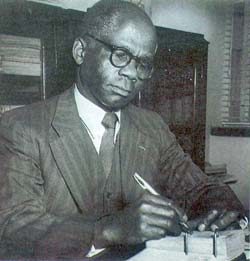
Alfred Bitini Xuma is born, the seventh child born of Abraham and Elizabeth Xuma, an aristocratic Xhosa family living in Manzana Village in the Engcobo district of the Transkei.
1900
Xuma attends the Wesleyan Mission School in Manzana.
1908
After completing primary school, Xuma attends Clarkebury Boarding School, where he qualifies as a primary school teacher.
1911
After the government begins to make distinction between the certificates granted to Europeans and Africans almost all the Clarkebury boarders walk out in protest against the inequalities in education.
1911
Xuma begins to study teaching at the Martizburg Training Institute, after which he begins teaching at various schools in the Transkei.
1912
1913 Xuma starts working as a teacher at two primary schools; one in a settlement known as Newala and the other in Ntibani in the Transkei.
1913
August: Xuma and two colleagues travel to East London, where they board a Union Castle steamer bound for the United States of America via Cape Town and Southampton, England.
1913
20 September: Having been awarded a small Wesleyan Mission scholarship, Xuma arrives in the United States of America to further his studies at Tuskegee Institute in Alabama, specialising in agriculture.
1916
25 May: As one of the three top graduates, Xuma makes a speech on ‘Problems in Poultry Raising’ at Tuskegee Institute’s commencement ceremony.
1916
13 July-October: In order to pay his outstanding debt to the Tuskegee Institute, Xuma travels to Birmingham, Alabama to find a job. He works at the American Cast Iron Pipe Company until his debt is paid. He then travels to St Paul, Minnesota.
1917
February: After sitting the entrance examinations, Xuma is admitted to the University of Minnesota’s College of Agriculture.
1919
Xuma joins Alpha Phi Alpha, a nationwide Black fraternity.
1919
December 1919-January 1920: Xuma is part of the University’s delegation at a conference of Christian students in Des Moines, Iowa.
1920
17 June: Xuma graduates with an Honours degree in Science from the University of Minnesota’s College of Agriculture, Forestry and Home Economics.
1920
June: Xuma travels to Wisconsin to attend the Lake Geneva YMCA student conference.
1920
September: The University of Minnesota offers Xuma a position at the medical school. However, his marks at the end of the first semester were so low that the University granted him an ‘honourable dismissal’.
1921
Xuma moves to Chicago for nine months and works as a shipping clerk at Chicago’s Methodist Book Concern to try and earn enough to cover further studies. To boost his academic qualifications, Xuma enrolls at Chicago’s Lewis Institute, taking classes in physics and French. However, Xuma is not readmitted at the University of Minnesota.
1921
October: Xuma is accepted to study medicine at Marquette University in Milwaukee, Wisconsin.
1922
23 July: Xuma attends a dinner in honour of Sol Plaatje in Chicago.
1923
October: Xuma transfers to Chicago’s Northwestern University to continue his medical studies.
1924
July: A nationally syndicated newspaper publishes a story headlined ‘Poverty May End College Career of Young African’, which outlines Xuma’s financial difficulties. The article results in numerous donations to allow Xuma to continue his studies.
1925
15 June: Xuma receives his four-year certificate in medicine at Northwestern’s commencement ceremony.
1925
1 July: In order to be awarded his MD degree, Xuma begins a one-year internship at St Louis City Hospital.
1926
June: Xuma graduates with an M.D. degree from Northwestern University.
1926
July: While waiting to receive his passport from the British Consulate, Xuma does observation work at the Mayo Clinic in Minnesota.
1926
1 September: Xuma boards a German-bound steamer and then travels to Budapest, Hungary and works gaining experience in women’s diseases and midwifery. Xuma studies complex surgery at New St. Johns Hospital.
1927
April: In order to sit for his qualifying exams and license to practice in the British Empire, Xuma travels to the University of Edinburgh, Scotland.
1927
October: Xuma becomes fully qualified in gynaecology, obstetrics and surgery. He is also awarded the Licentiate of the Royal College of Physicians and Surgeons.
1927
November: Xuma sets sail for South Africa after spending 14 years studying overseas.
1927
4 December: Xuma arrives back in South Africa on the RMS Saxon.
1928
Xuma moves to Sophiatown and opens a surgery in the city centre, in a building opposite the Johannesburg Magistrates Court.
1928
25 August: Clara Bridgman invites Xuma to speak at the Bridgman Memorial Hospital’s opening ceremony.
1929
Xuma becomes a member of the Johannesburg Joint Council for Europeans and Africans.
1929
January: Xuma is elected to the governing board of the Bridgman Memorial Hospital.
1929
31 July: Xuma addresses a meeting of the British Association for the Advancement of Science in Johannesburg.
1929
7 September: In an article published in Umteteli, Xuma praises Rev. John Dube, DDT Jabavu and Charlotte Maxeke for their leadership.
1929
21 September: Xuma participates in a debate on segregation in Pretoria before a multi-racial audience. Sharing the podium are Selope Thema, Selby Msimang and Edgar Brookes.
1930
Municipal officials ask Xuma to become a part-time Medical Officer of Health for Alexandra, a position he held for the next 25 years.
1930
27 June-3 July: Xuma address a Conference of the European and Bantu Christian Student Associations at the University College of Fort Hare. The conference is attended by 300 delegates and Xuma speaks on ‘Bridging the Gap Between White and Black in South Africa.
1931
Xuma testifies before the Native Economic Commission and Liquor Commission.
1931
21 October: Xuma marries Amanda Priscilla Mason, from Liberia, at the Grahamstown Methodist Church.
1931
November: Xuma chairs the first African Eisteddfod, featuring performances by African vocalists and instrumentalists. The event is such a success that it becomes an annual event.
1932
Xuma’s book, Reconstituting the Union of South Africa or a More Rational Union Policy, is published.
1932
May: Xuma makes an address before the Bantu Studies Club at the University of Witwatersrand.
1932
June: Xuma’s wife gives birth to a daughter, Elizabeth.
1932
October: Along with J.D. Rheinallt-Jones, Edgar Brooks and Charlotte Maxeke, Xuma is part of a South African Institute of Race Relations (SAIRR) deputation to the Minister of Native Affairs to discuss the deteriorating living conditions of Africans.
1933
Xuma becomes one of the Bantu Men’s Social Centre’s vice-presidents.
1933
Due to his continual involvement in the Johannesburg Joint Council, Xuma is elected vice-chairman.
1933
February: Xuma becomes an official member of the Wilberforce Institute’s board of trustees in the Transvaal.
1933
July: At the annual SAIRR conference in Bloemfontein, Xuma delivers a paper entitled ‘Native Taxation’.
1933
August: Xuma agrees to chair the educational session of AME Church’s national conference.
1933
September: Xuma becomes the chair of the Wilberforce board’s teachers committee.
1933
October: Xuma becomes the Wilberforce Institute’s interim treasurer.
1933
Xuma delivers a speech entitled ‘The Indispensable Work of a Teacher’ to the Orange Free State African Teachers Association.
1934
29 April: Xuma’s wife Priscilla dies suddenly after undergoing a Caesarean section for the birth of their son, Alfred Mtutuzeli.
1935
In his statement to a government committee on African education, Xuma accuses the government of ignoring its responsibilities to the Black community.
1935
Xuma writes an essay for Die Soeklig entitled ‘The Evil Effects of Political Differentiations Based on Race and Colour’.
1935
15-18 December: The delegates at the first All African Convention (AAC), held in Bloemfontein, elect DDT Jabavu as president and Xuma as vice-president.
1936
12-14 February: The government summons Xuma to join the negotiations with an AAC deputation on the Native Bills in Cape Town.
1936
15 February: The ACC delegation rejects the government’s compromise to create a separate voters roll for Africans in the Cape. Despite this the Hertzog government later passes the Representation of Natives Act.
1936
30 November: Xuma writes to JH Hofmeyr, Minister of Interior, Education and Public Health, and praises him for voting against the Native Bills.
1937
28 May: Xuma sets sail for the USA on a talking tour.
1937
July: Xuma begins traveling the American Midwest on a speaking tour to fundraise for various projects.
1937
25 July: At a talk at Columbia University’s International House, Xuma meets Madie Beatrice Hall, a Masters student at Colombia University, while taking advanced classes there.
1937
15 September: Xuma sets sail for London to begin a course in public health at London University’s School of Hygiene and Tropical Medicine.
1938
January: Xuma and DDT Jabavu speak at the Quaker-run Friends’ House in London.
1938
The Research Students Association of the London School of Economics invites Xuma to give an address on ‘The position of the native in South Africa’.
1938
February: Patrick Duncan invites Xuma to give a talk before Oxford University’s South African Society on African health.
1938
April: Xuma addresses a meeting of the Methodist Laymen’s Missionary Movement.
1938
21 June: Xuma gives a talk on imperialism in Africa sponsored by the London Society of Friends.
1938
October: Xuma finishes his studies in London and leaves for South Africa.
1938
November: On his return, Xuma resumes his participation in the Johannesburg Joint Council.
1938
December: Xuma becomes the first African from South Africa to be awarded a Diploma in Public Health.
1939
February: Xuma is elected to the executive committee of the Bantu Men’s Social Centre.
1939
Xuma is present at the opening ceremony of the new AME Church-run health centre in Evaton, Johannesburg.
1939
At the annual Mendi ceremonies – to commemorate the Black South African soldiers who died in World War I – Xuma speaks out against the government’s continued inattention to the African voice in South African affairs.
1939
April: After months of letter writing, Madie Hall accepts Xuma’s marriage proposal and agrees to come to South Africa.
1939
December: Rev James Calata invites Xuma to the African National Congress’s (ANC) annual conference in Durban. Xuma serves as the conference’s deputy speaker of the house.
1940
March: Xuma becomes the physician-in-charge at the Crogman Community Clinic.
1940
May: Stephen Oliphant nominates Xuma for the role of president of the ANC.
1940
18 May: Just after her arrival in Cape Town, Madie Hall and Xuma are married at the Bethel AME Church.
1940
June: Xuma is elected president of the Johannesburg Joint Council.
1940
15-17 December: At the annual ANC conference, Xuma is elected president. He gives the go-ahead for the formation of a Congress youth league and nominates ET Mofutsanyana to serve as Secretary for Labour in his cabinet.
1941
Xuma is elected Chairman of the Johannesburg Joint Council.
1941
23 February: Xuma gives anaddressat the Mendi Memorial Celebration held at the Bantu Sports Grounds, Johannesburg and pays tribute to African servicemen who perished in the Mendi tragedy.
1941
8 July: An ANC Deputation, comprising Xuma, SP Matseke and Selope Thema (who is later replaced by Mofutsanyana) meet with the Minister of Justice. To read the report of the meetingclick here.
1941
August: Xuma publishes a statement entitled ‘The Policy and Platform of the African National Congress’ in the Communist Party of South Africa’s newspaper Inkululeko.
1941
14-16 December: During his presidential address, Xuma declares that “... the African National Congress is the mouthpiece of the African people of the Union of South Africa. All its efforts are and must be concentrated upon raising the status of the African people from their semi-serfdom to citizenship.” To read more of Xuma’s presidential addressclick here.
1942
March: Xuma organizes a deputation of Africans, including Rev Calata and ZK Matthews, to see Deputy Minister Reitz in Cape Town.
1942
August: Xuma calls a meeting of the ANC executive to discuss the transgressions of the Cape African Congress. It is decided that the whole executive of the CAC should be suspended and elections held for new leaders.
1943
June: ANC officials authorise Xuma to take control of the affairs of the Transvaal branch until elections can be held for provincial officials. Xuma holds the position for a year before elections are held.
1943
December: Xuma opens the first ANC national office in Market Street, Johannesburg.
1943
13-14 December: The ANC’s Atlantic Charter Committee, led by Xuma, meet in Bloemfontein and draw up a memorandum titled The Atlantic Charter from the Standpoint of Africans within the Union of South Africa. This becomes the basic policy statement on which all subsequent ANC documents are based. Xuma, with the help of Bram Fischer, also drafts a new constitution for the ANC which allows membership of all races, eliminates the House of Chiefs and gives women equal right within the Congress.
1943
15-17 December: Xuma is elected for a second term as president of the ANC.
1944
21 February: The leaders of the newly formed ANC Youth League – Nelson Mandela, William Nkomo, J. Congress Mbata and Walter Sisulu – meet with Xuma at his home to discuss the League’s proposed charter.
1944
March: Xuma publishes a statement in Bantu World giving his support to the newly formed anti-pass campaign.
1944
Xuma agrees to act as trustee of the anti-pass campaign.
1944
April: Moses Kotane and Xuma begin speaking at anti-pass demonstrations all over the country.
1944
20-21 May: Xuma presides over a national anti-pass conference held at the Gandhi Hall in Johannesburg. The conference elects Xuma as chair and Dr. Yusuf Dadoo as deputy chair of an anti-pass working committee.
1945
Xuma’s book, Africans’ Claims in South Africa, is published.
1945
April: With the anti-pass campaign losing momentum, Xuma calls an emergency conference of the anti-pass committee.
1945
8 May: Xuma makes a statement entitled ‘Africans and San Francisco’.
1945
August: At a conference of Black South African trade unions, Xuma reiterates the Congress’s support for higher wages and the recognition of African trade unions.
1946
January: Xuma is able to convince representatives of the Bantu Welfare Trust to award the ANC with a ₤200 grant to cover their expenses for 1944-1945 and ₤100 for 1946.
1946
14 January: Xuma issues a statement on the African Worker.
1946
June: A full conference of the Anti-Pass Council is held and Xuma addresses the conference stating that the pass laws were the ‘very foundation of economic exploitation’ (Walshe, 1970: 312).
1946
26 July: Xuma writes to the members of the Natives Representative Council (NRC) to convince them to adjourn until the government reverses its course against the mineworkers’ strike.
1946
September: Xuma initiates a plan to host an emergency conference of all Africans to try and determine the next step in the campaign to obtain full citizenship for all Africans.
1946
6-7 October: Xuma’s emergency ANC conference is held in Bloemfontein.
1946
21 October: Xuma leaves for the United States. He is an unofficial delegate at the United Nations where he assists in lobbying against South Africa’s plans to incorporate South West Africa (Namibia) into the Union.
1947
1947
As part of efforts to unite anti-apartheid organisations, Xuma signs a Joint Declaration of Cooperation, known as the ‘Doctors Pact’, with Dr Naicker from the Natal Indian Congress and Dr Dadoo from the Transvaal Indian Congress. To read Xuma’s statement click here.
1947
21 March: As part of the publicity campaign against the upcoming national elections,
1947
Xuma issues a flyer, To All Africans and Friends of Justice, which calls for, among others, the abolition of the Pass Laws and the removal of Land Restrictions against Africans in urban and rural areas. Click here to see the full list of demands.
1947
4 May: Xuma presides over a mass rally in Johannesburg as part of the anti-election campaign.
1947
11 May: On behalf of the ANC, Xuma responds to the proposals made by Prime Minister Jan Smuts on restarting the Native Representative Council.
1948
April: Xuma is invited to deliver the opening address at the annual conference of the Transvaal Indian Congress.
1948
5 April: Xuma issues a statement on the upcoming general elections.
1948
August: Xuma and Rev. Calata call a special ANC conference of the executive committee to formulate a response to the victory of the National Party.
1948
3 October: In an attempt to end the rift between the AAC and ANC, Xuma calls a meeting of 12 leaders. The leaders sign ‘A Call for Unity’.
1948
25 November: Xuma sends a cable to the UN responding to a statement made by Eric Hendrik Louw.
1949
20 January: The ANC Working Committee issues a statement signed by Xuma on the Durban Riots.
1949
6 February
1949
Representatives of the ANC, AAC and the SAIC attend a conference in Durban. In a joint statement, delivered by Xuma, the delegates condemn the exclusion of Africans and Indians in the commission appointed to investigate the riots.
1949
5 December: ANCYL members Nelson Mandela, Walter Sisulu and Oliver Tambo meet with Xuma at his home to brief him on the Youth League’s position – they would support his re-election provided he formally endorses the Programme of Action. Xuma rejects the League’s proposal.
1949
15-17 December: At the ANC’s annual conference Xuma is replaced as ANC President by Dr James Moroka.
1950
Xuma becomes involved in setting up the Xuma African National School Fund to assist with the funding of education for African children.
1950
18 March: In a press release published in Bantu World, Xuma clarifies his decision to resign from the ANC’s national executive.
1951
After the release of Kwame Nkrumah, Xuma sends him a cable congratulating him.
1951
March: Xuma unveils a monument to the Xhosa poet SEK Mqhayi in the Cape Province.
1951
April: After the government publishes its plans to resettle Sophiatown, Xuma calls a meeting of fellow landowners. They formed the Anti-Expropriation and Proper Housing Movement.
1951
23 May: Xuma speaks at the funeral of former ANC president SM Makgatho.
1951
7 June: Xuma speaks at the funeral of Pixley Seme.
1952
November: After some objections, in an interview for Advance, Xuma states that the defiance movement is the only way Africans can air their grievances.
1952
Xuma makes a statement, published in the Bantu World and Rand Daily Mail, calling for the government to hold consultations with African political leaders.
1953
Xuma travels to Northern and Southern Rhodesia. However, the reason for the trip remain unclear.
1953
April: Xuma takes part in a multiracial conference on South Africa’s future sponsored by the SAIRR. The conference is held at Adams College and attended by prominent African and Afrikaner leaders.
1953
August: The SAIRR sponsors a conference on the Western Areas removal scheme which is held at the University of the Witwatersrand. Xuma accepts an invitation to attend.
1954
December: Xuma gives an interview on the removals to the American CBS television programme See It Now, hosted by Edward R Murrow.
1955
6 February: After orders are issued in January for the removal of people from the Western Areas, Xuma, in interview with the Sunday Times, states that he will not move or sell his home.
1955
23 April: In a statement in the Bantu World, Xuma calls on African children to end the boycott against the Bantu Education Act and return to school.
1955
December: Xuma drafts a letter setting out his criticisms of the Congress Alliance and sends it to the ANC’s annual conference, sparking controversy. However, the ANC leadership refuses to read the letter in its entirety.
1956
At the conference of the Inter-denominational African Ministers Federation, Xuma is elected with 13 others to draft a response to the homelands proposal.
1956
28 January: The Bantu World publishes ‘Dr. Xuma’s Letter Congress Would Not Read’.
1957
1 February: In an attempt to end the Alexandra Bus Boycotts, Xuma along with other ‘moderate’ African leaders and members of the Johannesburg City Council, attends a meeting convened by Ray Philips.
1957
9 March
1957
After receiving much criticism over a meeting with the government to resolve the Bus Boycotts, Xuma writes a letter to the World defending his position.
1957
December: Xuma assists in sponsoring a multiracial conference, which takes place at the University of the Witwatersrand and is attended by approximately 600 delegates.
1957
3 December: The Native Affairs Secretary grants Xuma’s application to travel to England – to visit his first wife’s family – as well as to Ghana, Nigeria and the Belgian Congo.
1957
4 December: Xuma leaves on his overseas trip.
1958
December: Xuma hosts Dr Hastings Banda, leader of the independence movement in Nyasaland (now Malawi), at his home in Sophiatown.
1958
December 1958-February 1959: Xuma meets with representatives of the South African Bureau for Racial Affairs (SABRA).
1959
17 February: Xuma signs a contract to have a new home built at 1401 Mtipa Street, Dube.
1959
June: Xuma is finally forced to vacate his home of 30 years in Sophiatown.
1960
March: The Native Affairs Department grants Xuma’s application to travel overseas but only to the USA and not to the United Kingdom, Western Europe or the Caribbean.
1960
8 April: Xuma flies from Jan Smuts airport to London and New York.
1961
12 January: Xuma accepts a government- organised meeting, along with Dr William Nkomo and KT Masemola, with UN Secretary General Dag Hammarskjold.
1961
May: Xuma is diagnosed with pancreatic cancer and, despite major surgery, his condition deteriorates.
1962
24 January: Xuma slips into a coma.
1962
27 January: Xuma dies at Baragwanath Hospital in Johannesburg.
1962
1 February: Xuma’s funeral takes place. After a private ceremony at his home in Dube, Xuma’s body is taken in procession to the Donaldson Community Centre in Orlando. The service is conducted by AME Bishop Francis Gow with Rev James Calata, Dr Silas Molema, Dr James Moroka, JR Rathebe, Patrick Lewis and R.J van Buuren in attendance. Xuma is then buried at Brixton Cemetery, Johannesburg, next to his first wife.
1963
27 January: Madie Hall-Xuma unveils a tombstone for her husband at Brixton cemetery.
1998
Xuma’s house in Sophiatown, one of two in the area to escape demolition, is declared a national monument.