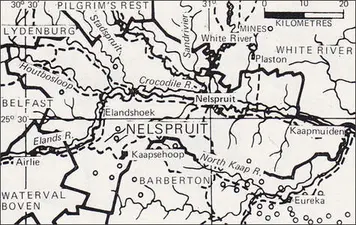
Nelspruit lies in the Lowveld, in the valley of the Crocodile River just below the great eastern escarpment of the Transvaal. Long before it acquired a European name, the region was home to Nguni- and Sotho-speaking farming communities, among them the Koni and the Southern Ndebele, and later the Swazi to the south, whose stonewalled settlements are scattered along the escarpment above the town. The colonial history of Nelspruit is the story of how this occupied landscape was drawn into the orbit of the Boer republics, the mineral revolution and the imperial economy, and of how a seasonal cattle-grazing ground on the farm of a single family became first a railway siding and finally a proclaimed colonial town.
Trekboers and the winter grazing frontier
White penetration of the eastern Transvaal began in earnest with the Voortrekkers. The ill-fated expeditions of Louis Trichardt and Hans van Rensburg crossed the region in the 1830s, and in 1845 Andries Hendrik Potgieter led a party that established the first substantial White settlement in the eastern Transvaal at Ohrigstad, from which a rival community soon broke away to found Lydenburg further south. These early settlements clung to the higher, healthier ground of the escarpment. The Lowveld itself, hot and malarial and infested with the tsetse fly, was for decades regarded by the trekboers as a place of death for cattle and people alike, to be entered only in winter.
Out of this fear grew the pattern of transhumance that would give the town its name. Highveld farmers, whose stock suffered in the frosts of the interior plateau, drove their animals down the escarpment each winter to graze on the warmer grasslands at the foot of the hills, retreating again before the fever season returned. Among these seasonal graziers was the family of Louis Johannes Nel, who had moved from Natal into the eastern Transvaal in the 1850s and taken up farms near the hill that became known as the Nelsberg. From about 1883 his sons, Gert, Louis and Andries Nel, brought their sheep and cattle down to graze the flats beside a small stream at the base of the Nelsberg. When railway surveyors working through the district in 1884 encountered the brothers at this watercourse, they marked it on their maps as "Nel's Spruit", the stream of the Nels, and it was under this name that the future town would be recorded in the Government Gazette.
Gold, the railway and the making of a station
The transformation of this grazing ground into a permanent settlement was driven by forces reaching far beyond the Nel family's herds. The discovery of gold at Pilgrim's Rest in 1873, and the far richer strikes in the De Kaap valley and at Barberton in the 1880s, turned the eastern Transvaal into a magnet for prospectors, traders and speculators, and drew the attention of imperial capital to a region that had until then lain on the margins of the South African Republic (ZAR). The mineral revolution created both the traffic and the political will for a railway.
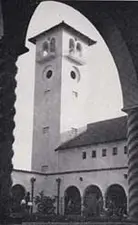
For President Paul Kruger's government, a rail link to the sea was above all a bid for independence from the British-controlled ports of the Cape and Natal. The concession was granted to the Nederlandsch-Zuid-Afrikaansche Spoorweg-Maatschappij (NZASM), the Netherlands-South African Railway Company, which built the Eastern Line from Pretoria towards the Portuguese harbour of Lourenço Marques (Maputo) in Delagoa Bay. As the line advanced up the Crocodile River valley, the low ground beside Nel's Spruit was surveyed for a station, and some 120 stands were laid out around the future station site in 1889. The railhead reached Komatipoort on the Mozambican border and arrived at Nelspruit on 20 June 1892. Around the new station a small settlement took shape, its first substantial building the Hall family's Fig Tree Hotel, and Nelspruit began its life as a railway town, a point of transhipment where the agricultural produce and minerals of the district met the line to the sea.
Nelspruit and the South African War
The railway that made Nelspruit also gave it a brief and unexpected prominence in the South African War (1899 to 1902). When British forces under Lord Roberts captured Pretoria in June 1900, the government of the ZAR did not surrender but withdrew eastward down the very Eastern Line that Kruger's republic had built, keeping the seat of state moving ahead of the advancing columns. The government functioned for a time from Machadodorp, while the ageing President Kruger lodged nearby at Waterval-Onder in the house since preserved as the Krugerhof. As Roberts pressed on, the republican capital was moved further down the line to Nelspruit, which for several months in 1900 served as the last seat of the government of the South African Republic on Transvaal soil.
It was from Nelspruit, in September 1900, that Kruger took his leave of the republic he had led for so long, travelling on to Lourenço Marques and then into European exile aboard the Dutch warship Gelderland, never to return. British troops occupied the eastern line soon afterwards, and although the war ground on for another eighteen months as a guerrilla campaign across the Transvaal, the formal life of the ZAR had reached its end at the little railway settlement in the Lowveld. The Peace of Vereeniging in 1902 brought the republic to a close and made the Transvaal a British colony.
Proclamation and the colonial town
Under colonial administration the loose settlement around the station was at last given formal shape. On 27 January 1905 Nelspruit was proclaimed, opening the way for the surveyed land to be parcelled out and sold to buyers and setting the settlement on the road to municipal status. The wider region was meanwhile being reordered in ways that would define its future: the fertile Crocodile River valley was turned increasingly to subtropical agriculture and citrus, while the conservation impulse that Kruger's government had signalled with the proclamation of the Sabie Game Reserve in 1898 grew into the Kruger National Park, binding the district's fortunes to farming and tourism alike.
With the establishment of the Union of South Africa in 1910, Nelspruit passed from colonial township into the segregated order of the new state. The dispossession of the African communities who had farmed the escarpment and the valley, the concentration of land and commerce in White hands, and the subordination of Black labour to the needs of White farmers and the railway were all set in motion during the colonial decades, and together they formed the foundation on which the segregated and later apartheid town would be built.