
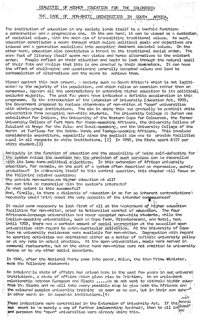
The institution of education in any society lends itself to two-fold functions, a conservative and a progressive one. It can be viewed as a custodian of societal values or constitute a threat to the traditional social order. Viewed against this background, South Africa which is not legitimated by the majority and relies on coercion rather than consensus, appears all the contradictory in extending higher education to its politically excluded majority.
archiveREF R-0114325Revised
Archive record
Dialectic of Higher Education for the Colonised: the case of Non-White Universities in South Africa
- Origin date
- 1971
- Updated
- 27 Aug 2019
South African History Online. (2016, February 22). Dialectic of Higher Education for the Colonised: the case of Non-White Universities in South Africa . South African History Online. https://sahistory.org.za/ref/R-0114325
South African History Online (2016) 'Dialectic of Higher Education for the Colonised: the case of Non-White Universities in South Africa ', South African History Online, 22 February. Available at: https://sahistory.org.za/ref/R-0114325 (Accessed: 3 August 2026).
South African History Online, Dialectic of Higher Education for the Colonised: the case of Non-White Universities in South Africa [website], https://sahistory.org.za/ref/R-0114325, (accessed 3 August 2026).
"Dialectic of Higher Education for the Colonised: the case of Non-White Universities in South Africa ." South African History Online, 22 Feb. 2016, https://sahistory.org.za/ref/R-0114325. Accessed 3 Aug. 2026.
South African History Online. "Dialectic of Higher Education for the Colonised: the case of Non-White Universities in South Africa ." South African History Online. February 22, 2016. https://sahistory.org.za/ref/R-0114325.
Further reading
 Article
DISA Archive
DISA is a freely accessible online scholarly resource focusing on the socio-political history of South Africa,...
 Archive
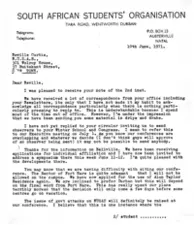
Letter from Barney Pityana to Neville Curtis
Letter from Barney Pityana (President, SASO) to Neville Curtis (NUSAS) regarding NUSAS and SASO relations.
 Place
Place
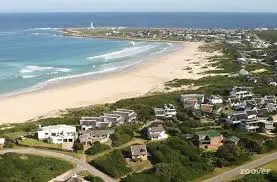
Cape St Francis, Western Cape Peninsula
Manuel Perestrelo visited Cape St Francis in 1575 and named it 'Bahia de Sao Francisco'.
SAHO is free because readers fund it. Donate →