
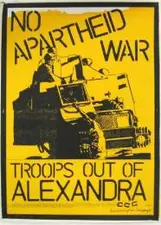
The formation of the United Democratic Movement (UDF) in 1983 amalgamated many grassroot organisations under one banner. Some organisations consisted of cultural workers who established screen-printing resource centres. These were aimed at providing training, while serving the needs of all the UDF affiliates. In Johannesburg, the Screen Training Project (STP) was established while the Community Arts Project (CAP) was based in Cape Town. These projects were responsible for the production of thousands of posters, T-shirts, badges and banners. As a result of these activities, they also attracted the attention of security police who raided the premises and confiscated posters. With increasing intimidation STP was forced to go underground and with this production declined. The project re-emerged as the Media Training Workshop after the 1990 unbannings.
Article record
Protest Art
- Published
- 30 Mar 2011
- Updated
- 21 Jul 2026
South African History Online. (2011, March 30). Protest Art . South African History Online. https://sahistory.org.za/ss/ref/A-0059399
South African History Online (2011) 'Protest Art ', South African History Online, 30 March. Available at: https://sahistory.org.za/ss/ref/A-0059399 (Accessed: 22 July 2026).
South African History Online, Protest Art [website], https://sahistory.org.za/ss/ref/A-0059399, (accessed 22 July 2026).
"Protest Art ." South African History Online, 30 Mar. 2011, https://sahistory.org.za/ss/ref/A-0059399. Accessed 22 July 2026.
South African History Online. "Protest Art ." South African History Online. March 30, 2011. https://sahistory.org.za/ss/ref/A-0059399.
Further reading
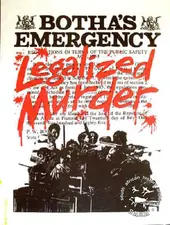 Article
Partial State of Emergency, July 1985
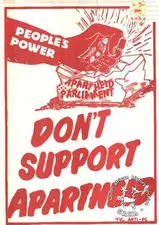 Article
”People’s Power!”, 1986
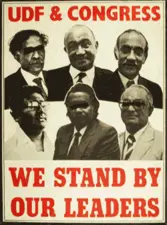 Article
The Pietermaritzburg Treason Trial, 1984
 Article
The Tricameral Parliament, 1983-1984
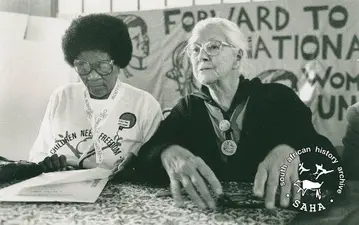 Article
Strong and Unnoticed: The Women of the UDF by Reid Arnold
 Article
State of Emergency - 1985
SAHO is free because readers fund it. Donate →
Contribute to this record0 comments
Comments are reader contributions. They are not part of the archival record.