Vredehoek is a hillside neighbourhood at the base of Devil’s Peak. The stairways here were built in the early twentieth Century to connect homes to streets and tram stops. At the time, the steep terrain made stairways essential for daily life.
Some of the stairways follow older paths used by soldiers stationed on the mountain. This adds another layer of history to their use. Today the Vredehoek steps are popular with locals for exercise. They also offer access to viewpoints where the City and the Mountain meet. The steps carry both a practical and historical legacy that speaks to the area’s past and present.
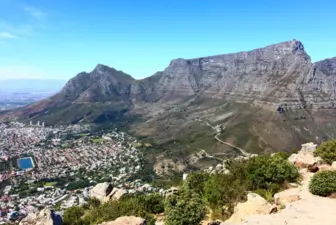
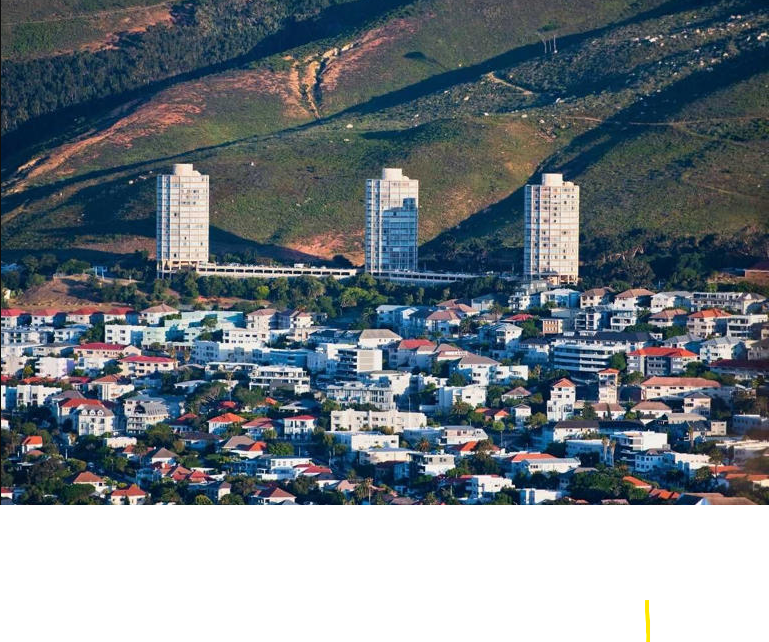
Vredehoek sprawls down from Table Mountain, a unique arrangement of art-deco Buildings, mid-century apartments and dotted displays of functional, urban architecture, packed between Devil’s PeakandOranjezicht. The quiet neighbourhood is recognised by the contentiously designed 'Disa Towers' that survey the Suburb from their lofty foundations at the base of the Mountain – built like salt and pepper pots to minimise the impact of the infamous South-Easter that harasses residents throughout the Summer.
Disa Park: The story of Cape Town’s three towers
"Ludicrous though it sounds, white housing developments were severely lacking in the Mother City. According to 'The Mail and Guardian': "The government suspended many building restrictions and relaxed zoning regulations in white group areas” in their bid to accelerate construction and mitigate this crisis. The three towers of Disa Park – named Blinkwater, Platteklip and Silverstroom, respectively – were designed by Kenneth Duncan and completed by his firm in 1969. The cylindrical design of the trio acts as a sort of stabiliser, allowing them to defy the fierce winds that whip through Vredehoek. Each tower stands at a height of 54.8 metres, their diameters measuring 24.3 metres. Their lofty stature boils down to the firm taking advantage of the government’s suspended building regulations. They built the base below the permitted development line at the foot of Table Mountain. They then continued building upward, thus exceeding the line. Altogether, the towers consist of 287 apartments, with 340 accompanying parking bays. As bonuses, amenities include a braai area, a swimming pool, a tennis court and a squash court. Overall, it cost R3 million to construct Disa Park. For what it’s worth, there were plans in the pipeline to build more of these towers on location, but they never came to fruition. THE GREAT DIVIDE- Fifty-six years later, the towers of Disa Park still maintain their lofty perch in Vredehoek. Its apartments house hundreds of residents, with the capacity to accommodate roughly 1 000 people." (link provided in FURTHER READING)
The trio offers panoramic vistas of Cape Town, the hub of which is mere minutes away. For hiking and nature enthusiasts alike, there are plenty of mountain trails at the back to traverse (if you can brave those winds, of course).
Although most Capetonians look upon Disa Park with a certain fondness, others behold it with the same scorn they reserve for the likes of Rhodes Memorial. They view the towers as symbols of apartheid, as blatant reminders of those controversial forced removals. Indeed, the effects of these removals can still be felt within the displaced Black and Coloured communities.
On a lighter note, some folks merely dislike Disa Park because of its quirky design. “Pepper Pots”, “Toilet Rolls” and “Tampon Towers” aren’t exactly flattering monikers ("though they are giggleworthy, that’s for sure"). Icon or eyesore, there will always be positive and negative opinions about the towers of Disa Park. Regardless, the trio is forever stitched into Cape Town’s historical tapestry. Throughout the city of Cape Town, there are many architectural landmarks to behold. On the slopes of Table Mountain, three lone buildings – of “Disa Park” – toe the line between iconic and eyesore. Constructed from steel, concrete and glass, this trio of 18-storey cylindrical towers is renowned among Capetonians. They’re almost as famous as the mountain that looms over them, featuring in countless photos, paintings and postcards.
During the 1960s, the apartheid government held a firm grip over South Africa. Millions of Black and Coloured South Africans were forcibly removed from the land they were living in to make way for white people.
In Cape Town, forced removals took place in areas such as Constantia and District Six, which were subsequently declared as “whites-only areas” under the Group Areas Act of 1950. Ludicrous though it sounds, white housing developments were severely lacking in the Mother City. According to the Mail and Guardian: “the government suspended many building restrictions and relaxed zoning regulations in white group areas” in their bid to accelerate construction and mitigate this crisis.
In response, architectural firm Bergamasco, Duncan & James set to work on what would become Disa Park, most likely named after the flowering plants found in Vredehoek, where these towers now stand.
The Suburb was proclaimed after the First World War by European settlers as: ‘Peace Corner.’ Peace, to a white community, insofar as the war was over. For its rich community-driven History, Vredehoek is not without a past marred by racial injustice. Structures like the 'Platteklip Wash House', along the Platteklip stream in Deer Park, serve as an architectural reminder of the social and Labour History of the City and the Suburb. Thanks toSANParks, the site of the wash houses forms part of a three-kilometre Washerwomen Trail and has been turned into an overnight Cottage. The same Deer Park, whose rich red earth and fynbos-filled paths have been a place of solace and an injection of Mountain and Forest air to me and many other runners, hikers and bikers, once provided sanctuary to runaway enslaved or imprisoned people! Today, two Karamat's mark the graves of holy men who died in the Cape.
"Birthed by the Mountain and founded in farmland, running down from the slopes of Deer Park towards the harbour, Vredehoek is indeed a complex network of back roads and Hills, whose layout may not make sense to many and whose History is as tangled as its streets. But it is a maze familiar to me, a neighbourhood full of character and colour, and on a still summer’s evening, when the wind has tired, one of the best places on earth to be. Each uneven street in Vredehoek holds some memory from my early childhood through to my final years of University. During school, I would often propose a move to Newlands, near my school and friends. My dad said he refused to see the sun go down at 3pm, and so it has been on the windy, but sunny side of the Mountain that I’ve spent most of my life. Both my parents still live in Vredehoek and in recent years, many friends have migrated to Town, with a few ending up in the Suburb they had never been to during school. What has come to distinguish Vredehoek, at least for me as a young adult, is its peaceful proximity to the hum of Cape Town’s CBD, close enough to descend into the busyness of the City bowl, peripheral enough to enjoy the calm qualities of suburbia. Vredehoek is five minutes fromGardens Shopping Centre, and the bustle of Kloof Street and beyond, but work your way up the web of Watsonia-lined streets towards the Mountain and the quiet richness of the community reveals itself. There are a select few businesses that operate in Vredehoek, and they have stood the test of time and the test of a loyal community whose trust is, nevertheless, hard-earned. For many years, the Carlyle brothers owned and ran the Restaurant and bar 'Carlyle's on Derry'. It’s recently changed ownership, but the Lamb Shank remains a winner, and their Monday night burger special is a nice way to start the week. Since 1999, Bella Italia has quietly gone about the art of pizza and pasta up the road. A highlight of my youth was theRed Sofa DVDstore, reserved for Sundays and hours worth of movie rentals. The DVD store is no more, but the name lives on with the Red Sofa Cafe and Deli, which has taken over the corner of Derry Street. Current owners Kate and Tara have kept the legacy alive with the same cosiness, comfort, and friendly faces of the original DVD store, but the coffee itself is enough of a catch! At the top of the hill, beneath the Vredehoek Quarry, is the KwikSpar and Tops. The women who work at the tills, have watched me grow from buying party packs to six packs, and the warmth of Vredehoek’s community is concentrated in that chaotic parking lot and never-ending queue." -- WRITTEN BY: Oliver Keohane OF CAPETOWNETC --