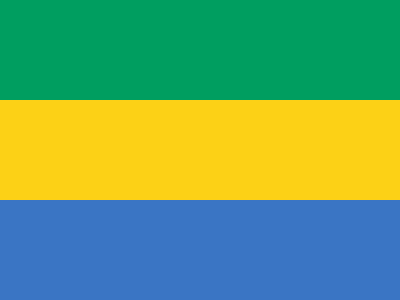
On 17 August 1960, Gabon, a country in west central Africa, astride the Equator. The Country gained independence from France. It shares common borders with Equatorial Guinea, Cameroon, Republic of the Congo and the Gulf of Guinea. Autocratic presidents ruled Gabon since independence. In the early 1990s, Gabon introduced a multiparty system and a new constitution that allowed for a more transparent electoral process and institutional reforms.
Gabon has a small population but abundant natural resources, and foreign private investment have helped, make Gabon one of the more prosperous sub-Saharan African countries. Gabon is Sub-Sahara's third largest producer and exporter of crude oil.
In Gabon's sprawling Forest, Archaeologists dig for ancient clues that could unlock the secrets of how prehistoric humans lived and interacted in the changing landscape of central Africa. Two billion Years ago, the Eastern Gabonese region of Lastoursvillewas covered by a vast ocean. Here you find an Area occupying 90 square kilometres. There are around 35 caves located in the dense primary Rainforests. They were formed some 50 million Years ago, and human activity has been shown to date back some 7000 years, when the caves were used in rituals. They are on the Tentative List for UNESCO World Heritage Status. Guides can be found in Lastoursville and ask at the Hotel Ngoombi. Be sure to wear suitable boots and take a waterproof torch,
As this Area has long given way to dense Forest withdolomite Cliffs, which aredotted with Caves. Scientists have unearthed traces of human life dating back to 25,000 years BC. Off the beaten track even for archaeologists, the Youmbidi Rock Shelter, which is a Cave typical of those chosen by prehistoric humans to set up their Homes, is the focus for French geoarchaeologist Richard Oslisly's team. Among their finds: 'a stone tool which could have been used for cutting or making fibers dating to before 10,000 BC. an arrowhead has also been unearthed, as has a collection of dolomite, quartz and jasper shards, cut up to 10,000 Years ago by the Cave's Inhabitants. "The vast majority of research in Africa has taken place in open landscapes such as the Sahara, Sahel or Egypt," said Oslisly, who has spent 45 Years, working in central Africa. "They said to me "there's nothing in the forest' (but) I took up the challenge of finding out what was happening there" he added.