

The original date of construction of the dwelling has not been definitely established but it is assumed that it was built, in its present form, by Willem Cornelis Boers, the notorious Cape Fiscal, who owned the estate between 1777 and 1782. Boers was reputed to have been a corrupt official who gained much of his wealth through extortion, and used government funds to develop this beautifully situated site. The house was a typical double storey flat-roofed town house of a type popular at the Cape during the mid-18th century, but it was designed on a grand scale and is larger than the average townhouse of its time. Its most distinctive features included a highly ornamented classical façade, a stoep with an overhanging balcony supported on four massive fluted teak columns with Corinthian capitals, and large cellars located beneath its teak floors. The front doors are surmounted by a decorative fanlight, and are believed to be the work of Anton Anreith. Typical of its time one enters the house from the stoep into a voorhuis, with reception rooms on either side. From there one passes through to the agterhuis which served as a dining room and opened out onto a rear courtyard. On one side of the courtyard were the kitchen and pantry while on the other were located the bedrooms. The upper floor was reached by means of a stair in the agterhuis, and comprised of a drawing room, bedrooms, a bathroom and a storeroom. Construction is on a massive scale, using teak for its beams and floors. Boers was recalled to Holland in 1783, and Rust en Vreugd came into the possession of OG de Wet, formerly Landdrost of Stellenbosch. From him it passed successively to Johannes Blesser, in 1798, and Ryno van der Riet in 1813. During the period of his governorship it was used by Lord Charles Somerset, and in 1828 became the property of the Hopper family. After this it passed into government ownership and was used as a residence by a number of educational facilities. It has since been restored and is now used as an art gallery. It was declared a National Monument under old NMC legislation on 1 November 1940.
Place record
Rust en Vreugd, Buitenkant Street, Cape Town
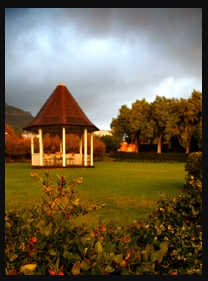
Garden of Rust en Vreugd Image source
- Coordinates
- -33.9299, 18.4198
- Updated
- 20 Jul 2026
Garden of Rust en Vreugd Image source
Location Map
Rust en Vreugd, Buitenkant Street, Cape Town
How we know this
- 019/2/018/0100
Last updated · 20 Jul 2026
South African History Online. (2011, July 14). Rust en Vreugd, Buitenkant Street, Cape Town. South African History Online. https://sahistory.org.za/nso/ref/P-0065754
South African History Online (2011) 'Rust en Vreugd, Buitenkant Street, Cape Town', South African History Online, 14 July. Available at: https://sahistory.org.za/nso/ref/P-0065754 (Accessed: 22 July 2026).
South African History Online, Rust en Vreugd, Buitenkant Street, Cape Town [website], https://sahistory.org.za/nso/ref/P-0065754, (accessed 22 July 2026).
"Rust en Vreugd, Buitenkant Street, Cape Town." South African History Online, 14 July 2011, https://sahistory.org.za/nso/ref/P-0065754. Accessed 22 July 2026.
South African History Online. "Rust en Vreugd, Buitenkant Street, Cape Town." South African History Online. July 14, 2011. https://sahistory.org.za/nso/ref/P-0065754.
Further reading
 Article
Cape Town the Segregated city
 Article
The Freedom struggle in Cape Town
 Article
Cape Town Timeline 1300-1997
 Article
Slave Resistance
 Article
Cape Youth Congress (CAYCO)
 Article
United Women’s Organisation (UWO)
SAHO is free because readers fund it. Donate →