
The property was originally part of the Leeuwenhof Estate and was developed in about 1820 by Johannes Zorn. It consisted of a gabled House which, together with a long Building serving as slave quarters and stables placed at right angles to it, and a high garden wall enclosing its courtyard, was occupied by the farm manager.Known as The Grove, it was let to William Sampson while its slave quarters and stables were converted to a dwelling which was let to a German botanist called Werner. The buildings continued to be rented out to various tenants until 1952 when they were bought by the HMC, at which stage the property became known as Bo-tuin. It was declared a National Monument under old NMC legislation on 11 September 1964.
placeREF P-0065796Revised
Place record
Bo-tuin, Hof Street, Gardens.
- Coordinates
- 18.4100, 33.9500
- Updated
- 20 Jul 2026

An Aerial view of the Suburb of Gardens Image source
Location Map
Bo-tuin, Hof Street, Gardens.
South African History Online. (2011, July 14). Bo-tuin, Hof Street, Gardens.. South African History Online. https://sahistory.org.za/nso/ref/P-0065796
South African History Online (2011) 'Bo-tuin, Hof Street, Gardens.', South African History Online, 14 July. Available at: https://sahistory.org.za/nso/ref/P-0065796 (Accessed: 22 July 2026).
South African History Online, Bo-tuin, Hof Street, Gardens. [website], https://sahistory.org.za/nso/ref/P-0065796, (accessed 22 July 2026).
"Bo-tuin, Hof Street, Gardens.." South African History Online, 14 July 2011, https://sahistory.org.za/nso/ref/P-0065796. Accessed 22 July 2026.
South African History Online. "Bo-tuin, Hof Street, Gardens.." South African History Online. July 14, 2011. https://sahistory.org.za/nso/ref/P-0065796.
Further reading
 Article
Cape Town the Segregated city
Contents
Early settlement patterns of exclusion
Towards racial segregation
Segregated city
Conclusion
Once the....
 Article
The Freedom struggle in Cape Town
Cape Town has a long history of the struggle against racial discrimination and social injustice.
 Article
Cape Town Timeline 1300-1997
Photograph of a Khoisan lady. Source: unknown
1300-1599
c.1300-c.1500
The Khoisan are established as the...
 Article
Slave Resistance
Slavery was introduced to the Cape Colony by the VOC in its desire to boost the agriculture and food supply while...
 Article
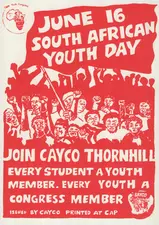
Cape Youth Congress (CAYCO)
Together with civic organizations, the youth played an in important role in the struggle against apartheid in the...
 Article
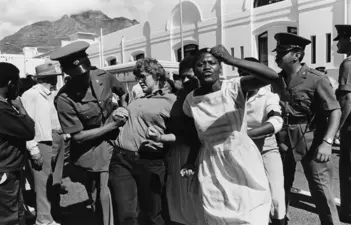
United Women’s Organisation (UWO)
The United Women’s Organisation (UWO) was launched in April 1981 with 400 delegates from the Western Cape attending.
SAHO is free because readers fund it. Donate →