This period began with the intensification of the anti-pass campaign, which resulted in the banning of the ANC and the PAC following the Sharpeville Massacre. In response to the banning, the parties were forced to set up underground structures and networks to continue with their political activities. The period also saw the continuation of the 1956 Treason Trial to its conclusion in 1961. That same year, the ANC and SACP jointly set up uMkhonto we Sizwe (MK) to engage in the armed struggle.
A number of high profile arrests – such as those of members of the MK High Command at Liliesleaf Farm which led to the Rivonia Trial, and other prominent MK operatives in the Little Rivonia trial – severely crippled the armed struggle. In addition, the ANC worked on establishing itself in exile, working closely with countries and individuals who were sympathetic to the anti-apartheid cause. Towards the end of the decade, the ANC held the Morogoro Consultative Conference and adopted the ‘Strategy and Tactics’ document as a way of giving new impetus to the struggle.
1960
Both the
African National Congress (ANC) and the
Pan Africanist Congress (PAC) take up anti-pass campaigns.
1960
The Anti-Apartheid Movement (AAM) is formed in Britain with the re-naming of the Boycott Movement. The AAM is an umbrella organisation that took a strong moral stand against apartheid and white supremacy in South Africa, operating as an instrument of solidarity with the liberation struggle. It embraced a network of organisations including student bodies, trade unions, the Communist Party and sections of the British Labour Party. After the banning of the ANC in 1960 and the reconstruction of its mission in exile, the ANC formed a strategy of establishing productive working relationships with organisations in the West such as the AAM.
1960
February/March, The
Pondoland Revolt, an uprising against the imposition of Bantustans and the opposition to the system of Black authorities takes place in the Transkei.
1960
14 March, The defense team opens their case in the
Treason Trial.
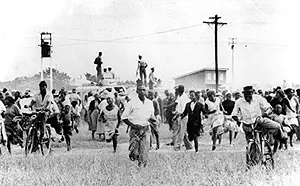
196021 March, In a peaceful anti pass march led by the PAC at Sharpeville, the police open fire on the unarmed and peaceful crowd, killing 69 and wounding 186 in what becomes known as the
Sharpeville Massacre. Two others were killed, and 49 were wounded in Langa, Cape Town. The Sharpeville massacre “signalled the start of armed resistance in South Africa.”
1960
28 March, The ANC calls for a nation-wide strike in protest of the Sharpeville massacre. Pass books are burned in countless bonfires. At one of the events
Chief Albert Luthuli publicly burns his pass.
1960Oliver Tambo leaves South Africa illegally on the instruction of the ANC to carry out the organisation’s work outside the country.
1960
30 March, The government declares a State of Emergency and arrests over 2 000 people. At lunchtime, an estimated group of between 30 000 and 50 000 Africans from surrounding African townships march into the centre of Cape Town led by
Phillip Kgosana and demand an interview with the Minister of Justice. The Chief of Security promises to approach the Minister and the crowds march out of Cape Town. Immediately after they disperse, Erasmus announces in Parliament that a State of Emergency has been declared in 80 of the 300 magisterial districts, including every important urban area, and that 18 regiments of the Citizens Force have been mobilised to supplement the police, army and air force.
1960
Chief Albert Luthuli is detained and held until August, when he is tried. He is given a six-month suspended sentence and fined £100.
1960
7 April, The
Unlawful Organisations Act No. 34 comes into effect. Under this Act any organisation deemed a threat to the public can be declared unlawful by the government.
1960
8 April, The government announces that the ANC and the PAC have been banned under newly passed the Unlawful Organisations Act.
1960
12 April, An intelligence report records the arrival of Oliver Tambo in Francistown from where he is to make the journey to Tanganyika.
1960
August,
Bram Fischer undertakes one of his most significant acts as an advocate, leading the evidence of
Robert Resha.
1960
24 August,
Geraldine Fraser-Moleketi, trade unionist, ANC member and Minister of Public Service and Administration after 1994, is born in Lansdowne, Cape Town.
1960
26 August, The state of emergency, declared after the Sharpeville Massacre, is lifted.
1960
7 October, Bram Fischer closes the case for the defense in the Treason Trial.
1961
The
South African Communist Party (SACP) and ANC members meet underground in Durban. At the meeting they decide to launch
Umkhonto we Sizwe (MK), a military branch separate from the ANC, but jointly led by the ANC and SACP.
1961
25-26 March, The All-in African Conference is held in Pietermaritzburg and attended by 1 400 delegates representing 145 religious, cultural, peasant, intellectual and political bodies. The conference calls for a national convention of elected representatives. The conference also elects
Nelson Mandela as secretary of the National Action Council.
1961
29 March, The accused in the Treason Trial are found not guilty, after a four year long trial.
1961
1 April, Robben Island is turned into a prison for those convicted of political crimes.
1961
27 April,
Walter Sisulu and his home at Orlando West are searched and various documents are seized, in which Africans are instigated to strike on 29, 30 and 31 May 1961. A case in compliance with Section 2 (A) of the Act 8/1953 (Instigation) is made against him.
1961
29-31 May, A Nation-wide Stay-At-Home, organized by the ANC, takes place. The PAC calls for non-Whites to ignore the stay-at-home. It is estimated that more than 40% of the labour force on the Rand stay at home.
1961
31 May, South African becomes a republic and the country’s membership of the Commonwealth simultaneously expires. A nation-wide strike is held in protest against the
establishment of the Republic of South Africa. 1961
June,
Billy Nair is arrested and charged with incitement to strike during the May Stay-At-Home, three hours after he is given a five-year banning order preventing his movement outside the Durban magisterial district and prohibiting him from entering a factory, African location, hostel or village.
1961
8-10 July, The Malmesbury Convention of Coloured Leaders is held. The convention seeks to foster unity between Coloureds and Africans.
1961
October,
Dr. Yusuf Dadoo and
Moses Kotane visit Moscow and are invited to attend the 22nd Communist Party of the Soviet Union Congress.
1961
28 October, Walter Sisulu attends a gathering in the form of a welcome party at the house of
Lilian Ngoyi. Sisulu together with Lilian Ngoyi and
Alfred Nzo are arrested and charged under inter alia section 9(1) of Act 44 of 1950. The case is later withdrawn because sufficient evidence could not be supplied to prove that the party was in fact a meeting.
1961
11 December, Chief Albert Luthuli, the ANC President is awarded the 1960 Nobel Peace Prize in Oslo.
1961
16 December,
Umkhonto we Sizwe (MK, ‘The spear of the nation’), the armed wing of the ANC, announces its existence through a series of bomb blasts against government structures and installations in Johannesburg, Port Elizabeth and Durban. One of its aims was to "hit back by all means within our power in defence of our people, our future and our freedom".
1961
20 December, The National Committee of Liberation (NCL) and the MK carry out a joint operation to blow up a power pylon (to be carried out by the NCL) and sabotage a telecommunications substation (to be carried out by the MK). The substation attack fails and only two legs of the pylon are blown up.
1962
January, Nelson Mandela secretly leaves South Africa to make a surprise appearance at the Pan African Freedom Movement Conference in Addis Ababa. He travels to other countries to receive military training and then comes back into the country to continue operating underground.
1962
1 February, A statement by Chief Albert Luthuli entitled ‘We don’t want crumbs’ appears in the New Age. In it he unequivocally rejects the governments’ homeland policy.
1962
July, Nelson Mandela returns to South Africa and travels to Stanger, Natal to meet with Chief Albert Luthuli who was banned at the time.
1962
15 July,
Ebrahim Rasool, future Premier of the Western Cape, is born in Cape Town.
1962
5 August, Nelson Mandela is arrested just outside Howick, Natal after the police receive a tip-off of his location by a CIA agent based in Durban.
1962
October, ANC conference takes place in Lobatsi, Botswana.
1962
Chief Albert Luthuli is appointed rector by the students of Glasgow University in recognition of his ‘dignity and restraint in a potentially inflammatory situation’.
1962
7 November, Nelson Mandela is sentenced to five years in prison for incitement and illegally leaving the country.
1962
10 December, Chief Albert Luthuli and
Dr. Martin Luther King Jnr issue a joint statement ‘
Appeal for Action Against Apartheid’
1963
January, Moses Kotane leaves South Africa for Dar es Salaam to assist Oliver Tambo. He is accompanied by
Duma Nokwe. During a mission for the ANC, Moses Kotane meets Kwame Nkrumah, president of Ghana.
1963
February, After
Chris Hani and Archibald Sibeko sentence is confirmed it is decided that they should go into hiding until a group could be assembled for the journey into exile.
1963
May, Chris Hani begins his journey into exile first travelling to Soweto where he stays with a family sympathetic to the struggle. A few weeks later the group leave for Bechualand and then to Northern Rhodesia (Zambia). However, on reaching Lusaka Chris Hani, along with the rest of the group, is arrested. After a brief court appearance the men are freed and taken by the United National Independence Party (UNIP) to the border with Tanganyika.
1963
June-6 August,
Albertina Sisulu becomes the first woman to be arrested under the General Laws Amendment Act and is held in solitary confinement.
1963
26 June, Walter Sisulu makes a
broadcast on a clandestine ANC Radio station.
1963
6 July,
Robert McBride, political activist, ANC member and future chief of Ekurhuleni Metro Police, is born in Durban.
1963
11 July, Acting on information provided by Gerard Ludi, police raid Lilliesleaf Farm in Rivonia, Johannesburg. Virtually the entire leadership of the MK – Walter Sisulu,
Govan Mbeki,
Raymond Mhlaba,
Ahmed Kathrada,
Lionel Bernstein and Bob Hepple – is arrested.
1963
3 August, Police arrest saboteur Bruno Mtolo who later becomes the prosecution’s main witness in the Rivonia Trial.
196311 August, Harold Wolpe, Arthur Goldreich,
Moosie Moolla and Charlie Jassat escape from Pretoria Central Prison after bribing a young prison warder.
1963
28 August, Harold Wolpe and Arthur Goldreich arrive in Francistown, Bechuanaland Protectorate from Swaziland. From there they go into exile in London.
1963
5 September,
Looksmart Ngudle dies while being held in detention. The Special Branch reports that he had committed suicide by hanging himself.
1963
9 September, To prevent an inquest into the circumstances of Looksmart Ngudle’s death, the state places a banning order on him, as a banned person cannot be quoted. As a result he becomes the first person to be banned after his death.
19639 October, 11 accused including those arrested at Lilliesleaf Farm, are brought to court in what becomes known as the
Rivonia Trial. While serving his 5 year sentence, Nelson Mandela is also charged in the Rivonia trial. The offences alleged are: (1) recruiting persons for training in the preparation and use of explosives and in guerrilla warfare for the purpose of violent revolution and committing acts of sabotage, (2) conspiring to commit the aforementioned acts and to aid foreign military units when they invaded the Republic, (3) acting in these ways to further the objects of communism, and (4) soliciting and receiving money for these purposes from sympathizers in Algeria, Ethiopia, Liberia, Nigeria, Tunisia, and elsewhere.
1963
29 October, Justice De Wet rejects the first indictment against the 10 accused in the Rivonia Trial. A new indictment is served on the 10 accused alleging two counts of sabotage.
1963
29 October, a motion was taken to quash the indictment against the 11 accused.
1963
30 October, Bob Hepple’s charges are withdrawn and is conditionally released. Justice De Wet rejects the first indictment against the 10 accused in the Rivonia Trial. A new indictment is served on the 10 accused alleging two counts of sabotage.
1963
November, Along with 30 other MK cadres, Chri Hani arrives in Moscow, USSR for further military training.
1963
25 November, Bob Hepple escapes with his wife Shirley to Bechuanaland Protectorate then to the ANC in Dar es Salaam. From there they go into exile in London.
1963
3 December, The Rivonia Trial begins again with a second indictment. The defendants enter ‘not guilty’ pleas. The prosecutor, Percy Yuter presents the opening statement.
1963
10 December, Bruno Mtolo takes the stand in the Rivonia Trial.
1964
4 March, The prosecution rests its case in the Rivonia Trial
1964
20 April, As part of the defense opens its case Nelson Mandela's makes the statement, ‘
I am prepared to die’, from the dock.
1964
May, Minister of Justice,
B.J. Vorster, serves Chief Albert Luthuli with yet another five-year ban confining him to his home in Groutville.
1964
20 May, Closing statements in the Rivonia Trial begin.
1964Z.K. Matthews makes a speech, entitled ‘
The Road From Non-Violence to Violence’ at a conference in Kitwe, Northern Rhodesia (now Zambia), sponsored by the World Council of Churches.
1964
31 May, Albertina Sisulu is served with a five-year banning order which restricts her to the magisterial district of Johannesburg, prevents her from visiting any area where Black people lived and communicating with any listed or banned person except her husband.
1964
12 June, The Rivonia Trial ends. Nelson Mandela,
Walter Sisulu,
Govan Mbeki,
Elias Motsoaledi,
Andrew Mlangeni, Raymond Mhlaba and Dennis Goldberg are found guilty on all four charges and sentenced to life imprisonment. Ahmed Kathrada is found guilty on one charge of conspiracy while Lionel Bernstein is found not guilty. He is later rearrested, released on bail, and placed under house arrest.
1964
26 July, A new refugee centre in Francistown, built to replace the old transit centre for political activists, is bombed. No one is injured but the building is completely destroyed.
1964
September, Specialized training in guerrilla warfare is organized for the higher levels of the ANC and SACP leadership, including Oliver Tambo, Moses Kotane, Duma Nokwe, Joe Slovo and Ambrose Makiwane.
1964
November, Chris Hani and the 30 cadres return to Dar- es Salaam.
1964
The ANC leadership is offered a piece of land at Kongwa, 400 kilometres south of the Der es Salaam, for use by MK. Chris Hani is put in charge of setting up the camp.
1964
November, The trial known as Little Rivonia commences in which Laloo Chiba, Dave Kitson, Mac Maharaj, John Matthews and Wilton Mkwayi are charged with sabotage. Lionel Gay one of the accused turns state witness; subsequently charges against him are dropped.
1964
6 November,
Vuyisile Mini, Wilson Khayinga and Zinakile Mkhaba, SACTU leaders, are sentenced to death and
executed.
1965
Jackson Fuzile, a member of the MK regional command and ANC committee in Port Elizabeth, is brought to trial for arranging the departure of ANC members from the country.
19655 January,
Mac Maharaj, Laloo Chiba, Raymond Nyanda and
Andrew Masondo arrive at Robben Island. Nyanda was suspected of being a police informer planted to obtain information from political activists imprisoned on Robben Island.
1965
February, Michael Dingake leaves South Africa for Botswana. From Botswana he organises infiltration routes from Zambia into Botswana for MK operatives.
1966
Chris Hani is moved to Zambia where he is responsible for setting up a joint training programme with ZAPU before their entry into Rhodesia in what would later become the known as the Wankie campaign. While trying to re-enter Botswana Chris Hani is arrested and detained for two weeks before being sent back to Lusaka.
1966
Michael Dingake is kidnapped on his way to Lusaka and transferred to Pretoria. After being tortured he is indicted for being a member of and carrying out activities for the banned ANC and SACP. He is sentenced to 15 years and sent to Robben Island.
1966
23 August, A paper on apartheid is presented on behalf of the ANC to the United Nations Human Rights (UNHR) Seminar on apartheid, held in Brazil, 23 August-5 September.
1966
6 September, Prime Minister
Dr. Hendrik Verwoerd is stabbed in the neck and chest by Dimitri Tsafendas. The Prime Minister is rushed to Groote Schuur but is declared dead on arrival.
1966
13 September,
B.J Vorster succeeds Dr. Hendrik Verwoerd as the eighth Prime Minister of South Africa.
1967
Chris Hani travels to Swaziland to secretly meet Gasson Ndlovu, head of
Poqo, to discuss possible co-operation with the MK.
196721 July, Chief Albert Luthuli is struck by a train while walking on a railway bridge close to his home in Stanger, Natal. Oliver Tambo becomes acting president of the ANC.
1967
23 July, Three thousand people gather at the church in Groutville to attend Chief Albert Luthuli’s memorial service. Nokukhanya Luthuli unveils a memorial stone that had been erected over his grave.
1967
July-September, MK begins a joint campaign with ZIPRA, a people's army fighting for the liberation of Rhodesia (later
Zimbabwe) in what becomes known as the
Wankie Campaign.
1967
2 August, Chris Hani’s contingent is named the Luthuli Detachment by Oliver Tambo in honour of Chief Albert Luthuli. They are sent into the Wankie Game Reserve (Hwange National Park) on their first covert mission.
1967
13 August, The Luthuli contingent is engaged in their first battle against the Rhodesian army in which they successfully force the army to retreat.
1967
25 August, The Luthuli contingent experience another victory and they decide to start the march towards the Botswana border.
1967
September, The MK soldiers are arrested by the Botswana security force. They are sentenced to between one and six years for weapons possession.
1968
Attempts at opening the “Eastern Front” in Zimbabwe are made, after fierce encounters; ANC-ZAPU units are forced to withdraw to Zambian territory.
1968
16 June, The ANC issues a pamphlet entitled ‘
We are at War!’
1968
18 June, Oliver Tambo delivers a speech, entitled ‘
Need for new level of international action against apartheid’, to a special session of the UN’s Special Committee Against Apartheid in Stockholm, Sweden.
1968
13-16 September, At the fifth session of the Assembly of Heads of State and Government of the OAU, in Algeria, Oliver Tambo delivers a joint speech by leaders of Liberation Movements, entitled ‘
We shall win’.
1969
The ANC opens its membership to include White people.
Jack Simons and
Ray Alexander Simons are amongst the first White people to become members of the ANC.
1969Winnie Madikizela-Mandela is placed in solitary confinement at Pretoria Central Prison for 17 months under the Terrorism Act.
1969
1 January, Moses Kotane suffers a severe stroke and is taken to Moscow for treatment. As a result
J.B. Marks becomes SACP Party Chairman.
1969
February-March, The trial of
Dorothy Nyembe and 11 others takes place in the Supreme Court on charges of conspiracy to overthrow the existing order of the Republic of South Africa. Of the 12 accused, 11 including Nyembe are found guilty under Terrorism Act.
1969
25 April-1 May, The ANC holds the Morogoro Consultative Conference in Tanzania. The ANC was involved with internal wrangles over strategy and tactics. In convening the conference the ANC’s leadership conceded that there were reasonable grounds for discontent within MK and far-reaching reforms had to be adopted in order to redirect the war effort. Both armed struggle and mass political struggle are to be used to defeat the enemy, which depended on building ANC underground structures within the country. At the conference the document entitled ‘
Strategy and Tactics’ is adopted.
1969
12 May-June, A country-wide swoop by the police takes place, with political activists and family members of political prisoners being detained in Johannesburg, Pretoria, Cape Town, Durban, Port Elizabeth, Cradock and Pietermaritzburg. The Commissioner of Police stated that those in custody were being held in connection with the activities of the ANC.
1969
July, Albertina Sisulu’s five-year banning order is renewed and extended to include partial house arrest.
1969
December, Twenty-two of the detainees arrested in the May-June swoop are charged under the Suppression of Communism Act.
1969
16 December, Oliver Tambo makes a broadcast, entitled ‘
Capture the Citadel’, to South Africa on the eighth anniversary of the formation of the MK.