
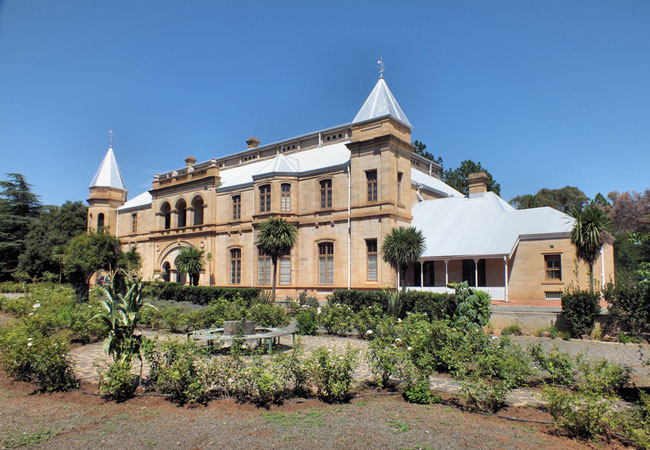
This building served as the official residence of the presidents of the former Republic of the Orange Free State, it was declared a National Monument under old NMC legislation on 27 January 1938. It had very humble begginings, when a Trekboer family, with the surname of Brits. Settled on the site in the 1820s and built a thatched A-frame dwelling for themselves. Major Henry Douglas Warden (then the British resident for the area North of the Orange River) purchased it from the Brits family in 1846. The thatched-house built by the Brits family was demolished and the house Warden, erected began as a small farm building which was made out of sun-dried bricks. In 1854, The British Government abandoned the Orange River Sovereignty and the Boer Republic then took over the residence. This independence saw the new Presidents of the Republic take up quarters in the "Residency", reportedly Presidents Josias Philip Hoffman, Jacobus Nicolaas Boshoff and Marthinus Wessel Pretorius. They all lived in the dwelling during their terms in office. In 1860, the Volksraad approved plans for a new Presidency house. At that time, the Volksraad could only afford £800 for the restoration of the old residency. Additional repairs were carried out in 1864 and 1874. In the early 1880s the Volksraad decided that the cost of maintenance was unfeasible and that the building was no longer suitable as the official residence of the Head of State of an Independent Country. Thus in 1882, President Johannes Brand submitted plans for a competition to design the 'new' Presidency to the Volksraad. There were in total 27 proposals submitted in 1884 for the prize money of £100. An international architectural competition was held and won by English architects – Lennox Canning and F Goad of Canning & Goad Architects. The construction of the building was budgeted at £10,000, but the design submitted by Canning was too sophisticated and even after being asked to simplify their design, it still amounted to £12, 200. With some reluctance, this was accepted. The excavation of new foundations for the new building was deemed too costly, subsequently it was decided to build the new building on the foundation of the old one. Construction started on 22 May 1885, when the foundation stone was laid, and the building was completed in 1886 with President Brand taking up quarters until his death in 1888. Presidents F.W. Reitz (1888–95) and M.T. Steyn (1896-1900) also resided in the building until the British occupation of Bloemfontein on 13 March 1900 when the building served as the headquarters of Field-Marshal Lord Roberts during the Second Anglo-Boer War.
Place record
Old Presidency
- Coordinates
- -29.1190, 26.2150
- Updated
- 18 Apr 2019

Old Presidency Image source
Location Map
Old Presidency
How we know this
- 01https://www.sa-venues.com/things-to-do/freestate/old-president-museum/
Last updated · 18 Apr 2019
South African History Online. (2011, July 14). Old Presidency. South African History Online. https://sahistory.org.za/nr/ref/P-0065657
South African History Online (2011) 'Old Presidency', South African History Online, 14 July. Available at: https://sahistory.org.za/nr/ref/P-0065657 (Accessed: 22 July 2026).
South African History Online, Old Presidency [website], https://sahistory.org.za/nr/ref/P-0065657, (accessed 22 July 2026).
"Old Presidency." South African History Online, 14 July 2011, https://sahistory.org.za/nr/ref/P-0065657. Accessed 22 July 2026.
South African History Online. "Old Presidency." South African History Online. July 14, 2011. https://sahistory.org.za/nr/ref/P-0065657.
Further reading
 Place
Place
Koopmans de Wet House, 35 Strand Street, Cape Town
 Place
Place
Oudtshoorn, Western Cape
 Place
Place
Sol Plaatje University
 Place
Place
Namibia
 Place
Place
Greyton, Western Province
 Place
Place
Tulbagh, Western Cape
SAHO is free because readers fund it. Donate →