1912
18 May, Walter Ulyate Max Sisulu is born in Engcobo District in the Transkei, in the same year, the ANC was formed.
1920
Walter returns from his aunt Agnes’ home at Cofimvaba, Transkei, about 30 miles from his mother’s home at Qutubeni. For a long time during his early life, Walter’s mother Alice had to work away from home. Walter tended cattle, sheep and goats like any peasant youth.
1920
Early s Walter is exposed to a mediated version of Marcus Garvey’s Pan-African liberation for black people via village meetings arranged by Wellington Buthelezi, a visiting Natalian who assumed an American identity.
1927
Sisulu leaves school at the age of 15. His mother works in faraway East London, and Dyantyi Hlakula, a family figure who was a point of identity and stability for Walter, dies.
1928
At the age of 16, Walter uses an older cousin’s identity to be accepted as a migrant labourer by the mine recruitment office. Sisulu travels 1000 kilometres to Johannesburg by train, only to be judged too young for underground work on his arrival. A compromise is struck where he is released from his contract by a relative, and works for a dairy farmer delivering milk to the mine. he attends various educational organizations. He later became secretary of the "Orlando Brotherly Society", a Xhosa organization, which prompted an interest in tribal history and encouraged economic independence from whites.
1929
After a quarrel he is beaten badly by his employer, and on reporting it to the police, receives further abuse. Other jobs as domestic worker, dormitory sweeper follow. Tired of city life, Walter returns home and once back in the Transkei, undergoes a traditional Xhosa initiation rite.
1930
Again a migrant, Walter returns to Johannesburg to reluctantly work 9 hour days loading ore underground in a gold mine. After a cave-in killed several miners in the shaft which he usually worked, a depressed Walter was transferred above ground. A strike threat over poor conditions led to concessions, and Walter has his first experience of organized industrial action.
1931
At mid-year, some time after his 120-day contract expires, Walter returns home to the Transkei. Finding domestic work in a liberal household in East London, Walter vainly attempts to meet the ANC’s founder, Walter Rubusana. Also influenced politically by Booker T Washington’s Up from Slavery, and culturally by the writing of WEB du Bois.
1932
Sisulu returns again to his village, Qutubeni, delivering a parcel to the son of a white stranger he met in East London. Typically, he is received with disdain by the recipient, a white pharmacist.
1933
Returning to Doornfontein, Johannesburg and staying with his washerwoman mother, Walter finds work at a bakery. Unbeknown to Sisulu at the time, a neighbour is Joe Slovo. Attends night school at the Bantu Men’s Social Club and takes driving lessons, getting to know the city better.
1934
The Slum Clearance Act affects Walter and his mother, amongst thousands of Black inner-city residents. He is forced to move to Orlando, which is later part of Soweto. Conditions are far from the promises made by the local government.
1936
Walter initiates a higher wage strike at Premier Milling Company, which is dissolved and he leaves. Suffers pass book and other police harassment and resolves to “suffer under the system until I have defeated it”. Works temporarily at Bantu World, a newspaper run by Selope Thema, a founder member of the ANC and a fine journalist. Also finds various clerical jobs, including with the Johannesburg municipality enumerating the population census.
1938
Finds employment at Union Bank of South Africa as a marketing agent, persuading potential clients to open accounts. This affords him contact with a wide range of people. By chance he has contact with Communist Party member Rusty Bernstein, who loans him the first piece of left literature which Walter read, Stalin’s 1913 article on the National Question. Meets Govan Mbeki, then a student at Fort Hare, after reading his The Making of the Transkei, and also Kaizer Matanzima, the Thembu chief.
1940
After putting himself through school while working as a houseboy, Sisulu starts working as an estate agent. He is formally recruited into the ANC by trade unionist Alfred Mbele. At the centre of ANC affairs from this year until arrest his arrest for suspected treason in1963 in Rivonia.
1941
Mandela and Sisulu first meet, at Walter’s office. Having avoided an arranged marriage in the Transkei, Mandela is in Johannesburg, finding his feet. Sisulu helps him find a job in his chosen career, law.
1942
December, Meets Pixley Seme, one of the founding members of the ANC, on a train bound for the ANC annual conference in Bloemfontein.
1943
Again attends the ANC annual conference, at which the organization is modernized, abolishing the House of Chiefs, the branch is elevated as a basic unit of the organization, full equality extended to women members and the women’s section is formed.
1944
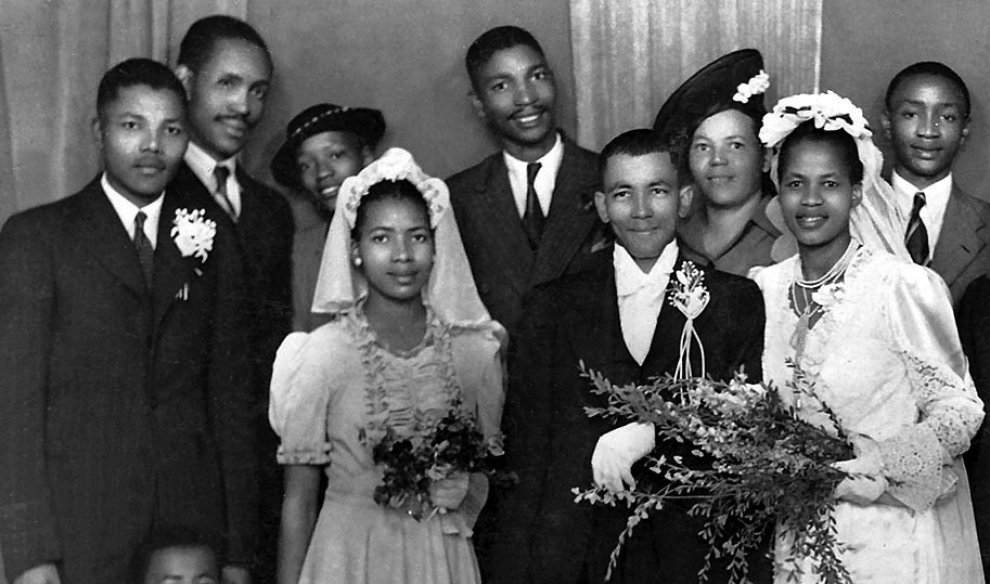
15 July, Walter and Albertina Sisulu were married on 15 July 1944 in a civil ceremony at Cofimvaba in the Transkei. Anton Lembede warns Albertina that she is marrying a man who is already married to the nation.
1944
17 July, The wedding was followed by a reception at the Bantu Men's Social Centre in Johannesburg on 17 July.
1944
11 September, With Nelson Mandela, Walter is the co-founder of the ANC Youth League, and is appointed its Treasurer.
1946
While the mass action of the African Miner’s strike is brutally suppressed during a meeting between the Native Representative Council and Smuts, Walter and the ANC YL become impatient with the “toy telephone” of the NRC. The ANC Youth League decides to actively support the strikers. Walter plays a key role in re-shaping the ANC after WW2.
1948
The election victory of the Nationalist government precludes democracy and Walter and other ANC members seek new ways to fight injustice and oppression.
1949
Appointed the first full-time Secretary General of the ANC, a position he held from 1949 to1954. At the same congress, the military Programme of Action was adopted. This would become a major impetus to transforming the ANC from a reactive, protest movement to a mass organization. It was at this shift in South African history that Sisulu led his political home.
1950
January, The ANC, together with its alliance parties, initiates the Defiance Campaign.
1950
"South Africa Behind Bars" a text prepared by Sisulu, is handed out among the representatives of the different countries during the session of the U.N.O.
1950
May, At a Johannesburg congress of the ANC, African People's Organization, South African Indian Congress and the Communist Party of South Africa, Sisulu is chosen to act as secretary and organizer of the National Protest Committee together with Y.A. Cachalia. They have to see to it that the resolution made at the congress is implemented, namely that all non-whites were to stay away from their work on 26 June 1950.
1950
18 June, Sisulu addresses a meeting at New Brighton, Port Elizabeth and tells the blacks about the decision that everyone should stay away from their work on 26 June 1950 as a sign of protest against the "Notorious Bill of the Malan Government".
1950
20 August, Sisulu officiates as speaker in a meeting which is held in Lady Selborne, a non-white township in Pretoria.
1950
30 September - 2 october, Sisulu speaks at the congress of the Transvaal branch of the ANC, held at Springs.
1950
6 December, Sisulu acts as one of the speakers at a meeting of the South African Peace Movement in the Ambagsaal, Johannesburg. The other speakers are Dr. Dadoo and Michael Harmel.
1951
March, Sisulu is in contact with the secretary of the National Council for Nigeria and the Cameroon in Accra.
1951
29 July, Sisulu attends a secret meeting of representatives of the ANC and South African Indian Congress in Johannesburg. At this meeting it is decided that the second phase of the resistance campaign will commence during 1952. An ultimatum has to be addressed to the Government to repeal all discriminating Legislation before or/on 29 February 1952, and if this does not take place a mass contravention of such Legislation will be launched in all sections of the country. The date upon which the campaign will begin is set for 6 April 1952 so that it can coincide with the beginning of the Van Riebeeck festival.
1951
December, Sisulu, Dr. Dadoo, J.J. Marks and Y.A. Cachalia (all members of the Joint Planning Council) together with R.T. Chari, former secretary of the Indian High Commissioner in the Union, visit Basutoland. They have discussions there with black headmen about the inauguration of the Protectorate by the Union.
1952
Sisulu travels through the country to organise for the resistance campaign and addresses numerous meetings. Among others, Sisulu visits Bloemfontein, Kimberley, Cape Town and Port Elizabeth.
1952
Sisulu elected with Yusuf Cachalia (TIC) as joint secretary of the national Action Council that courted volunteers for the Defiance Campaign. Walter partners with Nana Sitha as leader of the Defiance Campaign, which saw 8500 volunteers sent to prison.
1952
6 April, Sisulu is one of the speakers for a meeting which is described as a "People's Protest Day Rally" and outlines the "Plan of Action". The following people also officiate as speakers, Dr. Y.M. Dadoo, D. Ilsome, James Phillips, Moses Kotane and D. Bopape.
1952
21 April, Sisulu, Dr. Y.M. Dadoo, A.M. Dadoo and Y.A. Cachalia are detained at Idutywa in the Transkei, because they entered the area without the necessary permission.
1952
9 June, Sisulu speaks at a meeting of the ANC and South African Indian Congress in Johannesburg.
1952
12 August, Sisulu and others are arrested on a charge under the Suppression of Communism Act.
1952
2 December, For continuing to organize, Sisulu is convicted a second time and sentenced to 9 months imprisonment, conditionally for suspended for 3 years. He risked 10 years in prison.
1952
17 December, Sisulu is served a notification, in terms of section 9 of the Suppression of Communism Act, whereby Sisulu is prohibited, for a period of six months, from attending any meeting in the union.
1953
15 July, Sisulu and P.P.D. Nokwe, a former teacher and member of the ANC, go overseas under false names and without passports.
1953
21 July, Sisulu and Nokwe arrive in London, England. From there they go to Bucharest, Romania, where they attend the communist "World Festival of Youth and Students for Peace and Friendship". After this Sisulu and Nokwe embark on an extensive tour through the countries behind the iron curtain as guests of the Communists. Sisulu and Nokwe travel through Czechoslovakia, Poland, Russia and Communist China.
1953
December, After an absence of five months, Sisulu and Nokwe return to the Union.
1953
18-20 December, Sisulu attends the 41st annual conference of the ANC at Queenstown. Here it is decided to begin with the boycott campaign.
1954
6 February, Sisulu addresses an ANC meeting in Durban and gives a comprehensive account of his travel through Russia and Communist China.
1954
9 February, Sisulu acts as speaker at a meeting of the "South African Society for Peace and Friendship with the Soviet Union" which is held in the Ambagsaal, Johannesburg. Sisulu talks of the way in which Communism has been implemented in Russia and China
1954
11 March, Sisulu addresses an ANC meeting in Port Elizabeth. Sisulu talks in detail about his trip to Europe and of everything he saw and experienced there.
1954
19 March, Sisulu flies to Durban, to discuss the possibility of extending the boycott campaign to Natal with ANC leaders.
1954
28 March, Sisulu acts as speaker during a meeting of the ANC at Veeplaats. Sisulu speaks of the successes of the strikes and the co-operation of the black community in this connection.
1954
1 April, Sisulu addresses a meeting of the ANC in Cradock.
1954
4 April, Sisulu addresses a meeting in Queenstown.
1954
11 April, Sisulu acts as speaker at a meeting of the ANC in Sophiatown, Johannesburg. Sisulu urges the blacks not to allow themselves to be removed from the Western areas.
1954
1 May, Sisulu acts as speaker at an ANC meeting in the Alexandra Township area, Johannesburg. The same day Sisulu also addresses a meeting under cover of the Transvaal Council of Non-European Trade Unions in the Ambagsaal, Johannesburg.
1954
9 May, Sisulu makes the following statement at an ANC meeting in Newclare, Johannesburg, "We are educated people, the Nationalist and United Party Leaders can come and take lessons from us", as well as ,"the white people's time has expired. The Africans are now going to rule. We are not going to Meadowlands".
1954
20 June, Sisulu attends the annual conference of the ANC branch of the Cape Province at Uitenhage. Sisulu officiates as secretary of the "National Action Council of the Congress of the People".
1954
26-27 June, Sisulu speaks at the meeting of the ANC in the Communal Hall in the Western black township area of Johannesburg. Among others, Sisulu said the following, "We need 5 000 volunteers but we must get them before the removal of the "black spots" begins, they must then be ready.
1954
11 July, Sisulu attends a massive meeting of the ANC in Sophiatown, Johannesburg.
1954
23 July, Sisulu is served two notifications, in terms of Section 5 of the Suppression of Communism Act (Act 44 of 1950). Sisulu is herewith commanded to resign as member, official or office-bearer from certain organisations and not to take part again in the activities thereof, and is also prohibited from attending any gathering at any place within the Union of South Africa or the area South West, for a period of two years.
1954
24 July, Sisulu is taken into custody in the Bochabella location, Bloemfontein, on a charge under the Suppression of Communism Act. Sisulu attends a gathering there in spite of the notice that had been served on him.
1954
26 July, Sisulu appears before the Magistrate in Bloemfontein and is released on £50 bail. The case would serve before the Supreme Court Bloemfontein during August 1955.
1954
14 August, Sisulu attends a secret ANC meeting in Durban. This meeting is held during a conference of the "Congress of the People" which is held over the weekend 13 - 16 August 1954.
1954
20 August, Sisulu sends a statement to the different branches of the ANC in which he vehemently attacks the present government over the restrictions that have been placed upon him and others. Sisulu also requests that all the left-wing organizations intensify their propaganda.
1954
September, Sisulu approaches a number of prominent organisations in the USA for funds for the "Campaign Plan" as a representative of the National Action Council of the Congress of the People.
1954
11 December, Sisulu, together with a number of members from the T.I.C. and ANC, meet in the offices of the ANC in order to give certain instructions to delegates to the ANC conference, which will be held at Pinetown.
1955
22 April, Sisulu holds an interview with prominent members of the ANC over the boycotting of schools.
1955
6 June, Sisulu, together with a number of listed persons and members of the ANC, attend a secret meeting where plans are discussed to persuade members of the Residents Committee and Native Advisory Boards to join the ANC.
1955
26 June, Sisulu witnesses Congress of the People in Kliptown, not far from his home. Because of a banning order, he has to remain on the outskirts of the historic meeting. Here the Freedom Charter is read to the 2884 delegates.
1955
August, An article by Sisulu appears in the pamphlet Workers Unity under the heading "The Allegiance of the Trade Union and Liberatory movements in Africa" in which Sisulu describes the oppression of the mass (non-whites) under imperialism.
1955
Sisulu is recruited into the South African Communist Party (SACP). He later becomes member of the party's central committee.
1955
September, During one of the most widespread raids on homes and offices in South African history, Walter is one of the 500 accosted in their homes.
1955
1-2 October, Sisulu attends a function in Orlando in honour of Lillian Ngoyi, recently returned from Russia.
1956
December, Sisulu is arrested on a charge of High Treason.The trial continues until 1961.
1958
August, The start of the Treason Trial proper, which is relocated to Pretoria
1958
4 October, Sisulu attends an ANC meeting in the Congress Offices in Johannesburg.
1958
18 October, Sisulu attends an ANC Regional conference in the congress offices in Johannesburg.
1958
23 October, Sisulu attends an ANC meeting in the Congress Offices in Johannesburg.
1959
11 April, Sisulu attends a meeting of the National Consultative Committee in the Congress offices in Johannesburg. The boycott of certain goods and activities on 26 June 1959 inter alia, was discussed.
1959
11-19 April, Sisulu is one of the organisers of the "African Rag" celebrations at the Witwatersrand.
1959
23 May, Sisulu attends a secret meeting of the ANC Youth League in Johannesburg.
1959
6 June, Sisulu attends a secret meeting of the United Executive Committee (Congresses), in Johannesburg. This meeting is also attended by Alfred Mahlangu.
1959
20 June, Sisulu attends a secret meeting of the National Consultative Committee (ANC).
1959
26-27 June, Sisulu attends a secret ANC/NCC meeting at the congress offices in Johannesburg.
1959
1 August, Sisulu attends a secret united meeting of the Federation of South African Women and ANC Women's League in Johannesburg. Ahmed Kathrada and Ruth First also attend.
1959
5 December, Sisulu, John Mavuso, Moses Kotane, Marks Ramitloa and Betty du Toit attend a Christmas party in aid of the high treason accused, in Johannesburg.
1960
6, 9, 12 February, Sisulu attends a secret meeting of the ANC at Macosa house, Johannesburg, with Ahmed Kathrada.
1960
30 March, Sisulu is detained during a post-Sharpeville state of emergency.
1960
8 April, Both the PAC and the ANC (the latter of which Sisulu is a member) are banned under the newly created Unlawful Organizations Act.
1961
Death of Alice Sisulu, Walter's mother.
1961
29 March, Sisulu and other accused were found not guilty on a charge of High Treason, in the special court at Pretoria, and released.
1961
27 April, Walter Sisulu and his home at Orlando West are searched and various documents are seized, in which blacks are instigated to strike on 29, 30 and 31 May 1961. A case in compliance with Section 2 (A) of the Act 8/1953 (Instigation) is made against him.
1961
June, At an ANC Working Committee meeting, the policy of non-violence is abandoned and Umkhonto we Sizwe (Spear of the Nation, MK) is formed through the agency of Sisulu and Mandela, who are appointed chairman and political commissar respectively. Walter is responsible for framing the organizational units of National High Command, Regional Commands, Local Commands and cells.
1961
22 July, Sisulu, together with Moses Kotane and P.P.D. Nokwe, travel through the country to rally support.
1961
August, Sisulu visits Cape Town and organized for the extension to the ANC Youth League.
1961
6 October, Sisulu is sentenced to R30-00 or 90 days imprisonment because he is not in possession of a reference book.
1961
23 October, Walter helps Chief Luthuli, recently announced winner of the Nobel Peace prize, deal with media attention.
1961
28 October, Sisulu attends a gathering in the form of a party at the house of Lilian Ngoyi. He is, together with Lilian Ngoyi and Alfred Nzo, arrested and charged for inter alia 9(1) of Act 44 of 1950. The case is later withdrawn because sufficient evidence could not be supplied to prove that the party was in fact a meeting.
1961
16 December, MK is launched on the anniversary of Blood River. The intention was to associate with the significance for Afrikaners of this historic victory by vastly outnumbered Boers against the might of the Zulu army.
1962
7 February, Sisulu and Duma Nokwe go from house to house in Orlando, Johannesburg and rally support amongst the residents against the government's policy in respect of Bantu urban councils.
1962
7 August, Arrested while walking down Commissioner Street, Johannesburg, Sisulu is held for 12 days for inciting the May strikes.
1962
26 October, "Walter is the third South African to be placed under house arrest. Effectively he was imprisoned in his own home as he was not allowed to be away from his home from 14:00 on Saturday to 07:00 on Monday, and before 07:00 and after 18:00 on weekdays. When out of the house, he was still confined to Johannesburg, and precluded from any "location, native hostel or native village".
1963
11 January, Sisulu attends a secret meeting at the house of George Xarile together with F. Van Rensburg (a shift boss from Vlakfontein mine). It is understood that Van Rensburg made bombs for Sisulu - presumably from dynamite.
1963
20 February, Sisulu attends a secret ANC meeting of the Phomolang branch.
1963
4 March, Sisulu is sentenced, in the Johannesburg Regional Court, to 6 years imprisonment for (1) under section 3 (1) (A) Act 8/53 - 3 years imprisonment. Sisulu appeals, but bail is refused.
1963
9 March, Sisulu is released on R6,000 bail.
1963
20 March, Police obtain information that Sisulu is an office bearer of Umkhonto We Sizwe (Spear of the Nation)
1963
26 March, Sisulu attends an ANC party in Dube Pokaso. The party is held in aid of strengthening ANC funds.
1963
3 April, Sisulu placed under 24 hours house arrest.
1963
19 April, While awaiting the outcome of an appeal against a 6 year sentence, and thinking that jail was inevitable, Sisulu forfeited R6000 bail and went underground. Security Police visit Sisulu's house and find that Sisulu has fled.
1963
20 April, The Rand Daily Mail reports that Sisulu has fled to Bechuanaland.
1963
22 April, The Transvaler reports that Sisulu has not yet arrived in Bechuanaland. The Star, however, alleges that Sisulu has been seen in Bechuanaland.
1963
24 April, The Pretoria News alleges that Sisulu had arrived in LorenÁ‡o Marques, Mozambique, on the 24th of April 1963 according to a press report in the L.M. Newspaper.
1963
30 April, Sisulu is in Lobatse.
1963
26 June, Sisulu speaks on "Freedom Radio" and urges the youth to join forces and continue the struggle to fight for freedom.
1963
11 July, Sisulu, Captured at Liliesleaf farm, Rivonia and arrested under Section 17 Act 37/1963 (the 90 day detention law), Walter is offered freedom during interrogation in exchange for information. He did not.
1963
Sisulu and the rest of the "Rivonia group" were held in solitary confinement for 88 days.
1963
9 October, Walter Sisulu, Nelson Mandela, Govan Mbeki, Ahmed Kathrada, Rusty Bernstein, Dennis Goldberg, James Kantor, Andrew Mlangeni, Elias Motsoaledi, Ramond Mhlaba and Bob Hepple (The Rivonia Trialist) are charged with sabotage and attempting to overthrow the state violently.
1963
15 December, Sisulu's appeal is dismissed by the Transvaal section of the Supreme Court.Sisulu must serve his 6 year prison sentence.
1963
Sisulu's wife Albertina placed under banning orders (remains so until 1983).
1964
12 June, Conclusion of Rivonia trial.
Sisulu, Mandela, Mbeki, Kathrada, Mhlaba, Mlangeni & Motsoaledi sentenced to life imprisonment on Robben Island by the Pretoria Supreme Court for,
Sisulu, Mandela, Mbeki, Kathrada, Mhlaba, Mlangeni & Motsoaledi sentenced to life imprisonment on Robben Island by the Pretoria Supreme Court for,
1964
- Sabotage
- Conspiracy to sabotage and
- Furtherance of the aims of a prohibited organisation (The Communist Party of South Africa and the ANC).
1964
That night they were flown in a military plane to Robben Island. Albertina was left to rear her and Walter’s five children, plus her late sister's two children, on her own.
1969
April, Mandela's letter to Minister of Justice demanding release of poltical prisoners.
1970
When Sisulu was imprisoned in the 1960s, he began leading the first structured political discussions, which were held while the prisoners worked in the lime quarry. Here he also lectured on the history of the ANC. In the 1970's Walter's informal lectures on the ANC formed the major component of a fully-fledged course of study known as Syllabus A.
1975
Sisulu's son Zwelakhe joined Rand Daily Mail as cadet.
1976
13 June, Sisulu's daughter Lindiwe detained.
1977
Sisulu's wife Albertina is diagnosed with diabetes.
1977
Sisulu writes to Minister of Justice protesting against Lindiwe's continued detention.
1977
May, Sisulu's daughter Lindiwe released from prison.
1977
June, Sisulu's daughter Lindiwe goes into exile.
1977
29 July, A prisoner in the isolation section at Robben Island is caught in possession of an exercise book in which notes were made of the history of the so-called freedom struggle. The documents are referred to a graphologist of the SA Police who, on 17 August 1977, certifies that the documents had been drawn up by Sisulu and Mandela.
1978
1 January, The study privileges of Sisulu and Mandela are permanently withdrawn.
1978
9 December, Sisulu's son Zwelakhe married Zodwa Mdladlamba.
1979
Sisulu's daughter Lindiwe marries Xolile Guma in Swaziland.
1979
Sisulu's son Zwelakhe sentenced to 9 months imprisonment in Thami Mkhwanazi trial.
1982
April, Walter Sisulu was admitted to Groote Schuur hospital in Cape Town for a ‘routine medical examination’. In the same month Sisulu, Mandela, Raymond Mhlaba, Andrew Mlangeni and Wilton Mkwayi were moved from Robben Island to Pollsmoor prison in Cape Town. Later they are joined by Ahmed Kathrada.
1983
Sisulu is visited by Zwelakhe after UDF launch.
1984
Sisulu awarded honourary degree from University of York in Canada.
1984
January, Sisulu is thoroughly examined by a specialist physician, Dr. Dawid Le Roux. Sisulu is declared healthy except for the normal infirmities of old age and that his left eye is very weak.
1984
Offer of conditional release is rejected.
1984
April, Walter writes letter to Lindiwe about Matanzima's release plans.
1986
Sisulu visits with Mandela who is ill.
1987
Sisulu has discussions Mandela regarding meetings with government.
1987
Govan Mbeki is released and their is speculation over Sisulu's release.
1987
18 May, Sisulu celebrates his 75th birthday.
1989
15 October, After 26 years in prison, Rivonia trialist’s Walter Sisulu, Ahmed Kathrada, Andrew Mlangeni, Elias Motsoaledi, Raymond Mhlaba and Wilton Mkwayi, were released along with Oscar Mpetha, the veteran ANC and SACP Cape Leader, and Japhta Masemola, a PAC leader. Their release was greeted with scenes of wild celebration around the country.
1990
s Sisulu plays a crucial role in the 1990-93 negotiations between the South African liberation movements and the incumbent Nationalist government and does much conflict resolution.
1991
Elected ANC Deputy-President to avoid a potentially divisive contest between Thabo Mbeki and Chris Hani.
1991
August, Visits Singapore, Australia and Mauritius with Albertina. Later that year they visited North America (7 major Canadian cities and New York, Washington, Atlanta and Boston).
1992
Made Chancellor of the University of Venda, a duty he stretched to fulfill.
1992
8 January, In Bloemfontein, Walter Sisulu is awarded the Isitwalandwe Seaparankoe, the ANC’s highest honour, for his contribution to the struggle for liberation.
1992
September, Addressed the 10th Non-aligned Summit in Jakarta, Indonesia, appealed for continued pressure on the existing government in South Africa.
1993
October, Sisulu visits China, Taiwan and South Korea.
1994
Ill health forced Sisulu to retire from active politics, but he remained active in the ANC after his term as deputy president ended.
1994
April, South Africans enjoyed their first ever free and fair elections and overwhelmingly elected the ANC to government. With millions of their comrades, Walter and Albertina Sisulu celebrated the convincing electoral victory of the organisation to which they had devoted most of their lives.
1994
May, Reunites with Father Trevor Huddleston on the latter's return to South Africa.
1994
17 July, 50th wedding anniversary of Walter and Albertina.
1996
Walter travels overseas for his last time. He and Albertina make fundraising trips to the USA and Ireland and the UK on behalf of Education Africa.
1998
15 July, Sisulu is awarded the Padma Vibhushan, one of the highest civilian awards of the Republic of India for exceptional and distinguished service in fields of human endeavor. He was awarded this for his struggle against apartheid and was the 4th non-Indian citizen to receive it.
1999
Albertina and Walter leave parliament for the last time and retire from politics completely.
2000
The Congress of South African Trade Unions confers a special award on Sisulu in recognition of his role in the liberation struggle.
2002
Walter and Albertina Sisulu: In Our Lifetime, a biography by Sisulu’s daughter-in-law Elinor, is launched by the Nigerian poet Ben Okri, who also wrote the tribute for Walter’s 90th birthday.
2003
On the way to bed that evening, Walter collapses and dies in the arms of his wife.