
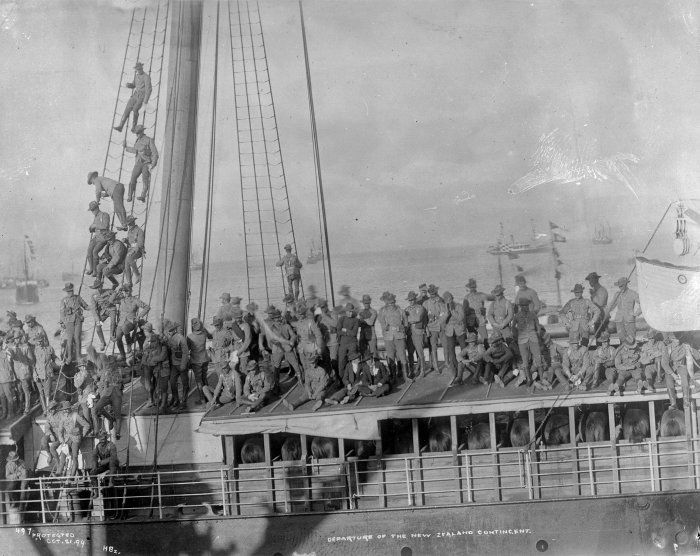
The first contingent of New Zealand Mounted Rifles (NZMR) departed from Wellington aboard the SS WAIWERA ship bound for South Africa on 21 October 1899. As the war drew became an inevitable reality, in September 1899 New Zealand offered British forces in South Africa a contingent of its mounted rifles. The contingent comprised of 214 officers including the crew and 251 horses sailed to South Africa to fight along the British forces in South African War. This contingent was largely recruited from the peacetime volunteers who were expected to provide their own horses and equipment. New Zealand was the first to offer its services and this was the first time that its forces served overseas.On 23 November 1899 the first contingent of troops arrived in Cape Town and deployed to the northern part of the Cape Colony to join the cavalry division commanded by Major General French. Over the course of the war, New Zealand sent ten contingents of volunteers of an estimated 6,500 men and 8,000 horses. Other contingents continued to arrive at different times and were deployed in various areas. For instance, the fourth and fifth contingents were deployed with the Rhodesian Field Force while the sixth and seventh contingents that arrived in 1901 were deployed to relieve other troops. The ninth and tenth contingent of about 2000 men arrived too late in the war to participate. The largest casualty in combat of the New Zealand troops was suffered by Seventh Contingent at Langverwacht (or Bothasberg) in February 1902. A total of 65 troop casualties were sustained contingent by the out of a total of 80 in a single combat confrontation with the Afrikanner guerillas. In April 1902, sixteen New Zealand troops were killed when their train collided with a goods train in Machavie.By the end of the war, 70 New Zealanders had died in combat, 133 had died of disease and 166 were wounded. The public in New Zealand had donated some £113,000 to the war effort in South Africa. In the recent past several monuments of places where New Zealand troops fought and graves have been highlighted. For instance, New Zealand Hill or Memorial Hill in Colesberg, Diamond Hill near Pretoria and Langverwacht in the Free State among others are sites that are dedicated to New Zealand's contribution to the South African War.
21 October 1899
The New Zealand Mounted Rifles leave Wellington for the South African War
- Updated
- 19 Oct 2020
How we know this
- 01Crawford J & Ellis, E. (1999), To Fight for the Empire - An Illustrated History of New Zealand and the South African War 1899-1902, (Wellington), pp 53, 93&99
- 02New Zealand Embassy, New Zealand and the Anglo-Boer War from the New Zealand Ministry of Foreign Affairs and Trade, [online] Available at www.nzembassy.com [Accessed: 17 October 2013]
- 03Archives New Zealand (2010), South African War Records now on Archway, 23 April 2010, [online] Available at www.archives.govt.nz [Accessed: 17 October 2013]
- 04Anon, (2008), 1899 - 1902 South African War from the NZ Army, 19 December 2008, [online] Available at www.army.mil.nz [Accessed 13 October 2010].
Last updated · 19 Oct 2020
South African History Online. (2011, March 16). The New Zealand Mounted Rifles leave Wellington for the South African War. South African History Online. https://sahistory.org.za/ref/E-0011188
South African History Online (2011) 'The New Zealand Mounted Rifles leave Wellington for the South African War', South African History Online, 16 March. Available at: https://sahistory.org.za/ref/E-0011188 (Accessed: 7 October 2026).
South African History Online, The New Zealand Mounted Rifles leave Wellington for the South African War [website], https://sahistory.org.za/ref/E-0011188, (accessed 7 October 2026).
"The New Zealand Mounted Rifles leave Wellington for the South African War." South African History Online, 16 Mar. 2011, https://sahistory.org.za/ref/E-0011188. Accessed 7 Oct. 2026.
South African History Online. "The New Zealand Mounted Rifles leave Wellington for the South African War." South African History Online. March 16, 2011. https://sahistory.org.za/ref/E-0011188.
Also on 21 October
- 1833Alfred Nobel, inventor of dynamite after whom the Nobel prize is named, is born
- 1968Archibald Campbell Mzoliza Jordan, Xhosa writer and linguist, dies
- 1973Government bans 20 Black leaders
- 1976Justice Minister, Jimmy Kruger, announces mass arrest
- 1977Five developed countries recall their Ambassadors from South Africa
- 1986The company, IBM, re-forms in South Africa
- 1996Police head admits to Khotso House bombing
- 2003Vanessa Brereton, former human rights lawyer, admits that she was an Apartheid spy
Search events by date
This day in history
What happened on your birthday?
SAHO is free because readers fund it. Donate →