
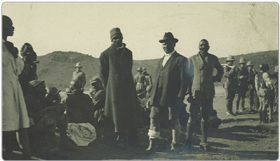
In 1921, in a battle lasting less than 30 minutes between police and Israelites, followers of prophet Enoch Mgijima, more than 180 people were killed. The battle started after police issued an ultimatum demanding that the Israelites evacuate land they were squatting on and warned that if they failed to comply, their leader would be arrested and their homes demolished. Soon afterwards a group of around 500 white-robed men, armed with sticks and spears, challenged the machine guns of an 800-strong police force sent by Jan Smuts to remove the Israelites who had settled at the holy village of Ntabelanga, Bulhoek in Queenstown to pray. The event coincided with Smuts’ birthday. He was turning 51 on the day. The Israelites used to gather in the area to celebrate Passover. Towards the end of 1919 Mgijima declared that he had a vision that the world would end in 1920. This caused a pilgrimage of his followers from all over South Africa. About 3 000 people arrived at Ntabelanga and proceeded to squat there, erecting a tabernacle and some huts without registering themselves or paying tax. Mgijima was insistent that the end of the world was at hand and that Jehovah had instructed him to remain there. Prophet Mgijima was charged with sedition and imprisoned. He was released in 1924. * Note: Sources vary on the number of Isrealites that gathered at Ntabelanga and proceeded to squat there, sources also vary on the exact number of victims of the massacre. Therefore all of the numbers in this piece are approximate and based on numerous sources (below).
24 May 1921
Nearly 200 People are killed in the Bulhoek massacre in the Eastern Cape
- Updated
- 23 May 2021
How we know this
- 01South African History Online, ‘General Jan Christiaan Smuts’, [online], available at www.sahistory.org.za (Accessed: 25 April 2012)
- 02Makobe, D. H. (1996). 'Religious fanatics that became political heroes: The historical distortions of the Bulhoek Massacre", Militaria 26(2), pp. 106-112.
- 03Makobe, D. H. (1996). 'Understanding the Bulhoek massacre: Voices after the Massacre and down the years', Militaria 26(2), pp. 98-105
- 04Makobe, D. H. (1996). 'The Bulhoek Massacre: Origins, casualties, reactions and historical distortions', Militaria 26(1), pp. 22-37.
- 05Sunday Times, ‘Enoch Mgijima”, [online], available at: heritage.thetimes.co.za (Accessed: 25 April 2012)
- 06Saunders, C. (ed)(1989). Reader's Digest Illustrated History of South Africa-The Real Story, Cape Town: Reader's Digest.
- 07Makobe, D. H. (1996). 'The price of fanaticism: The casualties of the Bulhoek Massacre', Militaria 26(1), pp. 38-41.
- 08Hermann Giliomee and Bernard Mbenga (2007). New History of South Africa. Tafelberg Publishers, Cape Town, pg 50.
- 09Wallis, F. (2000). Nuusdagboek: feite en fratse oor 1000 jaar, Kaapstad: Human & Rousseau.
- 10Cameron, T. (ed)(1986). An Illustrated History of South Africa, Johannesburg: Jonathan Ball.
- 11Potgieter D. J. (ed)(1973). Standard Encyclopaedia of Southern Africa, Cape Town: Nasou.
Last updated · 23 May 2021
South African History Online. (2012, May 17). Nearly 200 People are killed in the Bulhoek massacre in the Eastern Cape. South African History Online. https://sahistory.org.za/ref/E-0083385
South African History Online (2012) 'Nearly 200 People are killed in the Bulhoek massacre in the Eastern Cape', South African History Online, 17 May. Available at: https://sahistory.org.za/ref/E-0083385 (Accessed: 7 October 2026).
South African History Online, Nearly 200 People are killed in the Bulhoek massacre in the Eastern Cape [website], https://sahistory.org.za/ref/E-0083385, (accessed 7 October 2026).
"Nearly 200 People are killed in the Bulhoek massacre in the Eastern Cape." South African History Online, 17 May 2012, https://sahistory.org.za/ref/E-0083385. Accessed 7 Oct. 2026.
South African History Online. "Nearly 200 People are killed in the Bulhoek massacre in the Eastern Cape." South African History Online. May 17, 2012. https://sahistory.org.za/ref/E-0083385.
Also on 24 May
- 1870Jan Smuts is born
- 1900C James reports that South Africa is a poor market for produce
- 1915A few days after deciding to establish a Dutch newspaper in South Africa, the name De Burger is chosen
- 1921The first Comrades Marathon takes place
- 1952Solly Sachs addresses Garment Worker’s protestors
- 1963The Transkei Constitution Act is enacted
- 1972The first hijacking of a South African Airways plane takes place
- 1973Uranium enrichment programme gets a boost from B.J. Vorster
Search events by date
This day in history
What happened on your birthday?
SAHO is free because readers fund it. Donate →