
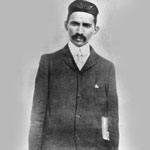
On his journey to South Africa in 1893, Mohandas Gandhi had first -hand experience of the discrimination faced by people of colour. His response to this was the establishment of the Natal Indian Congress (NIC) in 1894. Within three years of his arrival in South Africa, Gandhi had become a political leader, providing hope to many Indians who had no political rights under the dispensation of the time. In 1903, he founded a newspaper, the Indian Opinion, in which his ideas on passive resistance or Satyagraha were spread. Some years later, an act was introduced in which all Indians in the Transvaal were required to carry a pass. Under Gandhi's leadership, 3000 Indians protested against the law by refusing to register for their passes. This became known as the 1906 Satyagraha Campaign. By 1913, a tax had been imposed on all former indentured labourers, known as the Indian Relief Bill. In protest of this, Gandhi launched a passive resistance campaign, gaining the support of thousands of mine workers. While leading a march on 6 November 1913, which included 127 women, 57 children and 2037 men, Gandhi was arrested. He was released on bail, rejoined the march and was re-arrested. The Indian Relief Bill was finally scrapped. Gandi returned to India, and through his consistent passive opposition to British rule, led his country to independence. His philosophy on passive resistance was drawn on significantly during the fight against apartheid. The Defiance Campaign in 1952 can be seen as an example of this.
6 November 1913
Mohandas K. Gandhi is arrested as he leads a march of Indian miners in South Africa
- Updated
- 6 Nov 2020
How we know this
- 01South Africa.info,Gandhi's South African legacy [online] Available at: southafrica.info [Accessed 27 October 2009]
Last updated · 6 Nov 2020
South African History Online. (2011, March 16). Mohandas K. Gandhi is arrested as he leads a march of Indian miners in South Africa. South African History Online. https://sahistory.org.za/ref/E-0011356
South African History Online (2011) 'Mohandas K. Gandhi is arrested as he leads a march of Indian miners in South Africa', South African History Online, 16 March. Available at: https://sahistory.org.za/ref/E-0011356 (Accessed: 7 October 2026).
South African History Online, Mohandas K. Gandhi is arrested as he leads a march of Indian miners in South Africa [website], https://sahistory.org.za/ref/E-0011356, (accessed 7 October 2026).
"Mohandas K. Gandhi is arrested as he leads a march of Indian miners in South Africa." South African History Online, 16 Mar. 2011, https://sahistory.org.za/ref/E-0011356. Accessed 7 Oct. 2026.
South African History Online. "Mohandas K. Gandhi is arrested as he leads a march of Indian miners in South Africa." South African History Online. March 16, 2011. https://sahistory.org.za/ref/E-0011356.
Also on 6 November
- 1860Abraham Lincoln is elected president of the United States.
- 1900General De Wet is defeated by British forces
- 1929Ray Alexander Simons, founder of Food and Canning Workers Union, arrives in South Africa
- 1938Feminist writer and activist, Diana E. H. Russell is born
- 1964Names of 303 banned people are published
- 1964Vuyisile Mini, Trade unionist and uMkhonto we Sizwe (MK) activist is hanged
- 1982Paul Biya becomes president of Cameroon
- 1982Ellen Phyllis Hellmann, social anthropologist and executive member of the SAIRR, dies in Johannesburg
Search events by date
This day in history
What happened on your birthday?
SAHO is free because readers fund it. Donate →