
29 km from Oudtshoorn, at the head of the picturesque Cango Valley, lies the spectacular underground wonder of the Klein Karoo - the Cango Caves.
The limestone beds of the Cango Group are made through movement in the Earth's crust, no longer in a horizontal plane. The layers of strata are also displaced laterally, forming dykes. Rainwater, combined with acidic carbon dioxide from decomposing plant material on the surface, flows through a fracture zone. Limestone, i.e. - which dissolves in water, flows out. This process of `cave making' takes Millions of Years. Calcium Bicarbonate gives off Carbon Dioxide and reverts back to Calcium Carbonate, and the solution crystallizes and evolves into the various formations which can be seen in the Caves (Stalactites, etc.). The time in making the many formations depends on the supply of water and Carbon Dioxide, and in the case of the Cango Caves, may have started several Millions of Years ago, whilst many are still in the making.
The Cango Caves is one of the World's Great Natural Wonders, sculptured by nature through the ages - fascinating limestone formations in a wide variety of colours. An "underground wonder World" -according to legend the Caves were discovered during 1780. Early visitors had to brave the pitch darkness of the vast caverns from the poor light of self made candles. Over the Years improvements took place and today modern technology makes it possible that all the wonders of the Caves to be skillfully illuminated.
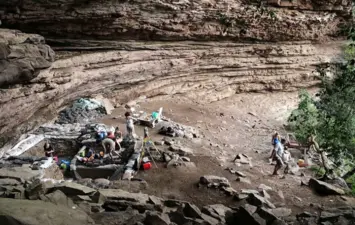
"In 2022, Faith, a paleoecologist and University of Utah professor of anthropology, set out to find a series of caves mentioned in a report from the 1980s. They were somewhere near the tip of South Africa in the Cango Valley, a region streaked with outcrops of limestone, the kind of rock that is often riddled with caves. But when he arrived, there were so many caves he couldn't narrow down which were described in the report. He came back several times over the years, documenting two dozen caves.
"We found all these caves, and there appears to be a really rich fossil record within them," Faith said. "Fossils are everywhere."
The caves formed as water worked its way through the limestone over millions of years, eventually carving out tunnels and chambers in the rock. Throughout the caves' existence, bones found their way inside. Sometimes, this was because a predator took its meals within the cave. Other times, remains were swept in with debris and water. And occasionally, an unlucky animal might have fallen in if a cave entrance or roof collapsed. Layers of sediment slowly built up over the bones, fossilizing them.
In June of 2025, Faith returned to the caves with a crew of researchers, ready to excavate. The work began with a tromp around, looking for cave entrances. Those entrances are inconspicuous to the untrained eye, sheltered by trees and vegetation. But their leafy concealment is one major tell that there's a cave nearby, Faith said. Because the caves need flowing water to form, trees and shrubs cluster around their opening to take advantage of the extra moisture." (FOR MORE ON THIS FOLLOW THE LINK PROVIDE IN FURTHER READING)