
Dr Mohammed Shukri Effendi was the first person of colour to graduate as a medical doctor from the University of Cape Town (UCT), completing his degree in 1942. His achievement predates the previously recognised first black UCT medical graduates - Maramoothoo Samy-Padiachy, Cassim Saib, and Ralph Lawrence - who graduated in 1945. Despite this pioneering accomplishment, Dr Effendi remained largely unknown in South African history until researcher Dr Halim Gençoğlu uncovered his story in 2016 through archival research.
Early Life and Family Background
Mohammed Shukri Effendi was born on 8 December 1915 in Pepper Street in the historic Bo-Kaap neighbourhood of Cape Town. He came from a distinguished Ottoman-descended family with deep roots in South African Muslim history. His grandfather was the renowned Abu Bakr Effendi, an Ottoman qadi (Islamic judge) sent to the Cape Colony in 1862 by Sultan Abdulaziz at the request of Queen Victoria to educate and assist the Muslim community of the Cape Malays.
Abu Bakr Effendi made significant contributions to Islam in South Africa, including translating his 1877 work Bayân al-Dîn into an early form of written Afrikaans using Arabic script. He is credited with introducing the fez as headwear for Muslim men at the Cape and had a profound impact on the expansion and consolidation of Islam in the Cape Colony.
The Effendi family had close connections to other prominent Cape Muslim figures. Mohammed Shukri's uncle, Ahmet Attaullah Bey, was married to Muhsine, the sister of the influential politician and physician Dr Abdullah Abdurahman - the first black person elected to the Cape Town City Council (1904) and founder of Trafalgar High School. Through these family connections, Mohammed Shukri was well positioned within the Cape Muslim community's educated elite.
Education
Mohammed Shukri attended Trafalgar High School in District Six, Cape Town. This school held particular significance as it was the first institution in South Africa to offer secondary education to Coloured students, having been established in 1912 through the efforts of Dr Abdullah Abdurahman and the African Political Organisation. The same school was also attended by Zainunnisa (Cissie) Gool, Dr Abdurahman's daughter, who would later become a prominent anti-apartheid political leader.
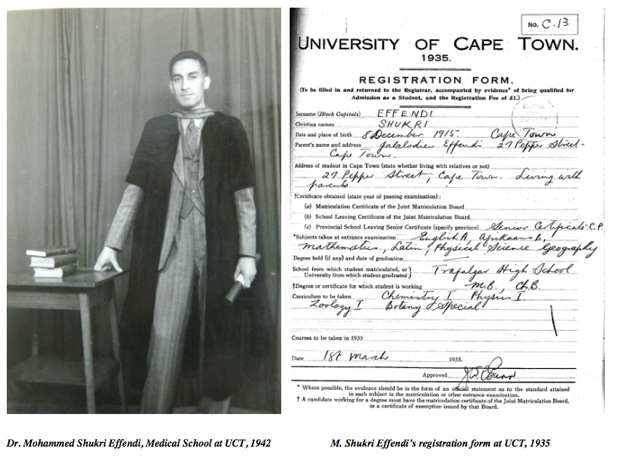
After matriculating from Trafalgar High School, Effendi enrolled at the University of Cape Town's medical school in 1935. According to his registration documents, his home language was recorded as English, with Afrikaans as his second language, though it is believed the family spoke Afrikaans at home. UCT being an English-medium university likely influenced this choice. His registration form recorded him as 'Muslim, Malay.'
Navigating Racial Classifications
The question of how Mohammed Shukri Effendi gained admission to UCT at a time of increasing racial segregation is complex. According to his birth certificate, his father was recorded as Turkish and his mother as 'Muhammad' (Muslim), classifications that technically made him a person of colour under South African racial categorisations of the era. However, his Turkish ancestry through Abu Bakr Effendi, who had been accepted as a 'white citizen' in colonial Cape Town, combined with his fair skin, may have allowed him to be admitted to the university. As Gençoğlu observed:
'It is an interesting fact that Dr Shukri Effendi was admitted merely on the grounds of his physical appearance, rather than his non-white identity.'
This is particularly significant given that, prior to 1943, universities were subject to strict laws of racial segregation that did not permit people of colour to study at UCT. Even when examining death records, the Effendi family members were consistently referred to as 'Asiatic' or 'Malay' - classifications that made them legally non-white regardless of their fair complexion. A copy of the identity document of Hesham Nimetullah Effendi, a living family member, clearly shows he is regarded as Cape Coloured despite his fair skin, demonstrating how these classifications persisted across generations.
The arbitrary nature of racial classification is further illustrated by comparing Effendi's case with that of his Turkish classmate, Dr Reginald Remzi Bey, son of Mehmet Remzi Bey (the first Turkish ambassador to South Africa). Remzi Bey was classified as white because he was raised as a Christian and attended the South African College Schools (SACS). He graduated in 1938, four years before Effendi. The contrast between their racial classifications - despite similar ethnic backgrounds - demonstrates how religion often determined racial categorisation in South Africa, with Muslims being regarded as 'secondary citizens' regardless of their skin colour or national origin.
Medical Career
Mohammed Shukri Effendi qualified as a medical doctor in 1941 and formally graduated in February 1942, making him the first Muslim medical doctor to qualify at UCT and the first person of colour to graduate from the medical school. Following graduation, he worked briefly at Groote Schuur Hospital before opening his own medical practice in the Bo-Kaap community where he had grown up.
In 1946, according to the South African Medical Journal, Dr Effendi relocated his practice to Woodstock, operating from a stone house on Mountain Road. The building was named 'Erzeroum' (also spelled 'Ezeroum') after his grandfather Abu Bakr Effendi's birthplace in eastern Turkey.
Death and Legacy
Tragically, Dr Mohammed Shukri Effendi died of tuberculosis in 1946 at the young age of 30, at his family home 'Erzeroum' in Woodstock. He was buried at Mowbray Cemetery in Cape Town. His early death may have contributed significantly to his obscurity in historical records, as he had little time to establish a lasting public presence or legacy.
For decades, Dr Effendi's pioneering achievement went unrecognised. It was widely believed that Maramoothoo Samy-Padiachy, Cassim Saib, and Ralph Lawrence, who graduated in 1945, were UCT's first black medical doctors. This misconception persisted until 2016 when Dr Halim Gençoğlu, a Turkish doctoral student at UCT with expertise in Ottoman history, undertook extensive archival research.
Rediscovery
Dr Halim Gençoğlu, a Turkish doctoral student at UCT with a keen interest in colonial history, began his research into Ottoman presence in South Africa during his honours studies in 2011. Working with Professor Nigel Worden and inspired by the late Professor Robert Shell, he recognised that Turkish and Ottoman archival sources could offer new insights into South African historical events. Much of his research was conducted at the Western Cape Archives and Records Services.
Gençoğlu's findings were published in the Bulletin of the National Library of South Africa in June 2015 under the title 'Forgotten Medical Doctors, Dr Muhammed Shukri Effendi and Dr Havva Khayrunnisa.' Using South African and Turkish archival sources - including UCT registration papers, death records, and documents from the Effendi family - he demonstrated that Effendi had graduated three years before those previously recognised as UCT's first black medical doctors.
Gençoğlu suggests that earlier researchers may have overlooked Dr Effendi because they were confused by his ethnic and national identity. His fair skin and well-known Turkish family background—as the grandson of Professor Abu Bakr Effendi and nephew of Dr Abdullah Abdurahman - may have led historians to assume he was white, when in fact the official records consistently classified him as non-European.
His research also revealed that the first black woman doctor to practise in South Africa was Dr Havva Khayrunnisa, Effendi's cousin. She graduated as a gynaecologist in London in 1920 under an Ottoman government bursary, initially practising in Istanbul before moving to Cape Town after her husband's death in Holland in 1929.
Reflecting on the significance of historical research, Gençoğlu quoted the Turkish proverb attributed to Mustafa Kemal Atatürk:
'Writing history is as important as making history. If the writer has no allegiance to the makers of history, the irrefutable facts become incomprehensible to human beings.'
He expressed hope that other scholars would continue researching this topic, noting that his findings represent only 'the tip of the iceberg.'
Following Gençoğlu's discovery, UCT's Faculty of Health Sciences officially acknowledged the correction to their historical records. In a 2022 seminar marking the 76th anniversary of Dr Effendi's death, titled 'White Skin, Black Destiny: UCT's first black medical doctor Muhammed Shukri Effendi,' Gençoğlu called for the university to name a building at the medical school after Effendi as a way to rectify this historical oversight and honour one of South Africa's forgotten heroes.
Family Recognition
The acknowledgment of Dr Effendi's achievement brought significant meaning to his surviving relatives. Hesham Neamatollah Effendi, a UCT alumnus of 1990 and near relative of Dr Shukri Effendi, contacted UCT to thank the university for recognising that his father's cousin was the first person of colour to qualify as a medical doctor from UCT. He described the acknowledgment as 'a rare case of restorative justice in the context of Apartheid laws at its worst.'
Hesham Effendi shared his own experiences of racial classification at UCT, recounting how when he applied to study at the university in 1978, despite his European appearance, he was initially refused admission because his identity card stated 'CAPE COLORED' in bold red letters. He eventually gained admission and graduated, though he was frequently questioned about his racial identity as the only Coloured student in classes of white students.
Dr Shukri Effendi was the first of several family members who went on to become medical doctors at UCT, including Dr Rusti Sedick (1957), Dr Faieka Jappie (1980s), and Dr Malika Van Der Schyff (1996), demonstrating the family's continuing contribution to South African medicine and healthcare.
Historical Significance
Dr Mohammed Shukri Effendi's story illuminates the complex intersections of race, religion, and identity in colonial and apartheid South Africa. His admission to UCT in 1935 demonstrates how racial classifications were often applied inconsistently, with religion and perceived ethnicity sometimes overriding physical appearance. His achievement, despite the limited educational opportunities available to people of colour in South Africa, represents a significant but long-overlooked milestone in the country's medical and educational history.
The rediscovery of Dr Effendi's story also highlights the importance of diverse archival sources - including Ottoman and Turkish records—in recovering the histories of South Africa's marginalised communities. As Dr Gençoğlu has noted, this research represents only 'the tip of the iceberg' in understanding the contributions of Ottoman-descended communities to South African society.