
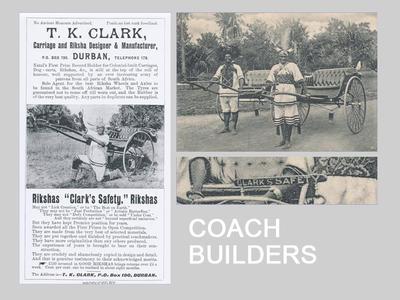
Within a short time a number of local wagon works had turned their hand to ricksha construction. The imported Japanese models did not survive the tender care of our roads, and a number of important adaptations were made. They differed from their Japanese models by seating two people, having no mudguards, using a back-guard to prevent possible tip-backs on steep hills, being equipped with a bell and a lantern, and with a cross-bar at the front of the two handles. Most of these precautions were defined by local traffic byelaws in Durban, but they appear to have become countrywide within a very short period of time.
imageREF I-0041939Revised
Image record
amalisha-14.jpg
- Updated
- 24 Jul 2019
Source unknown, please contribute
South African History Online. (2011, March 28). amalisha-14.jpg. South African History Online. https://sahistory.org.za/ref/I-0041939
South African History Online (2011) 'amalisha-14.jpg', South African History Online, 28 March. Available at: https://sahistory.org.za/ref/I-0041939 (Accessed: 6 September 2026).
South African History Online, amalisha-14.jpg [website], https://sahistory.org.za/ref/I-0041939, (accessed 6 September 2026).
"amalisha-14.jpg." South African History Online, 28 Mar. 2011, https://sahistory.org.za/ref/I-0041939. Accessed 6 Sept. 2026.
South African History Online. "amalisha-14.jpg." South African History Online. March 28, 2011. https://sahistory.org.za/ref/I-0041939.
Further reading


 Article
The ANC’s MK Special Ops Unit Material - Yunus Carrim Collection - 6 November 2025
The ANC’s MK Special Ops Unit Material Yunus Carrim Collection 06 November 2025 What is this about? The...


 Place
Place
Oyster Bay
Oyster Bay or “Oesterbaai” in Afrikaans, is a small coastal hamlet and resort located about 22.5 kilometres (14.
SAHO is free because readers fund it. Donate →