
A five-day conference of the South African Indian Congress (SAIC) held in Cape Town, unanimously resolved to oppose the proposed Asiatic Land Tenure and Indian Representation Act (No. 28 of 1946) or "Ghetto Act". The Act deprived the Asian South Africans of communal representation and took away their fundamental and elementary right of land ownership and occupation. It was known as the "Ghetto Act" because it was thought to have reduced the opportunities of the masses of the Indian people to earn a decent living and ultimately condemn them to exist in increasingly over-crowded slums.
During the conference, a large deputation of sixty Indians called on the prime minister, General J.C. Smuts, on 11 February and urged him to postpone the legislation, pending a proposed round table conference with India. The SAIC proceeded immediately to prepare the Indian people of South Africa for concerted and prolonged resistance, which started in June and continued for several months. Delegations were also sent to India, Britain and the United States.
The Indian government protested against the Act by breaking off trade relations with South Africa and recalling its representative. In June 1946, India requested the secretary-general of the United Nations to put South Africa's treatment of the Indian population on the agenda of the General Assembly.
eventREF E-0011676Revised
12 February 1946
South African Indian Congress opposes "Ghetto Act"
- Updated
- 20 Jul 2026
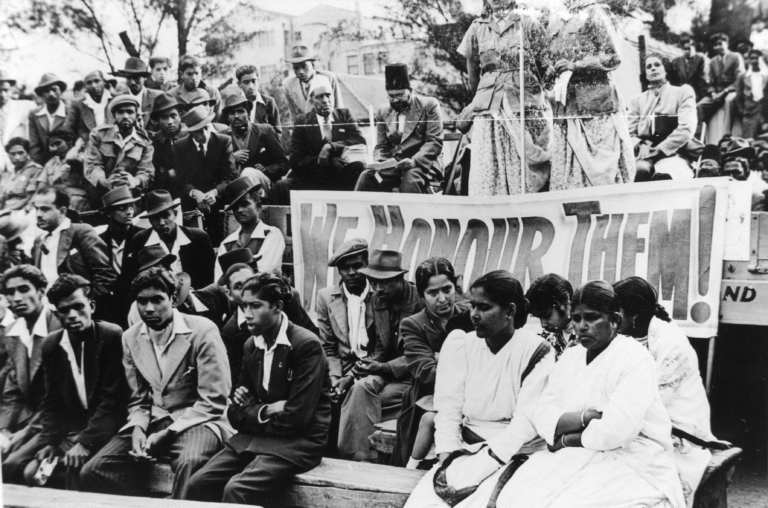
Indian passive resistance in South Africa 1946, Source: Gandhi-Luthuli Documentation Centre
How we know this
- 01Muller, C.F.J. (ed)(1981). Five Hundred years: a history of South Africa; 3rd rev. ed., Pretoria: Academica, p. 459.
- 02SAHO, General History Timeline: 1940's, from South African History Online, [online], Available at www.sahistory.org.za [Accessed: 28 January 2014]
Last updated · 20 Jul 2026
South African History Online. (2011, March 16). South African Indian Congress opposes "Ghetto Act". South African History Online. https://sahistory.org.za/ref/E-0011676
South African History Online (2011) 'South African Indian Congress opposes "Ghetto Act"', South African History Online, 16 March. Available at: https://sahistory.org.za/ref/E-0011676 (Accessed: 13 October 2026).
South African History Online, South African Indian Congress opposes "Ghetto Act" [website], https://sahistory.org.za/ref/E-0011676, (accessed 13 October 2026).
"South African Indian Congress opposes "Ghetto Act"." South African History Online, 16 Mar. 2011, https://sahistory.org.za/ref/E-0011676. Accessed 13 Oct. 2026.
South African History Online. "South African Indian Congress opposes "Ghetto Act"." South African History Online. March 16, 2011. https://sahistory.org.za/ref/E-0011676.
Also on 12 February
- 1930Sculptor Tavhana is born in Dzanani
- 1951Kwame Nkrumah is released from jail
- 1965Public places of recreation for whites only, are proclaimed
- 1979State Security Council Approves Cross
- 1980The Quail Commission report is released
- 1982Thami Mazwai, former journalist and anti-apartheid activist, is jailed for two years
- 1989Vlakplaas Operatives kill 3 South African students in Swaziland
- 2006At an international summit in SA leaders pledge to push for a new global trade deal that will help poor countries
Further reading
 Article
Indian South Africans timeline 1960-1969
Indian South Africans Timeline: 1960-1969
1960
19 February, Dr Monty Naicker called for strength in resistance,...
 Article
Indian South Africans timeline 1930-1939
1930
The Durban Municipality was a major employer of Indian labour, employing an average of 2 000 workers through...
 Article
Indian South Africans timeline 1920-1929
1920
February, The Asiatic Inquiry Commission, headed by Sir Johannes Lange, is appointed to inquire into laws...
 Article
Indian South Africans Timeline 1910-1919
1910
Public Servants Superannuating Act and Teachers Pensions Act. Discrimination against Indians – Indians were...
 Article
Indian South Africans timeline 1900-1909
Indian South Africans timeline 1900-1909
1900
The East London Mayor's Minute for 1899-1900 states that 1,000...
 Article
Indian South Africans timeline 1654-1899
Indian South Africans Timeline: 1654-1899
1654
Slaves from India and South East Asia are introduced to the Cape.
Search events by date
This day in history
What happened on your birthday?
SAHO is free because readers fund it. Donate →