
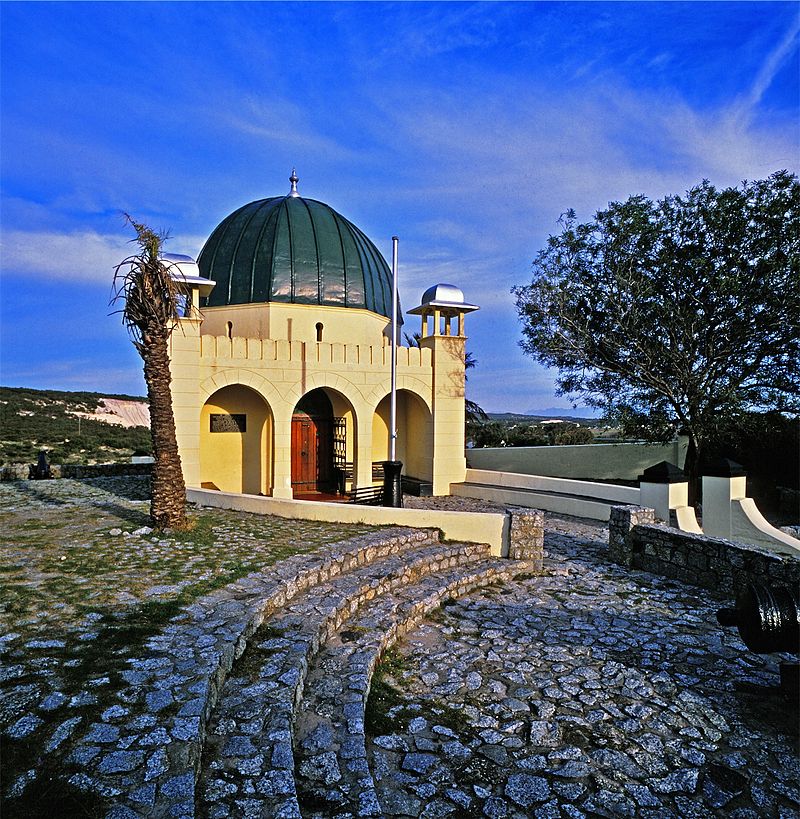
In the late 1600s many Muslim men of wealth and influence were banished to the Cape from their homeland in the East because the Dutch feared them as a threat to their political and economic hegemony. The first political exiles or Orang Cayen were the rulers of Sumatra. Shaykh Yusuf of Macassar is the best known of the Orang Cayen. Shaykh Yusuf ['Abidin Tadia Tjoessoep] was born in 1626 of noble birth in Gowa in the East Indies. He fought alongside and supported Sultan Ajung of Bantam, Gowa, in his war against the Dutch. Twice Sheikh Yusuf escaped from Dutch custody in the East, but was finally persuaded in 1694 to surrender on the promise of a pardon. The Dutch did not fulfill their promise and Sheikh Yusuf was banished, along with his family and followers, to the Castle in Batavia from where he was transferred, under armed guard, to the Castle in Colombo, Ceylon [now Sri Lanka]. Fearing Sheikh Yusuf's influence in Ceylon the Dutch exiled him to the Cape of Good Hope ten years after his initial surrender. The Sheikh arrived on board `De Voetboog' on April 02, 1694 along with his entourage of 49 which included his two wives [Carecontoe and Carepane], two slave girls [Mu'minah and Na'imah], 12 children, 12 imams [religious leaders] and several friends with their families. He was royally welcomed by Governor Simon van der Stel at the Cape. They were moved to a farm in Zandvleit, near the mouth of the Eerste River in the Cape, on June 14, 1694. The Company's attempt to isolate Sheikh Yusuf at Zandvleit did not succeed. On the contrary, Zandvleit turned out to be the rallying point for `fugitive' slaves and other exiles from the East. It was here that the first cohesive Muslim community in South Africa was established. Since many of the Sheikh's followers hailed from Macassar, the district around Zandvleit is still known today as Macassar. Sheikh Yusuf is regarded, by many, as the founder of the Islamic faith in the Cape. He died in Zandvliet on 23 May 1699. His Kramat has been a place of pilgrimage ever since.
23 May 1699
Sheikh Yusuf, regarded as the founder of the Islamic faith in the Cape, dies at Zandvliet (Macassar)
- Updated
- 3 Dec 2020
How we know this
- 01South African Government Information Sheikh Yusuf (1626 - 1699) [online] Available at: www.info.gov.za [Accessed on 23 May 2013]
- 02Islamic Focus Sheikh Yusuf Macasari [online] Available at: www.islamicfocus.co.za [Accessed on 23 May 2013]
Last updated · 3 Dec 2020
South African History Online. (2011, March 16). Sheikh Yusuf, regarded as the founder of the Islamic faith in the Cape, dies at Zandvliet (Macassar). South African History Online. https://sahistory.org.za/ref/E-0010844
South African History Online (2011) 'Sheikh Yusuf, regarded as the founder of the Islamic faith in the Cape, dies at Zandvliet (Macassar)', South African History Online, 16 March. Available at: https://sahistory.org.za/ref/E-0010844 (Accessed: 13 October 2026).
South African History Online, Sheikh Yusuf, regarded as the founder of the Islamic faith in the Cape, dies at Zandvliet (Macassar) [website], https://sahistory.org.za/ref/E-0010844, (accessed 13 October 2026).
"Sheikh Yusuf, regarded as the founder of the Islamic faith in the Cape, dies at Zandvliet (Macassar)." South African History Online, 16 Mar. 2011, https://sahistory.org.za/ref/E-0010844. Accessed 13 Oct. 2026.
South African History Online. "Sheikh Yusuf, regarded as the founder of the Islamic faith in the Cape, dies at Zandvliet (Macassar)." South African History Online. March 16, 2011. https://sahistory.org.za/ref/E-0010844.
Also on 23 May
- 1926Joe Slovo is born
- 1939Evelyn Dalberg, SA opera singer, is born in Germany
- 1943Member of the African National Congress and Deputy Minister of Environmental Affairs, Rejoice Thizwilondi Mabudafhazi is born
- 1951Former SANNC President Sefako Mapogo Makgatho dies
- 1980SADF troops kill SWAPO guerrillas
- 1981The State Theatre in Pretoria opens
- 1983South African Air Force bombs ANC in Maputo
- 1994South Africa joins the OAU
Search events by date
This day in history
What happened on your birthday?
SAHO is free because readers fund it. Donate →
Contribute to this record0 comments
Comments are reader contributions. They are not part of the archival record.