
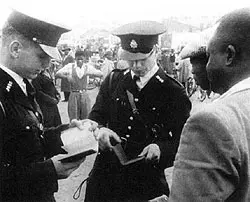
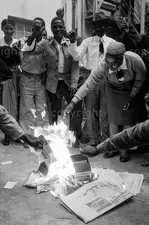
The South African Commissioner of Police announced that the pass laws, applicable to the African population, were suspended until normality had been restored, following the Sharpeville Massacre. The Police Commissioner said that the pass laws were not being suspended to appease the unfounded protests of Bantu agitators, but because the jails could no longer accommodate the many Africans who presented themselves for arrest by openly violating the pass laws. Pass laws required that Africans carry their pass books all the time; this helped the government in restricting their movements. The suspension of pass laws followed the country-wide anti-pass campaign that resulted in the Sharpeville Massacre, where more than 200 protesters were shot down by police.
27 March 1960
Pass laws are suspended in South Africa

- Updated
- 21 Jul 2026
How we know this
- 01SAHO, Liberation history Timeline 1960-1969, from South African History Online, [online], Available at www.sahistory.org.za [Accessed: 10 March 2014]
- 02O’Malley, P., '1960' from Nelson Mandela Center for Memory, [online], Available at www.nelsonmandela.org [Accessed: 10 March 2014]
Last updated · 21 Jul 2026
South African History Online. (2012, March 16). Pass laws are suspended in South Africa. South African History Online. https://sahistory.org.za/ref/E-0079720
South African History Online (2012) 'Pass laws are suspended in South Africa', South African History Online, 16 March. Available at: https://sahistory.org.za/ref/E-0079720 (Accessed: 29 October 2026).
South African History Online, Pass laws are suspended in South Africa [website], https://sahistory.org.za/ref/E-0079720, (accessed 29 October 2026).
"Pass laws are suspended in South Africa." South African History Online, 16 Mar. 2012, https://sahistory.org.za/ref/E-0079720. Accessed 29 Oct. 2026.
South African History Online. "Pass laws are suspended in South Africa." South African History Online. March 16, 2012. https://sahistory.org.za/ref/E-0079720.
Also on 27 March
- 1914The first successful non-direct blood transfusion is carried out
- 1960Johannes Kerkorrel, Afrikaans singer and songwriter, is born in Johannesburg
- 1968Separate Representation of Voters Amendment Act No 50 of 1968 is enacted
- 1975Government’s final consolidation of ‘homelands’
- 1985Beyers Naudé and Allan Boesak arrested for leading a protest march
- 1985A school bus with seventy-six learners plunges into the Westdene dam, killing forty-two
- 1994SA is readmitted to the IOC
- 1995Winnie Mandela is dismissed from government
Further reading
 Article
1960-1966: The genesis of the armed struggle
 Article
Women’s resistance in the 1960s - Sharpeville and its aftermath
 Article
List of victims of police action, 21 March, 1960 (Sharpeville and Langa)
 Article
A History of the Bulhoek Massacre
 Article
Pass Laws and Sharpeville Massacre
 Article
Aftermath: Sharpeville Massacre 1960
Search events by date
This day in history
What happened on your birthday?
SAHO is free because readers fund it. Donate →