
The announcement by President F.W. de Klerk to release Nelson Mandela and unban the African National Congress (ANC), Pan Africanist Congress (PAC), the South African Communist Party (SACP) and other liberation movements. This was received with mixed feelings inside and outside Parliament. Black and White South Africans celebrated the news as they were optimistic that the country was taking a turn for equalty. In Cape Town, Archbishop Mpilo Desmond Tutu was at St George's Cathedral with his congregation ready to celebrate an event he considered as the Second Coming.
It is believed that de Klerk’s decision to release Mandela and to unban political parties was the result of the following factors. Firstly, South Africa had been isolated through international trade sanctions to the extent that the South African economy was severely impacted. Coupled with this, the multiple States of Emergency measures enacted by the Apartheid State had consistently failed to combat the ongoing uprisings. Lastly South Africa was almost totally isolated from the international community in terms of cultural and sporting events. This milestone was followed by tension-driven negotiations aimed at transferring power from the white minority to the majority of South Africans.
Though it brought about democracy, this journey was not totally without obstacles. These ranged from intensification of political violence in some parts of South Africa to unilateral declarations by some groups to break away from South Africa and form their own homelands. Some scholars have argued that de Klerk narrowly avoided a civil war that would have been disasterous to the country and the region as a whole. The decision taken by de Klerk was not an easy one, as he faced opposition not only from the political opponents, but also from his own party (the National Party).
eventREF E-0073083Revised
2 February 1990
F.W. de Klerk announces the release of Nelson Mandela and unbans political parties
- Updated
- 1 Feb 2020
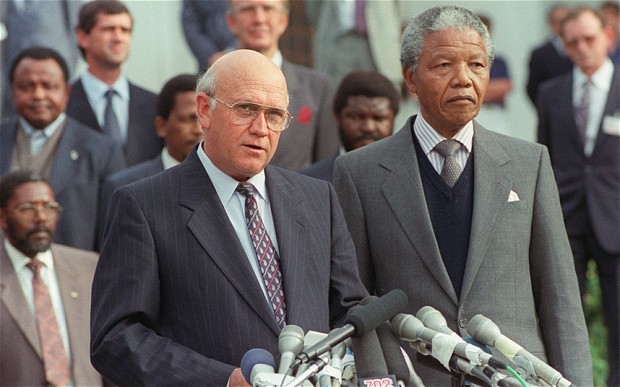
F. W. de Klerk (left) with Nelson Mandela (right), Source: Getty Images
How we know this
- 01Sommer.H,(1996), From Apartheid to Democracy: Patterns of Violent and Nonviolent Direct Action in South Africa, 1984-1994, Africa Today, Vol. 43, No. 1, Southern Africa in the Post apartheid Era (Jan. - Mar., 1996), pp. 53-76
- 02The Independent, (2010), ‘FW De Klerk: The day I ended apartheid’, 02 February, [online], Available at www.independent.co.uk[Accessed: 20 January 2012]
- 03Answers.com, ‘Nelson Mandela’,[online], Available at www.answers.com[Accessed: 20 January 2012]
- 04Klotz.A, (1996), Norms and Sanctions: Lessons from the Socialization of South Africa, Review of International Studies, Vol. 22, No. 2 (Apr., 1996), pp. 173-190
Last updated · 1 Feb 2020
South African History Online. (2012, January 27). F.W. de Klerk announces the release of Nelson Mandela and unbans political parties. South African History Online. https://sahistory.org.za/ref/E-0073083
South African History Online (2012) 'F.W. de Klerk announces the release of Nelson Mandela and unbans political parties', South African History Online, 27 January. Available at: https://sahistory.org.za/ref/E-0073083 (Accessed: 19 October 2026).
South African History Online, F.W. de Klerk announces the release of Nelson Mandela and unbans political parties [website], https://sahistory.org.za/ref/E-0073083, (accessed 19 October 2026).
"F.W. de Klerk announces the release of Nelson Mandela and unbans political parties." South African History Online, 27 Jan. 2012, https://sahistory.org.za/ref/E-0073083. Accessed 19 Oct. 2026.
South African History Online. "F.W. de Klerk announces the release of Nelson Mandela and unbans political parties." South African History Online. January 27, 2012. https://sahistory.org.za/ref/E-0073083.
Also on 2 February
- 1915Eban Abba, Israeli statesman is born in Cape Town
- 1989Apartheid leader P. W. Botha Resigns
- 1990The Harms Commission officially restricts investigations into South African security force
- 1994President F W de Klerk announces that South Africa’s first democratic elections will be held
- 1996Minister of Constitutional Development Roelf Meyer set to resign
Further reading
 Archive
Unbanning of ANC: some strategic considerations
Notes on strategy after the unbanning of the African National Congress.
 Archive
Search events by date
This day in history
What happened on your birthday?
SAHO is free because readers fund it. Donate →