
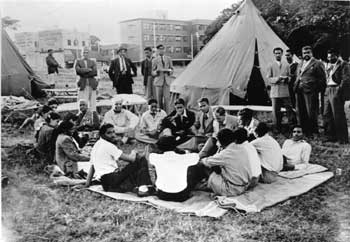
In July 1939 at a meeting of 6,000 Indians, held at the Indian Sports Ground in Johannesburg under the chairmanship of E. I. Asvat, a decision was taken to launch a Passive Resistance Campaign (as decided upon at the earlier meeting of 7 May) on 1 August 1939. The campaign was in response to the South African governments repressive against anti-Indian legislation. A 'Council of Action' for the campaign was set up with Dr. Yusuf Dadoo as chairman. India declared its support for the intended the campaign; however, following a request by Mahatma Gandhi, Passive Resistance was only implemented in June 1946, as Gandhi believed that an honourable settlement could still be achieved. By July of 1946 Passive Resistance protests had engulfed Natal resulting in police brutality against the resisters. On 8 July 1946 hundreds of resisters were arrested and appeared before court - some on as many as five different charges. The government attempted to side-step the real issue by charging resisters under the old 'Natal Law of Trespass'. The imprisoned Resisters were fined £5 each. They were told that if they did not pay their fines, their property would be confiscated. No one, however, paid the fine. The 'Riotous Assemblies Act' was invoked against the leaders of the movement, and they were given long terms of imprisonment.
9 July 1939
Date set for start of Passive Resistance Campaign
- Updated
- 7 Jul 2020
How we know this
- 01"Passive Resistance Campaigns in South Africa 1906-1989", [online] Available at: sahistory.org.za [Accessed on 1 July 2009]
- 02Dadoo, Y., (1968) 'Yusuf Dadoo, fromSouth African history online, [online], Available at: sahistory.org.za [Accessed on 1 July 2009]
- 03SAIC, 'South African Indian Congress', [online] Available at: sahistory.org.za [Accessed on 1 July 2009]
Last updated · 7 Jul 2020
South African History Online. (2011, March 16). Date set for start of Passive Resistance Campaign. South African History Online. https://sahistory.org.za/ref/E-0011597
South African History Online (2011) 'Date set for start of Passive Resistance Campaign', South African History Online, 16 March. Available at: https://sahistory.org.za/ref/E-0011597 (Accessed: 15 October 2026).
South African History Online, Date set for start of Passive Resistance Campaign [website], https://sahistory.org.za/ref/E-0011597, (accessed 15 October 2026).
"Date set for start of Passive Resistance Campaign." South African History Online, 16 Mar. 2011, https://sahistory.org.za/ref/E-0011597. Accessed 15 Oct. 2026.
South African History Online. "Date set for start of Passive Resistance Campaign." South African History Online. March 16, 2011. https://sahistory.org.za/ref/E-0011597.
Also on 9 July
- 1893George Christopher Cato (79), Natal pioneer and first mayor of Durban, dies
- 1915Imperial German Forces forced to unconditional surrender by Union of South Africa Forces during World War I
- 1987Mozambique and Soviet Union reject Margo Commission’s finding
- 1988Venda school teacher hanged
- 1991South Africa allowed to compete in the Olympics again
- 1995F. W. de Klerk is implicated
- 2000Stampede kills twelve people in Harare
- 2011South Sudan is declared an independent state
Search events by date
This day in history
What happened on your birthday?
SAHO is free because readers fund it. Donate →