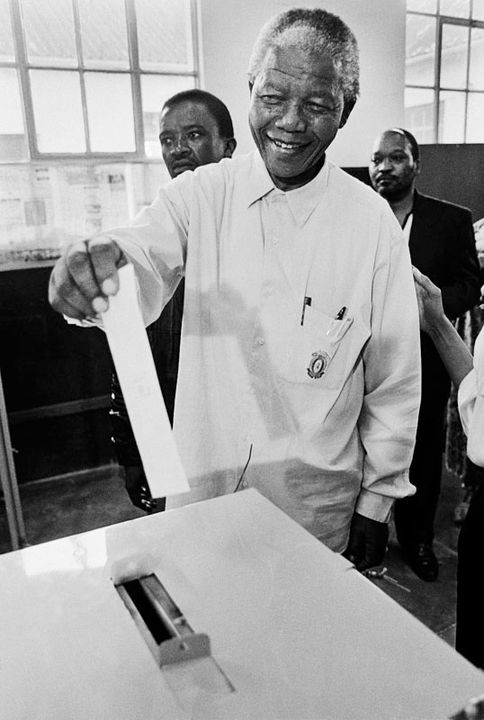
1994: South Africa's first non racial, democratic elections
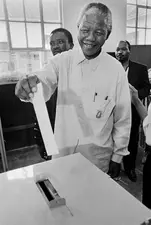
South Africa’s democratic system was endorsed by voters drawn from across the country’s racial divide in April 1994. There is little doubt that coming from a history of a racially divided society, people voted for their skin colour in 1994 over policies. Since then however, it appears that voting in South Africa has been transcending traditional racial preferences, with historically white political parties growing the number of black voters supporting them. Similarly, Black political formations have been increasing their support in other racial groups. It is Cape Town and the Western Cape where developments have been far from clear cut, with voting patterns inspiring the emergence of new compacts across the racial divide.
Nineteen political parties were registered and participated in the elections in 1994. In Apartheid South Africa there were only three main political parties. These were the NP, the Democratic Party and the Conservative Party. There was also a very weak tradition of Independent candidates at the tail end of apartheid, as opposed to early in the twentieth century.
The main parties in the election were products of political formations that were significant in the years leading to 1994. They include the African National Congress (ANC), Inkatha Freedom Party (IFP), the National Party (NP), the Democratic Party (DP), The Pan Africanist Congress (PAC) and the Azanian Peoples Organisation (AZAPO). Other smaller parties were mainly issue based, promoting the interests of specific groups in civil society. One of these was the Women’s Rights Peace Party. Others seem to have been concerned about the fate of specific communities in the new South Africa. The African Muslim Party seems to fall into this category.
| Results of the 1994 elections | |||
| National Assembly results | |||
Party | % Votes | No votes | Seats |
| African National Congress | 62.65 | 12 237 655 | 252 |
| National Party | 20.39 | 3 983 690 | 82 |
| Inkatha Freedom Party | 10.54 | 2 058 294 | 43 |
| Freedom Front | 2.17 | 424 555 | 9 |
| Democratic Party | 1.73 | 338 426 | 7 |
| Pan Africanist Congress | 1.25 | 243 478 | 5 |
| African Christian Democratic Party | 0.45 | 88 104 | 2 |
| Africa Muslim Party | 0.18 | 34 466 | 0 |
| African Moderates Congress Party | 0.14 | 27 690 | 0 |
| Dikwankwetla Party of SA | 0.10 | 19 451 | 0 |
| Federal Party | 0.09 | 17 663 | 0 |
| Minority Front | 0.07 | 13 433 | 0 |
| Soccer | 0.05 | 10 575 | 0 |
| Africa Democratic Movement | 0.05 | 9 886 | 0 |
| Women's Rights Peace Party | 0.03 | 6 434 | 0 |
| Ximoko Progressive Party | 0.03 | 6 320 | 0 |
| Keep it Straight and Simple | 0.03 | 5 916 | 0 |
| Workers' List Party | 0.02 | 4 169 | 0 |
| Luso-SA Party | 0.02 | 3 293 | 0 |
| Total | 99.99 | 19 533 498 | 400 |
| Source: INDEPENDENT ELECTORAL COMMISSION 1994 Report of the Independent Electoral Commission: The South African Elections of April 1994; for a detailed electronic version of the results see INDEPENDENT ELECTORAL COMMISSION UNDATED "National Election '94" IN Elections '94", [www] https://www.eisa.org.za/wep/sou1994results1.htm [opens new window] (accessed 1 August 2016). | |||
Elections: Post 1994 South Africa
Of the three general elections following the historic event of 1994, it was the 2009 election that promised a major shift in voting patterns and voter preferences. Much was expected after the Polokwane conference a year earlier. Yet, that election did not significantly alter the balance of power. The ANC still emerged with an overwhelming majority, except for the Western Cape, where the Democratic Alliance (DA) still has the majority of the votes. This has made the upcoming local government election in the province a more fierce duel between the ANC and the DA.
Local government elections, 1995 to 2011
Local government elections, won by the ANC in 1995, have galvanized communities in ways that was never before seen in South Africa. Successive attempts by the Apartheid government to involve Black communities in its “puppet” local government structures were met with fierce resistance marked by low voter turn outs as an expression of dissent. Elections held in Black Townships following the enactment of the Black Local Authorities Act of 1984 and the Community Councils the Act merely helped intensify the communities’ resistance to apartheid. In fact, it is the responses of communities to these structures that set in motion a process culminating in the collapse of the NP government in 1994.