
Oral interview with Amabutho which refers collectively to quasi-military formations of township youth who were also often known as "comrades" or "young lions." Mainly active in urban areas, especially in the eastern Cape, most were unemployed school-leavers who supported the United Democratic Front during the years of its ascendance, 1983-88. Often they lacked the political sophistication of school students, but with little to lose and time on their hands to roam the streets, they became the most militant and daring element within the UDF. Amabutho played a central, often unpopular, role in policing stayaways and consumer boycotts. The toyi-toyi, a high-spirited warriors' dance, became their political trademark at mass gatherings, marches and funerals. Between 1985 and 1987 they were responsible for rendering many townships temporarily off limits to state authorities - "ungovernable," in township parlance.
Archive record
Interview with Amabutho members

- Origin date
- March 1987
- Updated
- 27 Aug 2019
South African History Online. (2016, February 22). Interview with Amabutho members. South African History Online. https://sahistory.org.za/ref/R-0114226
South African History Online (2016) 'Interview with Amabutho members', South African History Online, 22 February. Available at: https://sahistory.org.za/ref/R-0114226 (Accessed: 26 October 2026).
South African History Online, Interview with Amabutho members [website], https://sahistory.org.za/ref/R-0114226, (accessed 26 October 2026).
"Interview with Amabutho members." South African History Online, 22 Feb. 2016, https://sahistory.org.za/ref/R-0114226. Accessed 26 Oct. 2026.
South African History Online. "Interview with Amabutho members." South African History Online. February 22, 2016. https://sahistory.org.za/ref/R-0114226.
Further reading
 Article
DISA Archive
 Archive
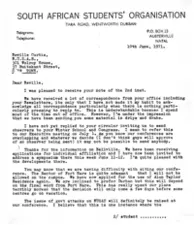
Letter from Barney Pityana to Neville Curtis

SAHO is free because readers fund it. Donate →