PART 2
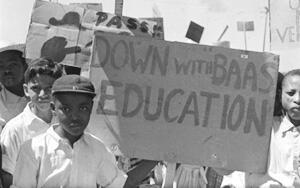
Bantu Education boycott
- 'The Bantu Education Act will make African mothers like fowls who
lay eggs for other people to take away and make what they like with them.' Lillian Ngoyi
In 1953 the government passed the Bantu Education Act, which the people
didn't want. We didn't want this bad education for our children. This
Bantu Education Act was to make sure that our children only learnt things
that would make them good for what the government wanted: to work in
the factories and so on; they must not learn properly at school like
the white children, Our children were to go to school only three hours
a day, two shifts of children every day, one in the morning and one in
the afternoon, so that more children could get a little bit of learning
without government having to spend more money. Hawu! It was: a terrible
thing that act. Verwoerd - he was the minister that time - he wanted
the Africans to stay in the reserves except when they had to become and
work for the white people. He didn't want our children to get a proper
education; he wanted to keep them down with this education system. Before
that time the education was a little bit better, the missionaries ran
mostly the schools, but now all the schools were going to be run by the
government.
In December 1954 at the ANC conference we rejected this new education
plan and we started to organize for a boycott of government schools.
I used to go about with other people explaining to the parents what Bantu
Education is about, what does it mean, and how are the children going
to be affected, because some of them didn't understand. And we told them,
'If you agree with us that this education is bad for our children then
we are going to boycott this education by taking our children out of
schools to show the government we are not satisfied.'
Many parents were anxious too. They didn't want their children to get
that Bantu Education. They took their children out of the schools so
much that in the government schools there was no child who attended
school. But we couldn't leave the children like that, out of school
and learning
nothing. So every morning we used to have buses standing to collect
all the children to take them to the veld. We used to take them there
and
get some teachers to teach them. We called them cultural clubs because
we weren't allowed to call them schools, and we weren't allowed to
have teachers either; we had to call them club leaders. It was illegal
to
have a school that wasn't registered with the government, so we had
to pretend that the cultural clubs weren't schools. We weren't allowed
to
have books or blackboards or anything like that either. Some other
people organized things for the children to be taught, (I know Helen
Joseph
was very involved in that) and we used songs and stories to teach the
children. They would sing a song about history, Dingaan or Shaka or
whatever, or there would be a story they can hear about geography
or what. The
teachers would draw in the sand instead of writing on a blackboard.
And they went on like that.
I was not teaching in those clubs even though I had trained as a teacher,
but I was involved in organizing the clubs and the training courses for
the club leaders. We trained all those people so they would know how
to teach without books and so on. We used to have training sessions with
someone from Johannesburg or Cape Town maybe, who would come to show
the teachers how to use the songs and the stories and how to teach the
children like that. So the children used to sit out in the veld, and
they would tell stories and sing songs. And they would have physical
exercises too every day. Then in the afternoon the buses would fetch
the children again and bring them home. Some of those children even wrote
exams during that time, J.C. and so on, and they passed them too.
It went on like that. But then the government saw that their teachers
are idling, there's nothing in the school for them and all the children
have gone to where we have these clubs. So they started now sending the
police to intimidate the children, to arrest the teachers, those who
had volunteered to teach. The government used to send the police to the
parents: 'And if your child is not at school, you know what is going
to happen to you?'
Some people were afraid: 'what can we do? Let's just let our children
go back to school.'
So the parents started to send their children back to the government
schools because they were afraid of what the police would do to them
if they didn't. But some of the children didn't go back to those schools
for a long time. Some of the cultural clubs stayed until 1960 or so.
Even now you can see that the young people are very unhappy with this
Bantu Education. That is why they are boycotting the schools and demonstrating.
It is still the same now as when they started this thing. The people
are still fighting that we don't want this education that the government
wants to give us. And the government is still using the police to say
that the children must go back to school.