On
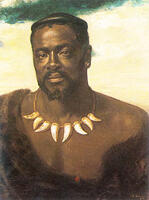
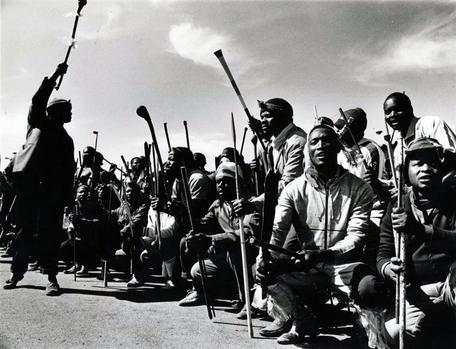
the afternoon of 17 January 1879 the Zulu king Cetshwayo addressed
20 000 of his warriors
at the
great military kraal of Nodwengu: "I
am sending you out against the whites,
who have invaded Zululand
and driven away our cattle. You are to go against the column
at
Rorke's Drift and drive it back into Natal."
A painting of the battle captioned: "The last order we heard
given was,"Fix bayonets and die like British soldiers do"
During
the Zulu War, on 20 January 1879, British and Natal colonial troops
under Lord Chelmsford, commander of
the British army, moved into Zululand and set up camp on the eastern
slopes of the saddle-shaped hill known as Isandlwana (Isandhlwana).
Ignoring
the advice of no less a person than Paul Kruger of the Transvaal, and
his own seasoned colonial officers, the British Commander pronounced
the
ground around the camp too rocky for digging trenches and did not bother
to form a laager. Sixteen hundred British soldiers spent the night
of
January 21 unprotected, beside the sphinx-like outcrop. Thinking
he had
the camp adequately defended, Chelmsford trotted off early in the morning
with half the force to search the hills for the Zulu army. About
1,000
men of the 24th Regiment (one of Her Majesty's finest battalions), together
with a detachment of African troops under Colonel A W Durnford,
some Natal
Carbineers and Natal Police were left to guard the camp. When the Zulu
struck at noon, the British were taken unawares. Some 24,000 Zulu
warriors
surrounded the hill.
A reconstruction of the battlesite at
Isandlwana. Hold your mouse over the numbers to see the key
(graphic: adapted
from Readers Digest Illustrated History of South Africa
p. 186)
Colonel Henry Pulleine had strung the defending troops far out around
the front perimeter of the camp and on the plateau above, and the
rear
of the mountain had been left unguarded. Moreover, there was confusion
over the issue of whether Colonel Henry Pulleine or Colonel Durnford
was
in charge, and about distribution of the ammunition. Hearing the sound
of distant firing and thinking that General Chelmsford was in trouble
Colonel Durnford left the camp with a force of men to go to his aid,
further
depleting the camp, and Colonel Pulleine did not withdraw his men to
a good defensive position. The story about the British not being
able to
get their ammunition because they could not open their well-screwed down
ammunition boxes was not entirely true. The sliding lid of the ammunition
box was held by a single screw that could be turned by hand or by
the
point of a bayonet. The ammunition supply failed at Isandlwana mainly
because of reasons in no way concerned with the construction of the
boxes.
While the ammunition lasted, the British put up a gallant defence of
the camp and the Zulu took many casualties. But, reinforced by warriors
from
behind, the Zulus rose and charged repeatedly until the British could
no longer withstand them.
The Zulu forces advanced in their classic horn formation, almost completely
encircling the British camp
(graphic:
Readers Digest Illustrated History of South Africa p.187)
Then it became a contest
of spear against bayonet, sabre and rifle butt, until the defenders
were overwhelmed. Chelmsford
returned to the camp too late. When it was over the stunned survivors
surveyed the carnage. Altogether, 1,271 of the British force were killed.
A bare handful of British troops survived. Chelmsford returned to bivouac
his exhausted troops in darkness on the saddle at Isandlwana where
their
comrades had been massacred. During the night, they watched a red glow
coming from the direction of Rorke's Drift.
At first light Chelmsford
ordered his men to fall in and the column marched away from the bloody
battlefield towards Rorke's Drift. An impi of
about
3,000 warriors was seen approaching from the direction of the Buffalo
River, but the warriors made no effort to attack. Although the Zulus
won
the battle, they lost many men and it was clear that Britain would
pour in reinforcements to avenge the defeat.
References:
Next events: January 20, 187 | January 22, 1879 | January 23, 1879.
Source:
Reader's Digest Illustrated History of South Africa
http://en2.wikipedia.org/wiki/Anglo-Zulu_War
|